Thursday, August 20, 2020

Imran Qureshi, Shahzia Sikandar, Hamra Abbas, Saira Wasim at Pera Museum essay by Hammad Nasar

Miniature in Contemporary Art

ISTANBUL
  • August 15 2020 07:00:00


Miniature in Contemporary Art

Suna and İnan Kıraç Foundation’s Pera Museum is bringing a new exhibition to art lovers. Curated by Azra Tüzünoğlu and Gülce Özkara, “Miniature 2.0: Miniature in Contemporary Art” exhibition brings together more than 40 works of 14 artists from different countries such as Turkey, Iran, Pakistan, India, Saudi Arabia and Azerbaijan. The exhibition features work by Hamra Abbas, Rashad Alakbarov, Halil Altındere, Dana Awartani, Fereydoun Ave, CANAN, Noor Ali Chagani, Cansu Çakar, Hayv Kahraman, Imran Qureshi, Nilima Sheikh, Shahpour Pouyan, Shahzia Sikander and Saira Wasim.

Noting that miniature gains theoretical potential again today, Tüzünoğlu and Özkara summarize the aim of the exhibition as “not treating miniature solely as a historical object but regarding it as a unique art form and emphasizing its theoretical potential. The works in the exhibition argue for action against the nostalgia that freezes miniatures in time and detaches them from their cultural context.”

The exhibition takes contemporary miniature as a means of resistance. Going beyond the familiar East-West comparisons, the works that answer questions about art and society show the audience that other forms of living and thinking are possible.

Problematizing issues such as colonialism, orientalism, economic inequality, gender, identity politics, the struggle against traditional prototypes, social violence, compulsory migration and representation, the exhibition “Miniature 2.0” creates fertile ground that helps us understand the changing structure of society, its repeating patterns and to observe cultural meanings.

Artists and their works

Interested in creating works that look into Turkey’s recent past, carrying a visual critique of the modernization process, CANAN produced two installations for the exhibition titled “The Beauty and the Beast (The Lion and the Gazelle)” and “Adams and Eves” among other series of drawings titled “Falname (2020).”

Altındere’s work entitled “Tesla to the Moon” (2019) centers on the 16th-century scientists viewing the 21st century from their observatory on the hills of Tophane. Referring to the painting made by Kapıdağlı Konstantin (Konstandinos Kizikinos) in 1789 entitled “Sultan’s Accession to the Throne Ceremony with Drone” (2018), Altındere brings elements from the classical miniature style and figures of the present, merging together in his work titled “Süleyman the Magnificient is Going to Friday Prayer” (2020), which refers to the panorama drawn by Zacharias Wehme in the 16th century.

Çakar participates in the exhibition with “Tak Tak Tak Gırç Gırç Gırç Tak Tak Gırç Gırç” (2017), “A Thousand Ink” (2016), and the newly commissioned work, titled “Rahime” (2019). Çakar’s pictorial compositions are influenced by the miniature style and present imaginary maps based on a peculiar sense of perspective.

Disturbing facts and stinging issues

One of the leading representatives of contemporary miniature painting, Sikander, uses classical Pakistani–Hindu miniatures as her departure point to level her current historical criticism. First shown at the Sharjah Biennial, Sikander’s work “Parallax” (2013) is a three-channel installation made up of hundreds of different digital animations.
One of the leading figures of his generation, Qureshi’s installation “Seeming Endless Path of Memory” and video titled “Breathing” form a unique synthesis of the formal language of contemporary motifs, abstract painting, traditional motifs and techniques, exhibited together with his drawings that were commissioned for the exhibition.

Wasim’s 16th-century traditional Iranian miniatures question the way migrant children are marginalized on Western television. Another work by the artist “Silent Plea” (2019), refers to Madonna, the famous nineteenth-century painting by the French painter William Bouguereau.

Ave defines “Shah Abbas and His Page Boy” (2017) as the borderline between the public and private and finds his inspiration in a miniature with the same name, drawn by Muhammad Qasim Musavvir in the 17th century and is now at the Louvre Museum.

Alakbarov creates unexpected scenes with found objects. He uses light and shadow as fundamental elements of his works, which can be described as shadow paintings. Appearing to be heaps of metal or plastic objects haphazardly thrown away, these compositions can be seen only with the help of a light source.

Chagani joins the exhibition with his work, a miniature made of “found” terracotta bricks carrying traces of graffiti or mural ads. The artificialness of the found material and the fluid form of a hard and solid material like the brick are illusions created by the artist for the audience.

Awartani’s installation and video were created in a vacant house in one of the old neighborhoods of Jeddah, where her grandparents once lived. The artist began to cover the floors of the house with sand in a manner reminiscent of old Arabic houses as well as of the geometrical tile that forms the traditional Islamic art. Once this difficult work was completed, she began sweeping the floors in symbolic reference to the destruction of this cultural heritage.

The links between home, cultural identity and Islamic geometry are even more vivid in the works of Hamra Abbas. The geometrical patterns the artist creates using two kinds of marble with different colors are reminiscent of floor tiles used in homes as well as the marginal ornamentations in miniatures.

The works of Pouyan uses culture to focus on fundamental concepts such as power, tyranny and sovereignty. His inspiration comes from Persian miniatures and the artist makes references to Sumerian, Babylonian, Persian, and Indian cultures.

“Miniature 2.0: Miniature in Contemporary Art” at Pera Museum is open for art enthusiasts until Jan. 17, 2021.

Saturday, July 25, 2020

Seattle Asia Art Museum - Artist Talks - Shahzia Sikander


Source: 

Asia Talks series highlights artists’ ways of coping with past and present moments

By Kai Curry
Northwest Asian Weekly

They say that art imitates life. Yet it does more than that. Art explains life, and art helps us understand our lives. The Seattle Asian Art Museum’s Asia Talks series is an ongoing program that sits down with Asian and Asian diaspora writers, artists, and others connected to the Asian art world. Starting July 2 through July 30, in a joint effort with Kazbar Media, the Talks will feature interviews with three female artists whose experiences revolve heavily around migration, and who each may use their art to cope with the past and present political situations.

Syrian Migration Series #14, 2016, by Helen Zughaib.

“We wanted to do a series with several artists who were born outside the United States, and then came here, so they were immigrants,” explains Sarah Loudon, Director of the Museum’s Gardner Center for Asian Art and Ideas. “It was interesting how it worked out because they all immigrated here as young adults and they all moved here to go to art school…that’s an interesting connection between them, and all three happen to be women.”

Arose, 2020, by Shahzia Sikander

Promotional material for the July Asia Talks states that the artists will discuss “their art, heritage, and coping with the present moment.” According to Loudon, “the present moment” refers to “the social and political context we all find ourselves in—the artists’ not necessarily having access to their studios, to possibly being alone, or confined, the way most of us are. It also has to do with the larger political context of difficulties that we’re having with issues of immigrants, and also with migrant workers and migration, that are addressed in these artists’ work, and also the Black Lives Matters movement— how they’re coping and working within that.”

Through the Window, 2020, by Hung Liu.

The first artist to be featured, Shahzia Sikander, was born in Pakistan and is now based in New York. “She deals with new applications of what she trained in —a traditional art form in Pakistan, the older court painting tradition, miniature painting…but with an eye to contemporary art and how that form might be opened up and become exploratory in a way of investigating a variety of issues,” Loudon describes. “She brings a lot of different perspectives to her work that inform that type of painting, American as well as Islamic, and of course feminist, and post-colonial concerns.” Sikander earned her Bachelors of Fine Arts at the National College of Arts in Lahore, then a master’s at the Rhode Island School of Design. While she has branched into different media, the work for which she became well known is dubbed “neo-miniature.”

Sikander’s work was shown at the Conversations with Tradition exhibition at the Seattle Art Museum in 2003.

Helen Zughaib (Photo by Basil Kiwan)

The second artist in the July Asia Talks series, Helen Zughaib, has seen conflict before, in the form of the Syrian refugee crisis. She had been living with her family in Lebanon, when war necessitated their relocating to Greece, then France. Zughaib ended up in the United States, where she studied at Syracuse University and then settled in Washington, D.C.

“She’s someone who has been experiencing this unfolding refugee situation because her father was from Syria,” Loudon tells us. “The Syrian refugee situation has been going on for a while now…the impact is enormous in terms of millions of people.” Zughaib’s art demonstrates how art and life so often interconnect by the strong link she feels to the art of Jacob Lawrence, and his Migration series, with whom many Seattleites are familiar.

“She was so drawn in by that series that she sat and looked at it for several hours, and then began a Syrian migration series of paintings,” Loudon explains.

The third and final artist of the July series, Hung Liu, also approaches the past and the present, and how we meld both to find our place and our meaning in the world. Originally trained as a Social Realist mural painter, Liu lived through the Maoist Chinese Cultural Revolution of the 1950s, 1960s, and 1970s. Now working out of Oakland, Liu developed her own style that draws inspiration from old photographs, starting with photographs of Chinese “street people, laborers, prostitutes, and so on,” says Loudon. “More recently, she’s been involved in painting a migration series that is based on photographs by Dorothea Lange of the migration from the Dust Bowl out to California.” Loudon says that Liu was “moved by” Lange’s work because of “her own family’s experiences, the difficult situations that they lived through.” Liu identifies with the citizens in Lange’s photos.

Hung Liu (Photo by Jeff Kelley)

“She could see one of them as being just like her grandmother.”

Each artist will be interviewed by Laila Kazmi of Kazbar Media. The July Talks are part of the Museum’s efforts to “create a new path forward,” as Loudon describes, during this challenging time. A series called Asia Arts in Action: Makers’ Night will continue in September with a local Tibetan American cartoonist and animator, Tenzing Dorjee, and also in the fall, the Asian Art Museum is looking forward to a series titled Color in Asian Art: Materials and Meanings. “Staying engaged online is the best thing we can do just now,” says Loudon.

The July Asia Talks are free and will be available via Zoom. To learn more and sign up, visit SAM’s website at seattleartmuseum.org/visit/calendar/events?EventId=69824.

Kai can be reached at info@nwasianweekly.com.

Friday, May 29, 2020

Rembrandt and the Inspiration of Mughal Miniatures


"Presented together for the first time with Mughal counterparts, this selection of drawings signals Rembrandt’s fascination with exceptional Indian artifice as well as elucidates his own artistic practice"

Credit: Getty Museum
Rembrandt as you’ve never seen him before.
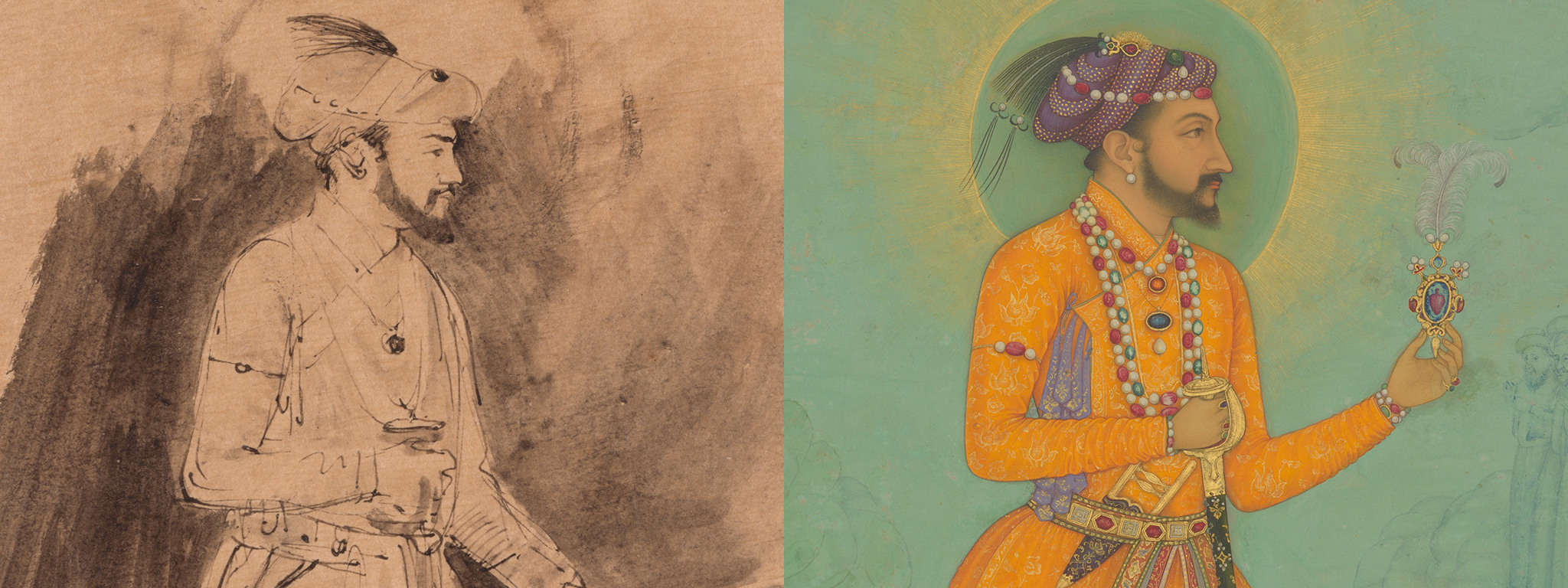
Left: Shah Jahan (detail), about 1656–61, Rembrandt Harmensz. van Rijn. Dark brown ink and dark brown wash with scratching out on Asian paper toned with light brown wash. The Cleveland Museum of Art, Leonard C. Hanna, Jr. Fund 1978.38. Image © The Cleveland Museum of Art Right: Jujhar Singh Bundela Kneels in Submission to Shah Jahan (folio from Minto Album; detail), 1630–40, Bichitr. Opaque watercolor and gold on paper. Trustees of the Chester Beatty Library. Image © Trustees of the Chester Beatty Library, Dublin, CBL In 07A.16Left: Shah Jahan (detail), about 1656–61, Rembrandt Harmensz. van Rijn. Dark brown ink and dark brown wash with scratching out on Asian paper toned with light brown wash. The Cleveland Museum of Art, Leonard C. Hanna, Jr. Fund 1978.38. Image © The Cleveland Museum of Art Right: Jujhar Singh Bundela Kneels in Submission to Shah Jahan (folio from Minto Album; detail), 1630–40, Bichitr. Opaque watercolor and gold on paper. Trustees of the Chester Beatty Library. Image © Trustees of the Chester Beatty Library, Dublin, CBL In 07A.16


IN AN INTRIGUING MOMENT LATE IN HIS CAREER, Rembrandt created a series of unusually meticulous drawings depicting emperors and courtiers from Mughal India. This exhibition explores the Dutch master’s careful studies of imperial Mughal portraiture and places them within a broader circuit of cross-cultural exchanges. By juxtaposing Rembrandt’s drawings with Indian paintings of similar compositions—and pairing Mughal artworks with European prints that inspired them—fascinating stories unfold about the flow of art and ideas across time and oceans.


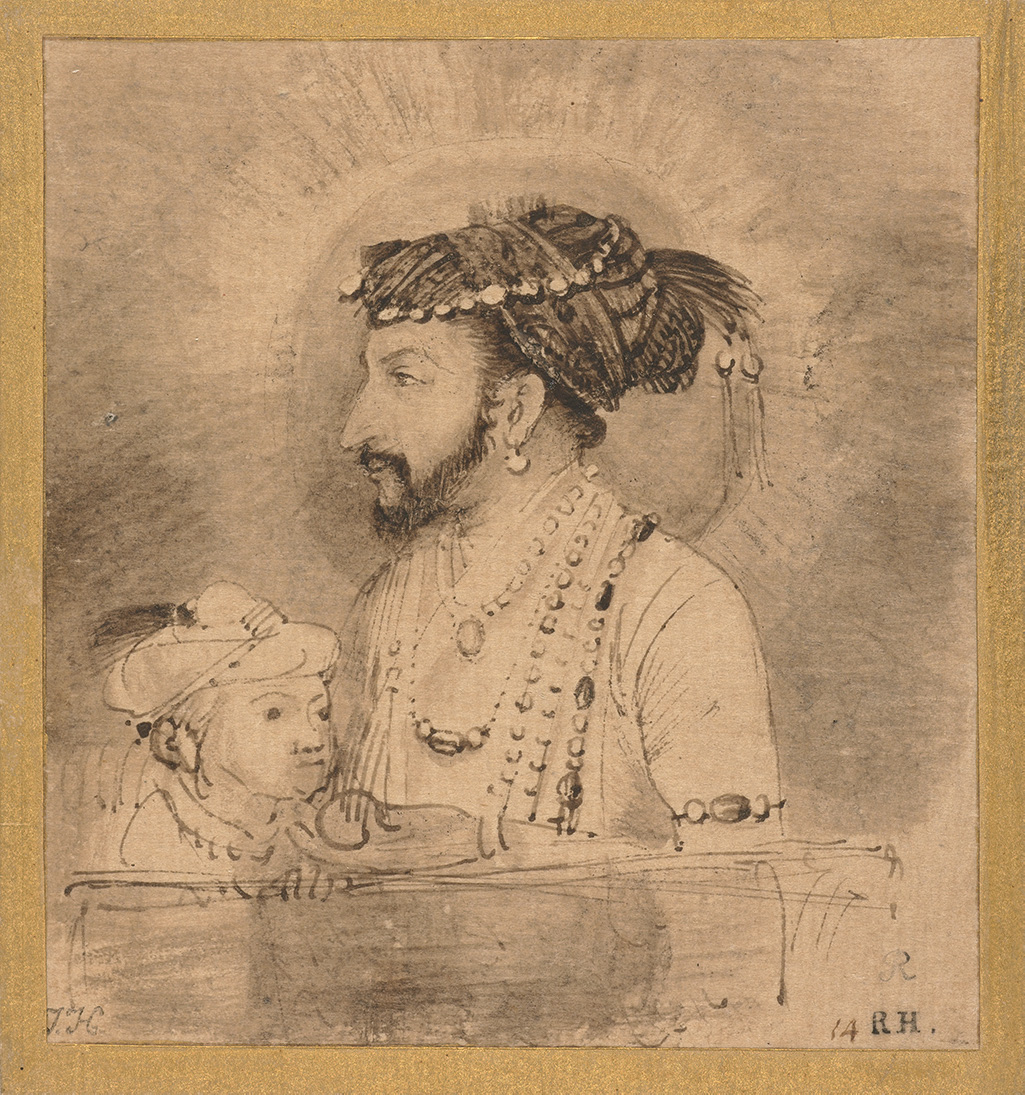
Shah Jahan and his Son, about 1656–61, Rembrandt Harmensz. van Rijn. Brown ink and brown wash with scratching out on Asian paper toned with light brown wash. The Rijksmuseum, gift of J.G. Bruijn-van der Leeuw, Muri, Switzerland. Image: Rijksmuseum, Amsterdam


Rembrandt and the Inspiration of India

The twenty-three surviving drawings Rembrandt Harmensz. van Rijn (1606–1669) made of Mughal emperors, princes, and courtiers mark a watershed moment, when the Dutch master responded to art of a dramatically different culture. Rembrandt and the Inspiration of India considers the unique significance of these cross-cultural works in the context of seventeenth-century global exchange. What motivated Rembrandt to study Mughal portraits? Did he own an album of them? Can we trace his drawings to specific, surviving artworks imported into Amsterdam from the Dutch trading post in India? This exhibition reveals the critical eye and attentive curiosity he turned toward Mughal portrait conventions. For Rembrandt, the art of Mughal India was not merely a foreign curiosity. It carried certain associations of empire, trade, luxury, and artistic skill.

Rembrandt and Global Amsterdam


Recreation of Rembrandt's Art Collection, The Rembrandt House Museum, Amsterdam, The Netherlands

With the establishment of the Dutch East India Company, or Verenigde Oostindische Compagnie (VOC), in 1602, the Dutch forged a dominant presence in the lucrative spice trade. This international trade network brought large quantities of foreign art and artifacts to Amsterdam. The 1656 inventory of Rembrandt’s possessions describes a collection of art objects from around the globe, including items from Mughal India. The Mughal Empire in Rembrandt’s time covered a vast area that today would encompass Afghanistan, Bangladesh, much of western Pakistan, and all of northern and central India. Mughal emperors traced their lineage back to Timur, the Turco-Mongol conqueror and founder of the Timurid Empire of Iran and Central Asia. Portraits promoting Mughal rulers’ wealth, political aspirations, and Islamic faith came to the Netherlands on VOC ships embarking from the Indian port of Surat. Possibly owned by a VOC official in Rembrandt’s circle, these meticulous portrayals of imperial magnificence sparked the artist’s imagination. Dutch merchants, collectors, and other artists would have recognized Rembrandt’s drawings after Mughal paintings as a demonstration of his international and refined taste.

Thursday, May 14, 2020

Zarina Hashmi, Artist of a World in Search of Home

Zarina Hashmi, Artist of a World in Search of Home, Dies at 82

Source: New York Times 
Ms. Hashmi was of a generation of artists whose life and work were haunted by the 1947 partition of India.
The artist Zarina Hashmi, who became internationally known for woodcuts and intaglio prints, many including semiabstract images of houses and cities she had lived in.
Credit...Ram Rahman


Zarina Hashmi, an Indian-born American artist who turned the history of her peripatetic life into an emotional and spiritual guide composed of spare images, poetic words and subtle politics, died on April 25 in London. She was 82.

The cause was complications of Alzheimer’s disease, said Imran Chishti, her nephew.

Ms. Hashmi, who preferred to identify herself professionally by only her first name, became internationally known for woodcuts and intaglio prints, many combining semiabstract images of houses and cities she had lived in accompanied by inscriptions written in Urdu, a language spoken primarily by Muslim South Asians. (It is the official national language of Pakistan.)

In South Asia itself, she is particularly revered as a representative of a now-vanishing generation of artists who were alive during the 1947 partition of the subcontinent along ethnic and religious lines, a catastrophic event that, she felt, cut her loose from her roots and haunted her life and work.

Zarina Rashid was born on July 16, 1937, the youngest of five children, in the small Indian town of Aligarh, where her father, Sheikh Abdur Rashid, taught at Aligarh Muslim University. Her mother, Fahmida Begum, was a homemaker.

In her 2018 memoir, “Directions to My House” (written with Sarah Burney), Ms. Hashmi described growing up in what she called a traditional Muslim home. In hot months she and her older sister Rani would sleep outdoors “under the stars and plot our journeys in life.” The floor plan of her childhood house, whose walls enclosed a fragrant garden, became a recurrent presence in her art.


Imag


e

Near-abstract images of houses recur in Ms. Hashmi’s art. “Homecoming” (1981) is an aerial view of a courtyard surrounded by arches,
 reminiscent of the one in the artist’s childhood home.
Credit...Zarina/Luhring Augustine

That life abruptly ended with the partition of India and the violence between Muslims and Hindus. For safety, her father sent the family to Karachi in the newly formed Pakistan. The experience of fleeing to a refugee camp and seeing bodies left in the road stayed with Ms. Hashmi.

“These memories formed how I think about a lot of things: fear, separation, migration, the people you know, or think you know,” she wrote in her memoir.

She eventually returned to Aligarh, near New Delhi, and earned a degree in mathematics from the university there, but the place would never be home again.

At 21 she entered into an arranged marriage with a young foreign service diplomat, Saad Hashmi, and a life of travel began. In 1958, they were posted in Bangkok, where her interest in printmaking started. In 1963, after an interlude in New Delhi, where she made friends in the city’s art community, her husband’s job took them to Paris. She attended the British printmaker William Stanley Hayter’s Atelier 17 workshop there, becoming immersed in European modernism, including abstraction.