Sunday, October 26, 2014

Local YET global - Adeel-uz-Zafar


Artwallaa believes that the recently opened exhibition ' Stranger Than Fiction' by Adeel Uz Zafar (AUZ) at Gandhara Art Space is local yet completely global in nature. The exhibition is local because it is happening in Pakistan (Karachi) but is truly global in nature in terms of diversity of works, quality of works, curatorial focus, installation of works, the duration of the show, accompanied by a book launch and last but not the least, the presence of the artist himself.


Wet-plate-collodian based work. Source: Gandhara-art

Artwallaa was aware of Mr Zafar's work, but really noticed him through his work in 'The Rising Tide' at the Mohatta Palace Museum in 2010.


You simply can not miss AUZ's works because they draw instant attention. They are very large in size (and hence impact), are usually monochrome (and hence unusual), appear to borrow from familiar natural or fictional characters (and hence affect natural attraction), the bandages make you wonder what the underlying message is and they draw you in because of one's curiosity towards the medium of work.


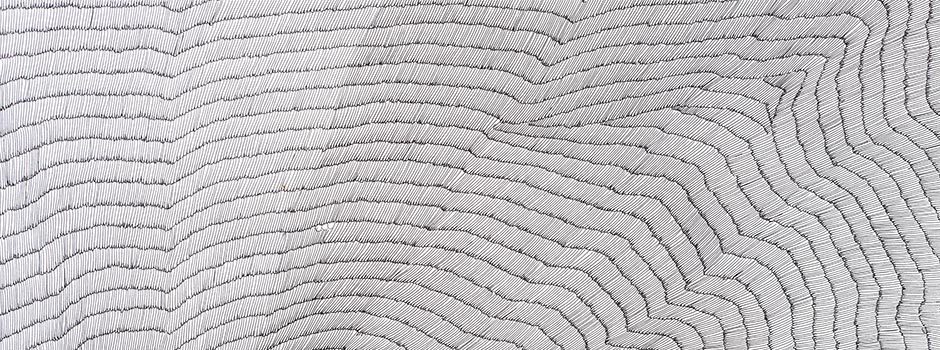
Once you get close to the work, you are intrigued by the technique and the material used (engraved drawing on plastic vinyl), and by the flawless execution of the technique. Amongst a lot of others, Artwallaa was also not able to avoid these 'temptations' and has enjoyed this series since then.

At the back of my mind, however, was always this question; what will AUZ do next. He cannot keep on doing this series alone (regardless of how enjoyable each of these works are). In the past twelve months, Artwallaa has found multiple answers to those too. AUZ has come up with new series in etching prints, wet-plate-collodian based images and the latest introduction of 3D works. The current exhibition seems culmination of the past two years of this journey of discovery.


Blossom, Painted Fiberglass, 66.04 x 53.34 x17.78 cm, 26 x 21 x 7 in.
Source: Gandhara-art

Artwallaa credits Mr Zafar of bringing pop culture into the Pakistan visual art vocabulary and using them in different mediums. according to trhe artist himself, "Stranger than fiction features a selection of seminal anthropomorphic characters known around the world for their incredible feats and heroic actions. The imagined content is not necessarily based on facts, but it contemplates and interrogates society, politics, philosophy, life and adventure. It highlights the hopes, frustrations, dreams and
disclosure from some of the living experiences of everyday life".

The use of Powerpuff girls in vinyl and also in fibreglass emphasises on feminine issues as well power. Artwallaa assumes Mr AUZ is also a tribute to the ever-increasing list of achievements of Pakistani women (including the Nobel Prize, the Oscars, The Emmys and the Asia Cricket World Cup; and not to forget the powerpuff girls of visual arts - Shahzia Sikander, Aisha Khalid, Naiza Khan and so many others).


Go Pakistani Women ! Go Pakistan Art ! *


Your 'Go Go'


Artwallaa


* these terms should not be misconstrued for the terms used repeatedly in the political apace in Pakistan. To avoid any doubt, the above terms definitely have positive connotations attached to them !


Saturday, October 25, 2014

International exhibitions of Pakistan art are NOT news anymore; but that IS good NEWS.

According to Oxford Dictionary, the definition of 'news' is, 'newly received or noteworthy information, especially about recent or important events'. If that particular incident starts to happen regularly, it stops being 'news'.

The most relevant (though inconvenient) example will be the brown-outs (load-shedding of electricity) in Pakistan. When this cycle of brown-outs started in 2007-08, it was headline news. Now it is not see as 'noteworthy information'.

Putting it in the context of Pakistan art; until a few years (months?) ago, an international exhibition of Pakistan art used to be 'news' as Pakistan art was hardly shown internationally. This has changed significantly to an extent where Artwallaa believes that international exhibitions of Pakistan art, in itself, are not news anymore.

Gone are the days when Pakistan art was promoted internationally by a few dedicated platforms like Green Cardamom, Gandhara-art and Aicon representing a handful of artists. Pakistan art is now being shown regularly outside Pakistan, by a much broader spectrum of art-promoting platforms who are representing a much wider and diverse artist base.

Internationalisation of Pakistan art is now entering its second phase. It has not been an easy ride, it still is not and is not likely to be in future too. But the 'movement' is gathering pace, the trajectory is surely positive and the 'product' is definitely creative and exciting.

To prove our point, as we write this blog, there are at least 10 good Pakistani art based exhibitions/shows either currently already on display or are being planned around the world. These are on top of the works shown in art-fairs (like at The Frieze) and Artwallaa has surely missed a few other exhibitions (if we have, please let us know and we will add to the list)


Important exhibitions of Pakistan Art - September-October, 2014:
     
  • Toronto: Aga Khan Museum, Toronto, September 18 2014 - January 18, 2015

    • The artists presented are Bani Abidi, Nurhajan Akhlaque, David Alesworth, Aisha Khalid, Atif Khan and Imran Qureshi

  • Paris: Imran Qureshi: Nuit Blanc, Paris, Saturday, 4 October 2014
 
  • London: Present Re-inventions,  October 11 – October 27, 2014, Grosvenor Gallery
    • The artists presented are Irfan Hasan, Muzzumil Ruheel and Muhammad Zeeshan.
 
  • Hong Kong: The Importance of Staying Quiet, October 4 – November 3, 2014,  Yallay Gallery
    • The artists presented are Anwar Jalal Shemza, Zahoor ul Akhlaq, Lala Rukh, Rashid Rana, Hamra Abbas, Sara Salman, Ali Kazim, Ayesha Jatoi, Fahd Burki and Iqra Tanveer. 
 
  • Gwangju, Korea - Gwangju biennale - Huma Mulji, September 5 - November 9, 2014
 
  •  New Dehli: Alif, Mohammad Ali Talpur, October 12 – November 10, 2014, Latitude 28
 
  • New York: Ethereal, October 23 - December 13, 2014, Leila Heller Gallery
    • The artists presented are Faiza Butt, Noor Ali, Ali Kazim, Rashid Rana, Irfan Hasan, SairaWaseem, Mohammad Ali Talpur
 
  • Karachi: Stranger Than Fiction - Adeel Uz Zafar, October 21 - December 5, 2014 
 
  • San Antonio: 'Parallax', Shahzia Sikander, October, 2014
 
  • Michigan: {Dis}Comfort Zones, Anilla Quayyum Agha, October 2014, Grand Rapids Art Museum, October


-------------------------------------------------------------------------------------------------------------------------


Toronto: Aga Khan Museum, Toronto, September 18 2014 - January 18, 2015

    • The artists presented are Bani Abidi, Nurhajan Akhlaque, David Alesworth, Aisha Khalid, Atif Khan and Imran Qureshi

'Your way begins on the other side' 2014 by Aisha Khalid (Reverse View). — at Aga Khan Museum [Fan Page].


Paris: Imran Qureshi: Nuit Blanc, Paris, Saturday, 4 October 2014


'And they still seek traces of blood' 2014, Site Specific Installation at Bibliothèque Sainte-Geneviève (BSG) on October 4th, 2014 for Nuit Blanche - Imran Qureshi — at Bibliothèque Sainte-Geneviève (BSG). Source: Gandhara-art


more blog ideas


Top Pakistan art in 2013 based on prices achieved
Pakistan's top exhibitions in 2012 - local and global - out now
Pakistan's top exhibitions in 2013 - local and global - out in March 2014


Top 10 art works of Pakistani artists with highest prices ever

Top 10 museums of the world (do an aggregate from a few sources like geographic national, reuters, guardian, etc and add comments)

The rise and rise of Imran Qureshi - What's common between Bill Gates and Imran Qureshi - Malcolm Gladwell

 Collect data on pakistan artists exhibiting outside pakistan in 2012 and 2013.

Develop a pakistan artist price indiex

Staking the claim, back home - Shahzia Sikander

Top ten art fairs I the world

Top art biennales in the world

Rooftop and celebrities

Arts and Literature Festival - Lahore - Nov 2013

Do a chart  showing which artists are at what levels

Pakistan Arts - 2013-2014 : show how much has been achieved ..... Oscar, emmy, Imran Q, Anila Quayyum, Naiza's award, Agha Khan,
LLF, KLF, Isld Literary Festival, ArtNow, ..............  Pakistan Arts is back !

Sunday, October 19, 2014

YET another title for Pakistan - YET another confirmation of the upward momentum of Pakistan visual arts

Last week, Pakistan art world received yet another award from the global art fraternity. Anila Quayyum Agha, an NCA alum, was the winner of both the juried as well as the public vote of the Michigan based ArtPrize2014.

Apart from taking home $300,000 in prize money, Ms Agha was the fist winner in the award's history to have won both public (whose votes decide the award) and the art experts (the jury).

Another feather in the cap of Pakistan Visual Arts and another confirmation of the depth as well as breadth of this movement.  

Artwallaa finds this work exceptionally pleasing to the eye and have therefore added two articles with a lot of images.

Your -  enjoying the 'gorgeous sculpture'

Artwallaa

 
------------------------------------------------------------------------------------------------------------------------
PS: To know more on why Artwallaa believes that the Pakistan visual art scene is in an irreversible upward pattern, read the following articles:  
 

Anila Quayyum Agha's "Intersections" at the Grand Rapids Art Museum (all photos by the author for Hyperallergic)
Anila Quayyum Agha’s “Intersections” at the Grand Rapids Art Museum (photo by Hrag Vartanian for Hyperallergic)


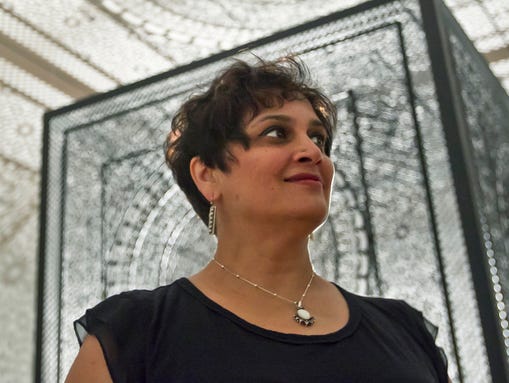
Anila Quayyum Agha with her ArtPrize entry “Intersections.”
Anila Quayyum Agha with her ArtPrize entry “Intersections.”(Photo: AP )
 
--------------------------------------------------------
 
 
This Gorgeous Sculpture Creates Instant Architecture in an Empty Room
By Kristin Hohenadel    
Source: The Eye  
 
171014_EYE_GRMI
Intersections by Pakistan-born Anila Quayyum Agha on display at the Grand Rapids Art Museum earlier this month.
Courtesy of the Grand Rapids Art Museum


Held annually since 2009 in Grand Rapids, Michigan, ArtPrize is a democratic art competition open to anyone in the world over age 18, with generous cash prizes awarded by both a jury of experts and popular vote. For the first time, a single work—Intersections by Pakistan-born Anila Quayyum Agha—took this year’s public and juried grand prizes for a total of $300,000.
 
Agha’s stunning piece is an obvious crowd-pleaser, a 6½-foot square laser-cut, black lacquer wood cube suspended from the ceiling and lit with a single light bulb that casts breathtaking 32-feet by 34-feet shadows to create instant architecture in an otherwise empty room.
 
DSC_0727
Courtesy of ArtPrize


Monday, October 6, 2014

Waqas Khan - keep him on your radar !


This artist, Waqas Khan, is worth keeping on your radar.


The pakistani miniature artist Waqas Khan returns to Sabrina Amrani Gallery, two years after his debut in Europe in the same space. These two years have been intense for the artist: He has exhibited in the most prestigious art fairs such as Art Basel, FIAC, Frieze London, Art Basel Hong Kong, Art Dubai, India Art Fair, Art Basel Miami and Art14 London; shown his work in multiple group shows in Vienna, New Delhi, Innsbruck, Madrid, Kraitchal, Kazan and Moscow; and he was shortlisted for the Jameel Prize 3. Furthermore, his work is now part of the permanent collection of the Victoria and Albert Museum.

Saturday, October 4, 2014

Sikander's animated 'Parallax' gets U.S. premiere in San Antonio


September 30, 2014           


The multichannel video work, a recent acquisition by the foundation, deals with global politics by focusing on the strategically crucial Strait of Hormuz, often called a “choke point” through which about 20 percent of the world's petroleum flows.

Thursday, October 2, 2014

What IS Art? New York artist creates 'art' that is invisible and collectors are paying millions

Read the article, listen to the audio and only after that read the other articles through the links. It will surely entertain you. The relevant question though still remains, 'What IS Art'?

Enjoy !

Artwallaa

--------------------------------------------------

New York artist creates 'art' that is invisible and collectors are paying millions

Source: cbc
Tuesday, September 23, 2014

Art enthusiasts admire Newstrom's paintings and sculptures at the Schulberg Gallery in New York. (Nick Fabin/Adriano Castelli / Shutterstock.com)       
Art enthusiasts admire Newstrom's paintings and sculptures at the Schulberg Gallery in New York. (Nick Fabin/Adriano Castelli / Shutterstock.com)
 
 
27-year-old artist Lana Newstrom says she is the first artist in the world to create invisible "art."  In this documentary we traveled to her empty studio to learn more about Lana and her unusual  artistic process. "Just because you can't see anything, doesn't mean I didn't put hours of work into creating a particular piece" Lana Newstrom, Artist.
 
"Art is about imagination and that is what my work demands of the people interacting with it. You have to imagine a painting or sculpture is in front of you," says Newstrom. 

Paul Rooney, Lana's agent, believes she might be the greatest artist alive working today: "When she describes what you can't see, you begin to realize why one of her invisible works can fetch upwards of a million dollars." said Rooney.

Listen to learn more about Lana Newstrom and her invisible art. Listen

 
Read the below articles only after you have listened to the interview:

Jonathan Jones on Art - The Guardian
New York Artist Lana Newstrom
 

Saturday, September 27, 2014

The biggest Museum art show of Pakistani artists outside Pakistan, is the most impactful too

The opening of the Pakistan contemporary art exhibition last week in the newly inaugurated Aga Khan Museum, Toronto, has lived up to the expectations of art enthusiasts including Artwallaa ( see Opening of the Aga Khan Museum in Toronto is good news for Pakistani Arts).

Pakistan's most impactful international exhibition ever
Though fewer in numbers of participating artists, Artwallaa believes that this exhibition has become the largest and most impactful exhibition of Pakistan visual arts outside Pakistan. The only exhibition which comes close is the 'Hanging Fire' at the Asia Society New York in 2009 which was much more diverse in terms of participating artists but not impactful in terms of scale.

The reason why Artwallaa believes that the current exhibition rises above the "Hanging Fire' is because:

1. The Phenomenon of Imran Qureshi
 
The 'phenomenon' of Imran Qureshi had not happened in 2009. Even though Mr Qureshi had an installation at the Hanging Fire too, it was much smaller in size and impact. The extent and impact of Imran Qureshi's work at the Aga Khan Museum is much bigger (his RoofTop installation at The Met, NY was more intense and dramatic, but was only a standalone work). Mr Qureshi's current work also departed from his signature colours of blue and red, and instead focussed on different types of greens. This departure is important not only because of the change in colours but also because it spoke to the surroundings of the museum very well.

2. Scale and size matter
Besides Mr Qureshi's works, the scale of some other works impressed Artwallaa too. Aisha Khalid's carpet 'Your way begins on the other side', is eighteen feet tall and six feet  wide, and weighs 200 kilograms. Similarly, Atif Khan's 'One Another' measures 100 x 100 x 86 inches and weighs a mighty 800 kilograms.
 
Artwallaa is not obsessed with scale but the reality is that mankind has always used scale and size to impress their fellow humans in every era, and art is no exception (with no offence to miniature artists!). But more importantly, combine scale with excellent execution of artistic skills and brilliantly conceived original ideas, and you have artistic works which would last/impact many generations. Artwallaa believes that some of the works in this exhibition belong to that category.

3. Biggest body of works by a Pakistani artist outside Pakistan
The exhibition brings together the biggest body of works ever shown at a single exhibition by a single Pakistani artist anywhere outside Pakistan. Displaying 59 of Khalid's paintings, the exhibition provides the unique (and so far the only) opportunity in the past 16 years to view such an extensive body of work of this much celebrated artist. To Artwallaa,  it seems like a (mini) retrospective of the artists journey over the past 16 years.

4. The Curator 
The curator of the exhibition, Sharmini Perrera (whose contribution has not been talked about as much !) has done an excellent job in the choice of artists and works. The works jell exceptionally well with the museum and its surroundings. From the perspective of diversity of styles of works  - from paintings to installations to videos to prints to textiles to multi-media - this exhibition has it all.

See a Photo Essay' of the exhibition here

Pakistan visual arts continue to go from strength to strength and Artwallaa's conviction remains high that Pakistan visual (and other) arts is on an irreversible upward trend.

Enjoy and feel proud

Yours feeling-proud

Artwallaa


PS: To know more on why Artwallaa believes that the Pakistan visual art scene is in an irreversible upward pattern, read the following articles:

Pakistan visual arts never had a better year than 2013 - Jan 25, 2014
Bloomberg article on Pakistan art - stereotyped, shallow but ..... - Aug 29, 2013
A Proud Milestone for Pakistan & Asian Art, - April 21, 2013


--------------------------------------------------------------------------------------------------------------------------


The artists (minus Bani Abidi) All photos credit to FB/artists/Tahir Mahmood.


Saturday, September 13, 2014

Aga Khan Museum Opening - Sneak Previews

The $300mn Agha Khan Museum was officially opened by the Canadian Prime Minister and Prince Karim Aga Khan on Friday, September 12. The inaugural exhibition - Garden of Ideas: Contemporary Art from Pakistan - will be opened to the public on September 18th. A number of 'previews' have already started and Artwallaa has trawled through the virtual and physical space to do a 'sneak preview' of the show.
 
There are six participating artists in the exhibition -  Imran Qureshi, Aisha Khalid, David Alesworth, Nurjahan Akhlaque, Atif Khan and Bani Abidi. The exhibition has brought together a very broad and diverse range of artistic styles including miniatures, prints, videos, installation and multi-media.
 
The exhibition also brings together a very extensive body of works of Aisha Khalid. Displaying 59 of Khalid's paintings, the exhibition provides the unique (and so far the only) opportunity in the past 20 years to view such an extensive body of work of this much celebrated artist. To Artwallaa,  it seems like a (mini) retrospective of the artists journey over the past 16 years.
 
What is however taking Artwallaa's attention the most is Khalid's large new work; a 'carpet' with Mughal Garden sensibilities, which uses her trademark needle work. 'Your way begins on the other side', looks beautiful both from the front as well as from the back (reverse); much like her earlier works from the same medium - 'Jacket' 2010 and 'Kashmiri Shawl' 2011.

Saturday, August 30, 2014

The Aga Khan Museum - The Garden of Ideas: Contemporary Art from Pakistan

More details on the inaugural exhibition of the Museum; and more good news for Pakistan art. The details below show that the first exhibition will be totally focussed on Pakistani artists, exhibiting a very large body of works. The exhibition titled, 'The Garden of ideas: Contemporary Art from Pakistan' will open on September 18 and will show case works of Bani Abidi, Nurjahan Akhlaq, David Chalmers Alesworth, Aisha Khalid, Muhammad Atif Khan and Imran Qureshi.

Friday, August 29, 2014

The New York Times - The Weekly Agenda - Aisha Abid Hussain

Source: New York Times

Good to see Pakistan's younger artists works being exhibited globally as well being highlighted in prestigious publications !

Well done Aisha !


On view at London's Hanmi Gallery is Aisha Abid Hussain's "Two Not Together Series III," 2014.Credit

Wednesday, London

See a Pakistani artist who questions gender roles.

Aisha Abid Hussain is often the star of her own photography, yet never the same character. Her show for London’s Hanmi Gallery, “Two Not Together,” explores the theme of different but equal identities. In one series, archaic photographs of men and women in traditional, gender-specific Pakistani clothing are pasted, collage-style, over decrepit buildings and sites of rubble. Another series captures Hussain, dressed like a Pakistani man, sitting side by side with a copy of herself, dressed like a Pakistani woman.
Runs until Sept. 25, 30 Maple Street, London, hanmigallery.co.uk.


Thursday, August 21, 2014

Opening of the Aga Khan Museum in Toronto is good news for Pakistani Arts

It goes without saying that museums and other public art spaces are required for the propagation of art and culture in any society. It is also a fact that developing countries struggle to provide such public spaces due to paucity of resources as well as focus. Pakistan is no exception to this fact. Things are changing for the better though.

The 17-acre Aga Khan Museum opens in the suburbs of Toronto on September 18, 2014. Apart from boasting a strong 1000-objects collection, the museum also plans a robust series of exhibitions, as mentioned in its mission statement .... "As a vibrant educational institution, the Museum encourages the full spectrum of public engagement with its diverse Permanent Collection of more than 1,000 objects and its ever-changing roster of exhibitions and innovative programs – including music, performances, culinary traditions, lectures, debates, special events, or film".

Artwallaa is excited about this new museum as it provides a very strong platform for show-casing Pakistani art in Canada (and North America). If the upcoming exhibitions/events are any indication of the future plans, Pakistan is surely going to feature prominently in the museum's event roster.

The inaugural exhibition of the museum on September 18th, it seems, is going to show case Pakistan artists including Imran Qureshi and Aisha Khalid. This will be followed by another Pakistan focussed event- a Qawwali evening on September 28 by Pakistan's Fareed Ayaz, Abu Mohammad Qawwal and Brothers.

Artwallaa is though not surprised by the strong attention given to Pakistan by the museum, given Aga Khan's strong connection to Pakistan and the fact that Pakistan art is really good and only waiting to be discovered more by the world !


Yours ardent follower of the ever growing Pakistan art scene

Artwallaa


The Ismaili Centre at the Aga Khan Museum. (Tom Arban)
Source: The Globe and Mail


Source: The Globe and Mail


Upcoming Exhibitions: (Source: The Aga Khan Museum)

Curator's Tour: The Garden of Ideas with Curator Sharmini Pereira

 
  •  
  • The Garden of Ideas

    Sunday, August 17, 2014

    Sufi Soul - The Mystic Music Of The Islam - William Dalrymple

    Source: Channel 4

    This is a beautiful documentary by William Dalrymple. A little bit old, but still very beautiful; worth watching again and relating it to what is happening in the world currently.


    "The film follows William Dalrymple's personal journey into the mystical and musical side of Islam as he charts traditions of Sufi music in Syria, Turkey, Pakistan, India and Morocco.
    For hundreds of millions of Sufi followers worldwide, music is at the heart of their tradition and a way of getting closer to God. From the Whirling Dervishes of Turkey to the qawwali music of Pakistan, Sufism has produced some of the world's most spectacular music celebrated by Muslims and non-Muslims alike. Dalrymple's film traces the shared roots of Christianity and Islam in the Middle East and discovers Sufism to be a peaceful, tolerant and pluralistic bastion against fundamentalism.

    Includes footage of performances by Youssou N'Dour, Rahat Fateh Ali Khan, Mercan Dede, Abida Parveen, Sain Zahoor, Galata Mevlevi Ensemble, Kudsi Erguner, Goonga and Mithu Sain, Junoon and Abdennbi Zizi."


    Friday, August 15, 2014

    BBC Report - In Pakistan, imposing tombs that few have seen


    By


    The tomb of Mirza Baqi Baig Uzbek (Urooj Qureshi)
    Covering more than 10sqkm, Makli is one of the world’s largest necropolises, acting as the final resting place of more than half a million people, including kings, queens, saints and scholars. And even though the 14th-century site was inscribed as a Unesco World Heritage Site in 1981 – one of just six in Pakistan – its imposing tombs and intricate artwork are little known to travellers today.
     
    Monuments from the Arghun, Tarkhan and Mogul period (1524 to 1739), Makli, Pakistan
    Monuments from the Arghun, Tarkhan and Mogul period (1524 to 1739). (Urooj Qureshi)

    Makli is located in the southern tip of Pakistan on the outskirts of Thatta, a historical port city on the Indus River. The necropolis rose to importance as a burial site between 1352 and 1524, when the Samma Dynasty made Thatta their capital. Legend has it that a traveller on holy pilgrimage to Mecca stopped at the site and, upon seeing a mosque just outside Thatta, fell in to a state of ecstasy repeating “Hadah Makka li” (this is Mecca for me). A popular Sufi saint of the Samma period, Sheikh Hamad Jamali, named the mosque Makli after the happening.

    Entering from Makli’s southern corner, where many of the newer monuments are located, it is hard to imagine just how large the site is. The structures seemed more like small palaces than graves. During my visit, there was no one there but me and my travelling companion, the ruins, and the sound of wind blowing gently over the sun-baked, barren earth.
    A canopy shelters the grave of Tughlag Baig, a Mughal governor, Makli, Pakistan
    A canopy shelters the grave of Tughlag Baig, a Mughal governor. (Urooj Qureshi)
    Six types of monuments can be found across Makli. They include tombs, canopies, enclosures, graves, mosques and khanqas, which are learning spaces where saints would teach and preach to their disciples.

    The first cluster of monuments we approached were erected during the Arghun, Tarkhan and Mughal dynasties, between 1524 and 1739. Rulers of these invading dynasties were Turko-Mongol people, who brought northern, central and western Eurasian influences, such as delicate floral patterns and geometric designs, to the architecture, art and stone carvings found in Makli.
    The grave of Mir Sultan Ibrahim, Tarkhan dynasty, Makli, Pakistan
    Quranic verses and geometric carvings adorn the grave of Mir Sultan Ibrahim (1556 to 1592), a ruler of the Tarkhan dynasty. (Urooj Qureshi)
    Two of the most impressive monuments from this period are the tombs of Dewan Shurfa Khan, who died in 1638, and of Isa Khan Tarkhan II, who died in 1644. Both men ruled as Mughal governors in Thatta.

    Isa Khan Tarkhan II, whose tomb is a two-storey stone building with majestic cupolas and balconies, is said to have constructed the monument while he was alive. Legend has it that after partial completion of the structure, Isa Khan chopped off the hands of the most talented craftsmen so that no other emperor could build a monument that would rival his.
    The tomb of Dewan Shurfa Khan overlooks the tomb of Isa Khan Tarkhan II, Makli, Pakistan
    The tomb of Dewan Shurfa Khan overlooks the courtyard housing the tomb of Isa Khan Tarkhan II. (Urooj Qureshi)
    Climate conditions, such as erosion-causing sea breezes as well as earthquakes, floods and pollution – not to mention a lack of access and attention during periods of national instability – have left the monuments in a critical state of deterioration. While plans for protection and restoration are being discussed by various Unesco-funded organisations, the fact that the monuments have lasted this long is a testament to the quality craftsmanship from this region.
    The enclosure of Mirza Jani sits alongside the tomb of Ghazi Baig, Makli, Pakistan
    The enclosure of Mirza Jani (left) sits alongside the tomb of Ghazi Baig (right). (Urooj Qureshi)
    Travelling through Makli, it’s easy to be distracted by the palace-and-fortress-like tombs. But equally interesting was the life we discovered. Throughout the site, nomadic tribes take shelter in the ruins or under makeshift camps, made using shrubs and discarded plastic bags. Many of the nomads living in Makli are internally displaced Pakistani people who come to the elevated plateau to take refuge during the annual floods.

    read more here

    Sunday, July 27, 2014

    The Met: 15 months on, Imran's Qureshi's Roof Top exhibition still scores well

    The Met recently announced its annual visitor attendance for the year ending June 30. Artwallaa was delighted to see that Imran Qureshi's Roof Top exhibition, which closed in November 2013, still contributed strongly to the Museum's annual attendance figures. The exhibition also attracted more visitors than the top 7 exhibitions highlighted in the article and only second to the PUNK exhibition if we include 2012-2013 year as well.
     
    -----------------------------------------------
    Exhibition attendance was also particularly strong through June 30 for:
    Jewels by JAR (257,243);
    Silla: Korea’s Golden Kingdom (194,105);
    Balthus: Cats and Girls—Paintings and Provocations (191,866);
    Ken Price Sculpture: A Retrospective (189,209);
    Interwoven Globe: The Worldwide Textile Trade, 1500–1800 (180,322);
    Ink Art: Past as Present in Contemporary China (151,154);
    At The Cloisters, Janet Cardiff: The Forty Part Motet (127,224).

    The final weeks of last summer’s popular exhibitions PUNK: Chaos to Couture (which closed 
    Source: The Met
    August 14 and drew 442,350 visitors), Photography and the American Civil War (which closed August 25 and attracted 323,853 people), and The Roof Garden Commission: Imran Qureshi (which closed November 3 and was attended by 395,239 visitors)
    -----------------------------------------------

    See full article below.
    Related article: Quarter of a million visitors to the Met Rooftop and counting .....


    --------------------------------------------------------------------------

    Metropolitan Museum Announces 6.2 Million Annual Attendance

    Source: The Met

     
    (New York, July 25, 2014)—The Metropolitan Museum of Art announced today that 6.2 million people—from New York City, the tri-state area, across the United States, and 187 foreign countries—visited the Museum during the fiscal year that ended on June 30. For the third year in a row, attendance at the Museum has exceeded six million—the highest levels of visitorship since the Museum began tracking admission statistics more than 40 years ago. The number includes attendance at both the main building on Fifth Avenue and The Cloisters museum and gardens in upper Manhattan, the branch of the Metropolitan devoted to the art and architecture of the Middle Ages. The Cloisters experienced a remarkable 50% increase in attendance in the past fiscal year, attracting nearly 350,000 visitors. 
     
    “We are proud to announce that, for the third year in a row, we have welcomed more than six million visitors to the Museum,” said Thomas P. Campbell, Director and CEO of the Metropolitan. “This clearly demonstrates the public’s ongoing excitement for the Museum’s collections, exhibitions, and programs. This September, we will open the new David H. Koch Plaza in front of our main building along Fifth Avenue. Once the construction is completed, this new plaza will become the newest of New York City’s major public spaces, providing a warm and welcoming entry to the Met for our visitors from around the world.”
     
    He continued, “We are also tremendously pleased that The Cloisters celebrated unprecedented attendance over the past fiscal year, which coincided with its 75th anniversary year. An additional 110,000 visitors visited The Cloisters’ exhibitions, collection displays, and gardens, compared to the year before.”

    This was the first year that the Museum was open to the public seven days a week. In addition, the opening time was moved to 10:00 a.m., while school groups were offered early admission beginning at 9:30. (The Museum previously was closed on Mondays.)

    Visitors in Fiscal Year 2014 were drawn in large numbers to the New European Paintings Galleries, 1250–1800 (opened May 23, 2013) and the recently renovated and newly named Anna Wintour Costume Center (opened May 8, 2014). As of June 30, 2014, those gallery areas had welcomed 729,839 and 143,843 visitors respectively.

    Exhibition attendance was also particularly strong through June 30 for:
    Jewels by JAR (257,243);
    Silla: Korea’s Golden Kingdom (194,105);
    Balthus: Cats and Girls—Paintings and Provocations (191,866);
    Ken Price Sculpture: A Retrospective (189,209);
    Interwoven Globe: The Worldwide Textile Trade, 1500–1800 (180,322);
    Ink Art: Past as Present in Contemporary China (151,154);
    At The Cloisters, Janet Cardiff: The Forty Part Motet (127,224).

    The final weeks of last summer’s popular exhibitions PUNK: Chaos to Couture (which closed August 14 and drew 442,350 visitors), Photography and the American Civil War (which closed August 25 and attracted 323,853 people), and The Roof Garden Commission: Imran Qureshi (which closed November 3 and was attended by 395,239 visitors) also contributed to the high attendance in FY 2014.

    The 6.2 million overall attendance figure for the Met includes nearly 206,000 school visitors. Membership totaled 151,269.

    Additionally, the Metropolitan Museum’s website (www.metmuseum.org) recorded more than 26 million unique users in Fiscal Year 2014. The Museum’s Facebook account has more than 1.17 million followers (with a reach of 92 million people). And its Twitter feed reaches more than 760,000. Instagram account, which recently won a Webby Award, now has 180,000 followers. The Museum launched its presence on Weibo, one of China’s largest social media networks, in December 2013; the Met’s posts have already had nearly 3 million views.

    The David H. Koch Plaza will open on September 9, 2014. This new public space in front of the Metropolitan will incorporate improved access, contemporary fountains, new landscaping and lighting, and seating. Groundbreaking on the new plaza took place in January 2013.

    Monday, July 14, 2014

    Imran Qureshi in Tour de France 2014


    Renowned Pakistani land artist jets in to unveil stunning works for Tour de France
    Source: The Examiner
    July 3, 2014


    Source: Little Bird

    Renowned land artist Imran Qureshi has completed two giant artworks designed to be viewed from afar.

    Imran jetted into Britain from Pakistan to unveil his two works Bridging and Here & There near Baitings Reservoir at Ripponden. Little more than two hours after landing at Manchester Airport, he was in the windswept wilds of West Yorkshire.

    The works are part of the Yorkshire Festival’s Fields of Vision project to celebrate the Tour de France. In all a dozen artworks have been sown, cut, weaved or painted into the landscape.
    The idea is in-keeping with French Tour traditions where huge artworks can be seen from above from helicopters which track the cyclists’ every move.

    Imran’s work was installed on Yorkshire Water-owned land and will send a message to the world this weekend.

    Bridging is a calligraphy work which spells out Tour de France in a form of Urdu. Imran said the inspiration came from Turkey where East meets West and was about bringing communities and peoples together.

    Here & There resembles exploding splashes of water to symbolise the reservoir.
    Imran, who has just installed artwork on the roof of the Metropolitan Museum of Art in New York, said his Yorkshire works were the largest he had attempted.

    “This is something very different for me,” he said. “I really wanted to be part of it.”


    -------------------------------------------------------

    Fields of Vision: La Tour De France 2014- Yorkshire
    Here and There, 2014 & Bridging, 2014.


    Friday, May 9, 2014

    Imran Qureshi paints the (Michigan) town red.

    The unstoppable Imran Qureshi's yet another museum exhibition opens today at the Eli and Edythe Broad Museum Michigan.


    His reputation has only grown during that time, with major installations at places like the Metropolitan Museum of Art in New York.
     
    Along with bringing existing pieces to the Broad, he’s creating site-specific works here. The exhibition is called “The God of Small Things”. On top of that, he’s also accepted an invitation to create what’s being called “Crack Art” for a project called “Fragmented” on the streets of East Lansing
     
     
    Broad Art Museum curator Alison Gass likes the way the Cassiopeia statue seems to be staring at 'Fragmented'.
    Scott Pohl, WKAR 
    ---------------------------------------------------------------------------------------------
     

    Pakistani painter's urban mural project to be displayed at Broad Museum

    Source: Detroit Free Press

    EAST LANSING – Imran Qureshi, a Pakistani painter known for his intricate work on plazas, rooftops and walls, began using public spaces leading from Ann Street Plaza to the Eli and Edythe Broad Museum earlier this week for a piece called “Fragmented,” part of East Lansing’s urban mural project.

     
    Imran Qureshi 1   
    Acclaimed Pakistani artist Imran Qureshi spreads red paint as he starts work on an installation called 'Fragmented,' a public art piece, in downtown East Lansing on Wednesday May 1, 2014. / Rod Sanford/Lansing State Journal
    Imran Qureshi 7
    Acclaimed Pakistani artist Imran Qureshi spreads red paint as he starts work on an installation called 'Fragmented,' a public art piece, in downtown East Lansing on May 1, 2014. / Rod Sanford/Lansing State Journal


    Monday, March 31, 2014

    How a working-class couple amassed a priceless art collection


    Dedicated to all the young collectors of art !


    Source: Mental Floss

    Image credit: 
    National Gallery of Art, Gallery Archives


    By Jed Lipinski

    Herb Vogel never earned more than $23,000 a year. Born and raised in Harlem, Vogel worked for the post office in Manhattan. He spent nearly 50 years living in a 450-square-foot one-bedroom apartment with his wife, Dorothy, a reference librarian at the Brooklyn Public Library. They lived frugally. They didn’t travel. They ate TV dinners. Aside from a menagerie of pets, Herb and Dorothy had just one indulgence: art. But their passion for collecting turned them into unlikely celebrities, working-class heroes in a world of Manhattan elites.

    While their coworkers had no idea, the press noticed. The New York Times labeled the Vogels the “In Couple” of New York City. They counted minimalist masters Richard Tuttle and Donald Judd among their close friends. And in just four decades, they assembled one of the most important private art collections of the 20th century, stocking their tiny apartment floor-to-ceiling with Chuck Close sketches, paintings by Roy Lichtenstein, and sculptures by Andy Goldsworthy. Today, more than 1,000 of the works they purchased are housed in the National Gallery, a collection a curator there calls “literally priceless.” J. Carter Brown, the museum’s former director, referred to the collection as “a work of art in itself.”

    The Vogels had no formal training in art collecting. They didn’t aspire to open a gallery or work in museums. They bought art the way any amateur collector shops: for the love of the individual pieces and the thrill of a good deal. But you don’t accumulate a priceless collection of anything by accident. Herb and Dorothy developed a methodical system for scouting, assessing, and purchasing art. When it came to mastering their hobby, the Vogels were self-trained professionals. This is how they did it.

    The Art of Buying

    Herbert Vogel was born in 1922, the son of a tailor and a homemaker. A rebellious teen, fond of jazz and zoot suits, he dropped out of high school because “I hated people telling me what to do,” he said. Instead, he worked in a cigar factory before doing a stint in the National Guard. When a dislocated shoulder resulted in a medical discharge, he enrolled in art history seminars at New York University’s Institute of Fine Arts, where legendary art historians like Erwin Panofsky and Walter Friedlaender held court. In the evenings, Herb frequented the storied Cedar Tavern, listening in awe as artists like Willem de Kooning and Franz Kline roared at each other over the meaning of abstract expressionism. He decided he wanted to be a painter. To subsidize his new passion, he landed a job at the post office, working the graveyard shift in the dead-letter department.

    In November 1960, Herb, then 38, went to a dance at the Statler Hilton Hotel in Manhattan. Scanning the crowd, his eyes fell on a pretty, bookish young woman 13 years his junior. This was Dorothy Faye Hoffman, the daughter of a stationery merchant from Elmira, N.Y. Dorothy had moved to Brooklyn two years earlier, after receiving her master’s in library science at the University of Denver. Herb thought she looked “intelligent.” Dorothy found him “cuddly” and liked his dance moves. It was love at first sight.
    Herb and Dorothy were married in 1962 and spent their honeymoon in Washington, D.C, where they made their inaugural voyage to the National Gallery. “That’s where Herb gave me my first art lesson,” Dorothy said. At the time, she knew next to nothing about art, having always preferred music and theater. But her husband’s enthusiasm inspired her. She enrolled with him in painting and drawing classes at NYU. That same year, they bought a small sculpture made from crushed car metal by the artist John Chamberlain. They had no idea that the joint purchase would be the first of thousands.

    The Vogels rented a tiny studio in Union Square, painting there at night and on weekends and using the vibrant, abstract products to decorate their new apartment on 86th Street. But by the mid-1960s, the couple realized that their artistic ambitions outweighed their abilities. “I wasn’t bad,” Dorothy claimed, adding, “I didn’t like Herby’s paintings.” Herb, an unfailingly modest man, admitted as much: “I was a terrible painter.” They decided to concentrate on collecting instead.
    At the time, Pop Art and Abstract Expressionism were in vogue and too expensive for the Vogels. Minimal and conceptual art, on the other hand, had yet to be embraced by the art world establishment. The Vogels made a pact: Her salary would go toward living expenses, his toward art. Under these new terms, they visited the SoHo studio of an obscure artist named Sol LeWitt and walked out with the first piece LeWitt ever sold: an untitled, golden, T-shaped structure. “He had more than average potential, and I felt it,” Herb said. LeWitt would later become a titan of contemporary American art.
    But Herb and Dorothy’s obsession was just starting to kick in. The couple began visiting dozens of galleries and studios each week, becoming what artist Chuck Close called “the mascots of the art world.” In making purchases, they functioned as a team. Herb, the impulsive Dionysian, searched for art “like a truffle hound,” said the artist Lucio Pozzi, who has more than 400 works in the Vogel collection. Dorothy, the Apollonian librarian with the encyclopedic memory, was more passive, hanging back and calculating the financial realities. They had only a few criteria: The work had to be affordable; it had to fit in their apartment; and it had be transportable via taxi or subway. Not part of the equation? The artist’s reputation. “We bought what we liked,” Dorothy said. “Simple as that.” And they continued to lead their double life—racing from studio to studio to gallivant with artists and to scout their next big purchase every night, while keeping their passions private from their work colleagues. Still, assembling such an incredible collection on such a tiny budget required a few other tricks.

    Work of Art

    Many in the art world call the Vogels’ method cheating. That’s because the couple never dealt with galleries and art dealers. Instead, Herb and Dorothy negotiated with hungry artists directly, arriving at studios with cash in hand. Artist Jeanne-Claude, who passed away in 2009, remembered receiving a phone call from Herb back in 1971, when the creators of “The Gates” were still broke. “It’s the Vogels!” Jeanne-Claude cried to her dispirited husband and partner in art, Christo. “We’re going to pay the rent!” But the Vogels didn’t just take their cash to big-name artists; they were equally passionate about unknown talents, often helping them to develop. David Reed, now a famous conceptual artist, said the couple encouraged him to make more drawings, which later became a central part of his practice. “The Vogels made you aware of what you were doing as an artist,” he said. “They had artist sensibilities.” When they spotted something beyond their means, they’d find a way to make the purchase: They’d buy on credit; they’d forgo a vacation; they’d even throw in cat-sitting to sweeten a deal. And the artists loved them for it. As Chuck Close told Newsday, “You knew when you were selling them something it was becoming part of an important collection.”

    It wasn’t long before the artwork overtook their home. By all accounts, the 450-square-foot apartment on East 86th Street was more of a storage facility than a place to live. The Vogels’ collection gradually replaced all their furniture save the kitchen table, some chairs, a bureau, and the bed, which concealed dozens of drawings by Richard Tuttle and Lynda Benglis. Visitors cracked their heads on clay Steve Keister sculptures hung from the ceiling and discovered typographic texts by Lawrence Weiner on the bathroom wall. And while they stashed the pieces wherever they could, Dorothy has repeatedly tried to squelch one persistent rumor: The Vogels never stored art in their oven.

    Herbanddorothy.com/Fine Line Media Inc.
    It wasn’t just the masterpieces that were crammed into the space; the Vogels shared their storehouse with 20 turtles, eight cats and an aquarium filled with exotic fish. To protect the artwork from kitten claws and rogue turtles, the couple boxed and wrapped the pieces not hung on the walls, further diminishing the available living space. “Art is Herby’s only interest, except for animals,” Dorothy once said. (Fittingly, they named their cats after artists, like Matisse, Renoir, and Manet.) When National Gallery curator Jack Cowart first saw their apartment, he was stunned. “It upset all of my alarm systems as a curator,” he said. “I began to think: What if there’s a fire? What if one of the mega-gallon fish tanks that Herb keeps his fish in springs a leak?”

    By the mid-1970s, the Vogels were famous—at least in New York City. The Clocktower Gallery, run by Alanna Heiss, the founder of P.S. 1 Contemporary Art Center, staged the first exhibition of the Vogels’ collection in April 1975. The opening coincided with a profile in New York magazine called “A New Art-World Legend: Good-by, Bob & Ethel; Hullo, Dorothy and Herb!” The title referred to Bob and Ethel Scull, a vulgar taxi magnate and his Vogue model wife. After a messy divorce, their entire collection of Pop Art and Abstract Expressionist was auctioned off for an eye-popping $10 million. The Vogels, by contrast, never sold a thing. “We could easily have become millionaires,” Herb told the Associated Press. “We could have sold things and lived in Nice and still had some left over. But we weren’t concerned about that aspect.”

    Pozzi offered an alternate explanation. “To ask them to sell a piece of their collection would be like asking me to cut off a square yard of one of my paintings,” he said. “They were artists, and the collection was their work of art.”

    Herb retired from the post office in 1979 and, naturally, used his pension to continue buying art. But the increasing size of the collection threatened to overwhelm the Vogels, like hoarders crushed to death by towering stacks of The New York Times. In the 1980s, they were forced to admit that their apartment could no longer contain their beloved art. They began meeting with curators and evaluating their options. They knew they wanted to donate their collection instead of selling it, and they liked the National Gallery, which is free to the public and maintains a policy against deaccessioning objects, meaning the collection would never be sold. In 1990, the year Dorothy retired, the Vogels followed through on their promise: Art handlers from the National Gallery transferred an astonishing 2,400 works from the Vogels’ tiny apartment, in a move that required five 40-foot trucks. In fact, unloading the works from the trucks and into the gallery tied up the museum’s freight elevators for weeks!

    Realizing that the Vogels hadn’t invested for their future, Jack Cowart, the museum’s curator of 20th-century art at the time, paid the Vogels a small annuity in exchange for their generous donation. But instead of saving the money for medical expenses or splurging on a better retirement, the Vogels couldn’t help themselves: They immediately started collecting more art. The annuity helped the couple purchase another 1,500 or so items. As Dorothy put it: “If we wanted to make money, we would have invested it in the stock market.” This led the grateful if overburdened institution to create the Fifty Works for Fifty States program, in which 50 museums across America will receive 50 pieces from the Vogels’ collection.

    In 2008, Herb and Dorothy, a documentary about the couple directed by Megumi Sasaki, was released to rave reviews. Sasaki, a former field producer for Japanese public television, had met the Vogels years before while filming a series about Christo and Jeanne-Claude. “I couldn’t believe it was a true story, that such people exist,” she recalled.

    It wasn’t until 2009, when Herb’s health began to fail, that the Vogels ceased collecting. “It was something we did together, and when Herb was too ill to enjoy it, we stopped,” Dorothy said with typical matter-of-factness. Herb died in July 2012, at the age of 89. Dorothy continues to live in the apartment they shared for 49 years, along with their one surviving cat, a flame-point Himalayan named Archie. Her job now, she says, is to make sure people don’t forget the collection she and her husband built, which is considered not just the most impressive art collection to have been housed in a tiny apartment, but one of the most important art collections of the 20th century. “I have no regrets,” Dorothy said. “I’ve had a wonderful life. And I believe Herb and I were made to be together.”

    This article originally appeared in mental_floss magazine. Consider giving someone special a gift subscription or treat yourself.