Showing posts with label Adeel ul Zafar. Show all posts

Sunday, October 26, 2014

Local YET global - Adeel-uz-Zafar


Artwallaa believes that the recently opened exhibition ' Stranger Than Fiction' by Adeel Uz Zafar (AUZ) at Gandhara Art Space is local yet completely global in nature. The exhibition is local because it is happening in Pakistan (Karachi) but is truly global in nature in terms of diversity of works, quality of works, curatorial focus, installation of works, the duration of the show, accompanied by a book launch and last but not the least, the presence of the artist himself.


Wet-plate-collodian based work. Source: Gandhara-art

Artwallaa was aware of Mr Zafar's work, but really noticed him through his work in 'The Rising Tide' at the Mohatta Palace Museum in 2010.


You simply can not miss AUZ's works because they draw instant attention. They are very large in size (and hence impact), are usually monochrome (and hence unusual), appear to borrow from familiar natural or fictional characters (and hence affect natural attraction), the bandages make you wonder what the underlying message is and they draw you in because of one's curiosity towards the medium of work.


Once you get close to the work, you are intrigued by the technique and the material used (engraved drawing on plastic vinyl), and by the flawless execution of the technique. Amongst a lot of others, Artwallaa was also not able to avoid these 'temptations' and has enjoyed this series since then.

At the back of my mind, however, was always this question; what will AUZ do next. He cannot keep on doing this series alone (regardless of how enjoyable each of these works are). In the past twelve months, Artwallaa has found multiple answers to those too. AUZ has come up with new series in etching prints, wet-plate-collodian based images and the latest introduction of 3D works. The current exhibition seems culmination of the past two years of this journey of discovery.


Blossom, Painted Fiberglass, 66.04 x 53.34 x17.78 cm, 26 x 21 x 7 in.
Source: Gandhara-art

Artwallaa credits Mr Zafar of bringing pop culture into the Pakistan visual art vocabulary and using them in different mediums. according to trhe artist himself, "Stranger than fiction features a selection of seminal anthropomorphic characters known around the world for their incredible feats and heroic actions. The imagined content is not necessarily based on facts, but it contemplates and interrogates society, politics, philosophy, life and adventure. It highlights the hopes, frustrations, dreams and
disclosure from some of the living experiences of everyday life".

The use of Powerpuff girls in vinyl and also in fibreglass emphasises on feminine issues as well power. Artwallaa assumes Mr AUZ is also a tribute to the ever-increasing list of achievements of Pakistani women (including the Nobel Prize, the Oscars, The Emmys and the Asia Cricket World Cup; and not to forget the powerpuff girls of visual arts - Shahzia Sikander, Aisha Khalid, Naiza Khan and so many others).


Go Pakistani Women ! Go Pakistan Art ! *


Your 'Go Go'


Artwallaa


* these terms should not be misconstrued for the terms used repeatedly in the political apace in Pakistan. To avoid any doubt, the above terms definitely have positive connotations attached to them !


Saturday, October 25, 2014

International exhibitions of Pakistan art are NOT news anymore; but that IS good NEWS.

According to Oxford Dictionary, the definition of 'news' is, 'newly received or noteworthy information, especially about recent or important events'. If that particular incident starts to happen regularly, it stops being 'news'.

The most relevant (though inconvenient) example will be the brown-outs (load-shedding of electricity) in Pakistan. When this cycle of brown-outs started in 2007-08, it was headline news. Now it is not see as 'noteworthy information'.

Putting it in the context of Pakistan art; until a few years (months?) ago, an international exhibition of Pakistan art used to be 'news' as Pakistan art was hardly shown internationally. This has changed significantly to an extent where Artwallaa believes that international exhibitions of Pakistan art, in itself, are not news anymore.

Gone are the days when Pakistan art was promoted internationally by a few dedicated platforms like Green Cardamom, Gandhara-art and Aicon representing a handful of artists. Pakistan art is now being shown regularly outside Pakistan, by a much broader spectrum of art-promoting platforms who are representing a much wider and diverse artist base.

Internationalisation of Pakistan art is now entering its second phase. It has not been an easy ride, it still is not and is not likely to be in future too. But the 'movement' is gathering pace, the trajectory is surely positive and the 'product' is definitely creative and exciting.

To prove our point, as we write this blog, there are at least 10 good Pakistani art based exhibitions/shows either currently already on display or are being planned around the world. These are on top of the works shown in art-fairs (like at The Frieze) and Artwallaa has surely missed a few other exhibitions (if we have, please let us know and we will add to the list)


Important exhibitions of Pakistan Art - September-October, 2014:
     
  • Toronto: Aga Khan Museum, Toronto, September 18 2014 - January 18, 2015

    • The artists presented are Bani Abidi, Nurhajan Akhlaque, David Alesworth, Aisha Khalid, Atif Khan and Imran Qureshi

  • Paris: Imran Qureshi: Nuit Blanc, Paris, Saturday, 4 October 2014
 
  • London: Present Re-inventions,  October 11 – October 27, 2014, Grosvenor Gallery
    • The artists presented are Irfan Hasan, Muzzumil Ruheel and Muhammad Zeeshan.
 
  • Hong Kong: The Importance of Staying Quiet, October 4 – November 3, 2014,  Yallay Gallery
    • The artists presented are Anwar Jalal Shemza, Zahoor ul Akhlaq, Lala Rukh, Rashid Rana, Hamra Abbas, Sara Salman, Ali Kazim, Ayesha Jatoi, Fahd Burki and Iqra Tanveer. 
 
  • Gwangju, Korea - Gwangju biennale - Huma Mulji, September 5 - November 9, 2014
 
  •  New Dehli: Alif, Mohammad Ali Talpur, October 12 – November 10, 2014, Latitude 28
 
  • New York: Ethereal, October 23 - December 13, 2014, Leila Heller Gallery
    • The artists presented are Faiza Butt, Noor Ali, Ali Kazim, Rashid Rana, Irfan Hasan, SairaWaseem, Mohammad Ali Talpur
 
  • Karachi: Stranger Than Fiction - Adeel Uz Zafar, October 21 - December 5, 2014 
 
  • San Antonio: 'Parallax', Shahzia Sikander, October, 2014
 
  • Michigan: {Dis}Comfort Zones, Anilla Quayyum Agha, October 2014, Grand Rapids Art Museum, October


-------------------------------------------------------------------------------------------------------------------------


Toronto: Aga Khan Museum, Toronto, September 18 2014 - January 18, 2015

    • The artists presented are Bani Abidi, Nurhajan Akhlaque, David Alesworth, Aisha Khalid, Atif Khan and Imran Qureshi

'Your way begins on the other side' 2014 by Aisha Khalid (Reverse View). — at Aga Khan Museum [Fan Page].


Paris: Imran Qureshi: Nuit Blanc, Paris, Saturday, 4 October 2014


'And they still seek traces of blood' 2014, Site Specific Installation at Bibliothèque Sainte-Geneviève (BSG) on October 4th, 2014 for Nuit Blanche - Imran Qureshi — at Bibliothèque Sainte-Geneviève (BSG). Source: Gandhara-art


Saturday, January 25, 2014

Pakistan visual arts never had a better year than 2013


By Artwallaa


Artwallaa believes that since the sixties, Pakistan visual arts never had a better year than 2013.

 
"Labyrinth of Reflections: The Art of Rashid Rana 1992 - 2012" is the best exhibition put up in Pakistan in the past decade (and perhaps one of the most under-marketed too). Source: Mohatta Palace.

The year started with the landmark retrospective of Rashid Rana at the Mohatta Palace. It is easily by far the best ever contemporary artists' exhibition put up in Pakistan (the only other coming close to this was Sadequain's Holy Sinner exhibited at the same venue in 2002.


Source: Mohatta Palace

The contrast in the venue and the art displayed couldn't be starker. Mohatta Palace is as old world as it gets; architecture/façade inspired by the stone palaces of Rajhistan, hand-dyed tiles, teak wood windows and multiples domes. The exhibition Mohatta Plalace is holding, Labyrinth of Reflections: The Art of Rashid Rana 1992 - 2012, is as cutting edge and contemporary as it could be. 


Source: Mohatta Palace

2013 nonetheless belongs to Imran Qureshi who was chosen for The Artist of the Year award by Deutsche Bank for 2013; an award which is awarded to an artist every year on a global basis and by a very prestigious group of international curators.


Photo

Mr Qureshi became not only the first Pakistan but also Asian to receive this award. The artist has never looked back since this announcement in the fourth quarter of 2012 and had been chosen for the Roof Top Commission at the Metropolitan Museum of Art (The Met) in New York (which was independent of the Deutsche Bank award), a separate paintings exhibition at The Met and making it into several 'who is who' lists of international artists.
Photo: Photography by Hyla Skopitz, The Photograph Studio, The Metropolitan Museum of Art. Copyright 2013
Source: The Met


Other Pakistani artists who continued to make their presence felt on the global scene included Shazia Sikander and Aisha Khalid. Also, the size of the group of artists following the above four established artists continues to grow in 2013. Artists who made significant progress in spreading their wings beyond Pakistan include Khadim Ali, Adeel Zafar, Fahd Burki, Basir Mehmood, Atif Khan, Saira Wasim, Noor Ali, Faiza Butt, Waqas Khan and Risham Syed and many more.


Important year-to-date 2013 Pakistan Visual art events at the global level:

January:
  • Rashid Rana Retrospective at the Mohatta Palace, Karachi - By far the best exhibition put up in Pakistan for any contemporary Pakistani artist and comparable to Sadequain's 'Holy Sinner' exhibited at the same venue in 2002.
February:
  • Imran Qureshi - Deutsche Artist of the Year 2013 - Announcement, celebration and exhibition at the NCA. First Pakistan and Asian to be chosen for this award.
  • Naiza Khan's solo exhibition, "Karachi Elegies" opens at the Eli and Edythe Broad Art Museum, Michigan.
March:
  • 2013 saw a resurgence of Pakistani artists' participation in Art Dubai, after a couple of years's nominal presence. Amongst the participants were Shahzia Sikander with her super-sized video installation at the Sharjah Biennial, Aisha Khalid whose artwork is believed to be picked up by a Saudi royalty, Fahd Burki who received the John Jones Art on Paper Award at the Fair and Basir Mehmood.
April:
  • Imran Qureshi's Solo exhibition opens at the Kunstahalle in Berlin - as part of the Deutsche Artist of the Year activities. The exhibition opening night was attended by over 1000 people and there were reportedly queues ouside the museum in central Berlin. The exhibition which included Qureshi's new as well as old works, was accompanied by a very comprehensive monograph of the artists encompassing the entire body of his work.
  • Waqas Khan of NCA got short-listed for this year's Jameel Prize.
May:
  • Imran Qureshi becomes the first Asian chosen for the Roof Top Commission at the Metropolitan Museum of Art, NYC.
  • Art Basel Hong Kong had the largest ever representation of Pakistani artists in the Fair's history. Artists exhibiting at the Fair included Shahzia Sikander, Aisha Khalid, Addel Zafar, Imran Qureshi, Risham Syed, Atif Khan, Shezad Dawood, Faiza Butt, Khadim Ali and Imran Channa.
  • Venice Biennale opened in which Imran Qureshi's works were part of the Main Pavillion at the Arsenale and Faiza Butt's works were exhibited at a satellite event.
June:
  • Imran Qureshi makes it into the Art+Auction's prestigious 50 Under 50: The Next Most Collectible Artists list for 2013. The magazine publishes its widely followed list in the middle of year and this is the first time that a Pakistani artist has made it to the list. Qureshi is also the only locally based artist from the sub-continent to make it to the list. Other artists with subcontinent connections are the London based Idris Khan and Raqib Shaw.
July:
  • Imran Qureshi makes the list of 'The Most Important Artists of 2013 (so far)'. Mr Qureshi's inclusion brought himself and Pakistan right in the middle of the truly global contemporary artists. The list includes - Jean-Michel Basquiat, James Turrell, JR, Ai Weiwei, Paul McCarthy, Keith Haring, Jeff Koons, Donald Judd, Tino Sehgal, KAWS, Richard Mosse, Imran Qureshi, FAILE, Marina Abramovic, Barbara Kruger, Tom Friedman, Tracey Emin, El Anatsui, James Franco, Takashi Murakami, Marc Quinn, Kenny Scharf and Brian Eno. 
  • Imran Qureshi's exhibition of miniature paintings opens at The Metropolitan Museum of Art in New York.
August:


September:

October
  •  
The Frieze 2013 and Pakistan: The Frieze Art Fair had a good representation of Pakistan artists including the likes of Imran Qureshi, Aisha Khalid, Shahzia Sikander to younger artists like Waqas Khan and Mehreen Mustaza.
November
December

A decade from now, 2013 will surely be seen as a watershed year in Pakistan's visual art history. I hope you enjoyed these developments in 2013 as much as Artwallaa did !


Your 'feeling very proud'

Artwallaa

-------------------------------------

PS: To know more on why Artwallaa believes that the Pakistan visual art scene is in an irreversible upward pattern, read the following articles:
Bloomberg article on Pakistan art - stereotyped, shallow but ......
A Proud Milestone for Pakistan & Asian Art

PPS: If you think that our list above has missed out on any important Pakistani visual art development, then please do share with us. The more the merrier.


Saturday, September 14, 2013

2013 is proving to be a banner year for Pakistan Visual Arts

By Artwallaa


Since the sixties, Pakistan's visual art never had a better year than 2013.

 
"Labyrinth of Reflections: The Art of Rashid Rana 1992 - 2012" is the best exhibition put up in Pakistan in the past decade (and perhaps one of the most under-marketed too). Source: Mohatta Palace.

The year started with the landmark retrospective of Rashid Rana at the Mohatta Palace. It is easily by far the best ever contemporary artists' exhibition put up in Pakistan (the only other coming close to this was Sadequain's Holy Sinner exhibited at the same venue in 2002.


Source: Mohatta Palace

The contrast in the venue and the art displayed couldn't be starker. Mohatta Palace is as old world as it gets; architecture/façade inspired by the stone palaces of Rajhistan, hand-dyed tiles, teak wood windows and multiples domes. The exhibition Mohatta Plalace is holding, Labyrinth of Reflections: The Art of Rashid Rana 1992 - 2012, is as cutting edge and contemporary as it could be. 


Source: Mohatta Palace

2013 nonetheless belongs to Imran Qureshi who was chosen for The Artist of the Year award by Deutsche Bank for 2013; an award which is awarded to an artist every year on a global basis and by a very prestigious group of international curators.


Photo

Mr Qureshi became not only the first Pakistan but also Asian to receive this award. The artist has never looked back since this announcement in the fourth quarter of 2012 and had been chosen for the Roof Top Commission at the Metropolitan Museum of Art (The Met) in New York (which was independent of the Deutsche Bank award), a separate paintings exhibition at The Met and making it into several 'who is who' lists of international artists.
Photo: Photography by Hyla Skopitz, The Photograph Studio, The Metropolitan Museum of Art. Copyright 2013
Source: The Met


Other Pakistani artists who continued to make their presence felt on the global scene included Shazia Sikander and Aisha Khalid. Also, the size of the group of artists following the above four established artists continues to grow in 2013. Artists who made significant progress in spreading their wings beyond Pakistan include Khadim Ali, Adeel Zafar, Fahd Burki, Basir Mehmood, Atif Khan, Saira Wasim, Noor Ali, Faiza Butt and Risham Syed and many more.


Important year-to-date 2013 Pakistan Visual art events at the global level:

January:
  • Rashid Rana Retrospective at the Mohatta Palace, Karachi - By far the best exhibition put up in Pakistan for any contemporary Pakistani artist and comparable to Sadequain's 'Holy Sinner' exhibited at the same venue in 2002.
February:
  • Imran Qureshi - Deutsche Artist of the Year 2013 - Announcement, celebration and exhibition at the NCA. First Pakistan and Asian to be chosen for this award.
  • Naiza Khan's solo exhibition, "Karachi Elegies" opens at the Eli and Edythe Broad Art Museum, Michigan.
March:
  • 2013 saw a resurgence of Pakistani artists' participation in Art Dubai, after a couple of years's nominal presence. Amongst the participants were Shahzia Sikander with her super-sized video installation at the Sharjah Biennial, Aisha Khalid whose artwork is believed to be picked up by a Saudi royalty, Fahd Burki who received the John Jones Art on Paper Award at the Fair and Basir Mehmood.
April:
  • Imran Qureshi's Solo exhibition opens at the Kunstahalle in Berlin - as part of the Deutsche Artist of the Year activities. The exhibition opening night was attended by over 1000 people and there were reportedly queues ouside the museum in central Berlin. The exhibition which included Qureshi's new as well as old works, was accompanied by a very comprehensive monograph of the artists encompassing the entire body of his work.
  • Waqas Khan of NCA got short-listed for this year's Jameel Prize.
May:
  • Imran Qureshi becomes the first Asian chosen for the Roof Top Commission at the Metropolitan Museum of Art, NYC.
  • Art Basel Hong Kong had the largest ever representation of Pakistani artists in the Fair's history. Artists exhibiting at the Fair included Shahzia Sikander, Aisha Khalid, Addel Zafar, Imran Qureshi, Risham Syed, Atif Khan, Shezad Dawood, Faiza Butt, Khadim Ali and Imran Channa.
  • Venice Biennale opened in which Imran Qureshi's works were part of the Main Pavillion at the Arsenale and Faiza Butt's works were exhibited at a satellite event.
June:
  • Imran Qureshi makes it into the Art+Auction's prestigious 50 Under 50: The Next Most Collectible Artists list for 2013. The magazine publishes its widely followed list in the middle of year and this is the first time that a Pakistani artist has made it to the list. Qureshi is also the only locally based artist from the sub-continent to make it to the list. Other artists with subcontinent connections are the London based Idris Khan and Raqib Shaw.
July:
  • Imran Qureshi makes the list of 'The Most Important Artists of 2013 (so far)'. Mr Qureshi's inclusion brought himself and Pakistan right in the middle of the truly global contemporary artists. The list includes - Jean-Michel Basquiat, James Turrell, JR, Ai Weiwei, Paul McCarthy, Keith Haring, Jeff Koons, Donald Judd, Tino Sehgal, KAWS, Richard Mosse, Imran Qureshi, FAILE, Marina Abramovic, Barbara Kruger, Tom Friedman, Tracey Emin, El Anatsui, James Franco, Takashi Murakami, Marc Quinn, Kenny Scharf and Brian Eno. 
  • Imran Qureshi's exhibition of miniature paintings opens at The Metropolitan Museum of Art in New York.
August:
  • Naiza Khan is one of the 11 global recepients of the Prince Claus Fund
September:
  • Aisha Khalid at the Moscow Biennale. Opening on the 20th of September, 2013.
With a number of significant global projects by Pakistan artists already in the pipeline for the rest of 2013. Stay tuned !

Your 'feeling very proud'

Artwallaa

-------------------------------------

PS: To know more on why Artwallaa believes that the Pakistan visual art scene is in an irreversible upward pattern, read the following articles:
Bloomberg article on Pakistan art - stereotyped, shallow but ......
A Proud Milestone for Pakistan & Asian Art

PPS: If you think that our list above has missed out on any important Pakistani visual art development, then please do share with us. The more the merrier.


Friday, August 16, 2013

Paradoxical Protagonists - Adeel Zafar in Singapore

 
by Durriya Dohadwala (Source: Artitude)
 
 
Fost Gallery’s new show opened on Friday night in the beautiful location of Gillman Barracks. Titled Protagonists, it is a solo show by Pakistani artist Adeel uz Zafar and features 17 artworks. The exhibition will run till 01 September 2013 and is well worth a visit.
 
Adeel, who trained at Pakistan’s prestigious National College of Arts in Lahore, uses the laborious technique of etching to construct large scale images of well known childhood characters on a surface not commonly used in this field. Vinyl or what we commonly know of as linoleum is the base for his work which is layered in black acrylic to make it sensitive to his mark making. Using a variety of tools like scissors, cutters and knives to score into the vinyl, he meticulously crafts his protagonists. Once made, each mark is permanent- the only way to rectify being to cover and manipulate the lines further. His subjects are familiar childhood objects in the shape of plush soft toys which he buys from a popular Sunday Bazaar in Karachi. Magnified many times over, Adeel’s heroes are wrapped in gauze bandages, sometimes tight and constrictive while at other times loose and breaking free. The folds of the bandages are beautifully rendered, gouged into the vinyl sometimes lightly and sometime deeply to create depth on a two dimensional surface.
 
Adeel Uz Zafar, Protagonist (Kong and Godzilla) diptych, 2013, Engraved drawing on vinyl, 40.64 x 30.48 cm (LR)gAdeel Uz Zafar, Protagonist (Kong and Godzilla) diptych, 2013, Engraved drawing on vinyl, 35.6 x 30.48 cm (LR)k

Monday, June 3, 2013

Pakistan @ Art Basel Hong Kong 2013


by Artwallaa

 Source: Artwallaa, Little Bird, Respective Gallery Websites
Whether you call it the power of the brand or it actually is the case – the first art fair after Art Basel had taken over the Hong Kong Art Fair decidedly looks better.  The layout was more fluid rather than straight lined, the first floor hall had a feel of a more curated show rather than the glitziest of pieces getting the centre stage, and the supporting infrastructure around the fair appeared definitely a couple of notches above the previous years.

With Hong Kong becoming the third destination for Art Basel after Basel and Miami, the city has undoubtedly become the international hub for the visual arts in Asia.

Pakistan had a very strong presence at the Art Basel Hong Kong. Gandhara-art (Hong Kong, Karachi) continued to be the unrelenting gallery showcasing Pakistani artists at the fair since its inception in 2008. This year it presented works of Imran Qureshi, Aisha Khalid, Atif Khan, Adeel-ul-Zafar and Khadim Ali.
We also had works from Risham Syed (Project 88, India), Faiza Butt (Vadhera Art Gallery, India), Shazia Sikander (Pillar Corias Gallery, London), Imran Channa (XVA Gallery, Dubai) and Shezad Dawood (Paradise Row, London). Green Cardamom (London), the other regular participant focussing on Pakistan, was missed this year as the gallery had closed down some six months ago.

The focal point of attraction continued to be Imran Qureshi given his recent successes as Deutsche artist of the Year, 2013 and his Roof Garden Commission at The Metropolitan Museum of Art, New York. His work at Art Basel, took a new direction where his Portrait Series reappeared after a space of a few years, combined with his, now trade mark, blood coloured floral motifs. Besides his work, Imran’s monograph was in big demand too and the bookstore had run out of stock on the second day.

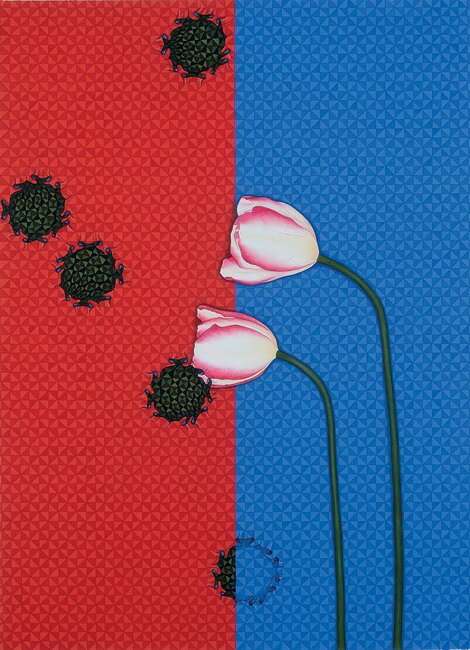
Also at Gandhara was Aisha Khalid’s who returned to her tulips with the politically laced works titled ‘West looks East’. While may be too subtle for most visitors, the depth of Aisha’s trademark ‘bullet holes’ in the East and the lifeless and robotic depiction of the tulips and their stems (very different from her previous tulips) are worth noticing and enjoying.


Faiza Butt’s work ‘My Love Plays in Heavenly Ways 2’, set in a light box and shown at the India Art Fair earlier this year too, grabbed attention due to its pointillism technique and the aesthetically pleasing execution. Slaying of a dragon (depicted in the work), though an act of myth and folklore in the West may not be seen as good Feng Shui in the Orient.


Risham Syed’s ‘Lahore Series’ is one of my favourite works from the artist. Small canvases, the size of a postcard, beautifully depict ordinary Lahore houses and are very nostalgic for non-resident Pakistanis. This is the same series which was shown at Rohtas Lahore a few years ago.
Khadim Ali’s star continues to rise and his work got a lot of attention especially from the Australian visitors (Khadim resides in Sydney). The artist continues to get significant international attention, with Guggenheim recently adding his work to its collection. His ‘Rustam’ series at the Art Fair were an instant hit.
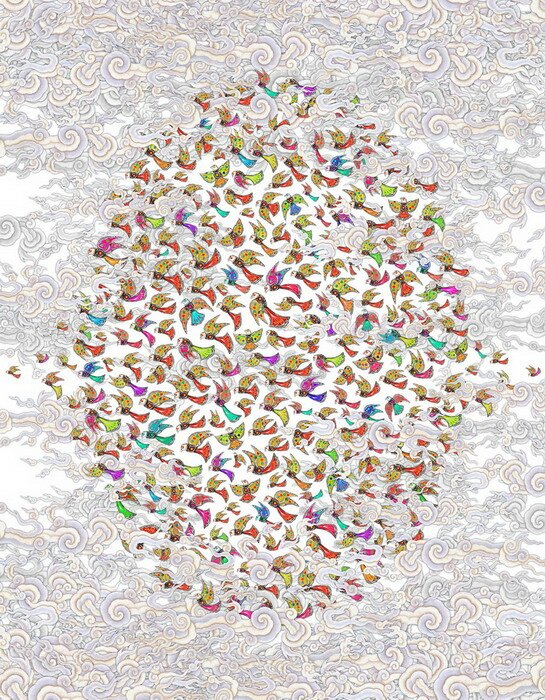
Imran Channa had a whole booth to himself and had works ranging from print, canvas and video. Atif Khan's 'Conference of Birds' got a lot of attention.

While Hong Kongers should be happy that with the success of the Art Basel, the city has now decidedly found a permanent place in the calendar of the closely knit international art fraternity; Pakistanis should be equally happy that Pakistani art and artists are very well represented at the most important art fair in the East.


Thursday, December 30, 2010

New York Times - Hanging Fire - Pakistan’s Palette of Blood and Tears

Source: NYT

KARACHI, Pakistan — In this chaotic city of 18 million people, an exhibition of works by Pakistan’s most significant contemporary artists shows just how imbued with violence daily life here is: on the street, in the air and in the debate about the future course of the nation.
Installed in the elegant rooms of the Mohatta Palace Museum, a confection of Mughal architecture in pink stone, the exhibition, “The Rising Tide: New Direction in Art From Pakistan,” includes more than 40 canvases, videos, installations, mobiles and sculptures made in the past 20 years. Its curator, the feminist sculptor and painter Naiza Khan, said her aim was to show the coming of age of Pakistani art, which blossomed when censorship was lifted after the death of the American-backed Islamic dictator Gen. Zia ul-Haq.
Violence was not an intended theme. “I wanted the works to reflect the many strands of the urban condition,” Ms. Khan said in her light-filled studio in an upscale neighborhood here.
But the corrosive impact of Pakistan’s struggle with Islamic militants, its tortured relationship with the United States and the effects of an all-powerful military pervade the show.
The artist Abdullah Syed, for example, assembled a fleet of drones — the pilotless American aircraft that fire missiles at militants in Pakistan’s tribal areas — constructed from the blades of box cutters, the very instruments used by some of the 9/11 attackers. They float on wires just above the viewer’s head, the silvery blades shimmering menacingly in bright light.
A second fleet of drones is constructed from dollar bills folded into the shape of the planes and stapled together in circular patterns that resemble those of an oriental carpet. Called the “Flying Rug,” the paper fleet casts an ominous shadow on a nearby wall.
Mr. Syed, one of several artists in the show pursuing a career abroad, teaches at the University of New South Wales in Australia. “I’m always navigating ideas between the West and here,” he said, perched on a ladder as he hung his killer fleets. The “Flying Rug” takes sides: “I’m saying, ‘To hell with Uncle Sam.’ ”
Though in the West the drones are often seen as an essential element in the fight against terrorism, in Pakistan they are considered imperial interference by the United States, he said. In the show’s catalog Mr. Syed notes that according to one estimate, drones have killed more than 1,000 Pakistani civilians since 2004. Many more civilians have fled the tribal areas and settled in Karachi to escape the attacks, an influx that has sharpened the city’s political tensions.
In recent years work by Pakistani artists has begun appearing in museum shows outside the country — in Paris, London and Dubai. Ms. Khan wanted to bring them home, to show the strength and variety of their projects. Among her choices are Rashid Rana, whose “Desperately Seeking Paradise,” a huge metal cube covered in photographs of the dilapidated residential buildings of Lahore, appeared at the Musée Guimet in Paris recently; and Imran Qureshi and Anwar Saeed, whose works appeared in “Hanging Fire,” a survey of Pakistani art at Asia Society in Manhattan last year.
Mr. Qureshi is a leader in the modern school of Pakistani miniature painting derived from the court painters of the Mughal era. But rather than paint delicate images of princes and princesses, modern miniaturists have expanded their vocabulary. Ms. Khan chose a Qureshi miniature of a missile, painted after Pakistan conducted nuclear tests in 1998. Also on display is a large-scale triptych panel by Mr. Qureshi of drips and splotches executed in a lush pomegranate hue. Or is that the color of blood?
Part of what differentiates this exhibition from the recent shows of Pakistani art in New York and Dubai is the inclusion of young people fresh out of the country’s growing number of art schools.
Sara Khan, 24, a recent graduate from the art department at Karachi University, is from the Pashtun ethnic group, whose traditional homeland is in the turbulent tribal areas in northwest Pakistan, where the army is embroiled in fighting militants. To escape the lack of development in the region, many Pashtuns have moved to Karachi in the past 30 years, among them Ms. Khan’s relatives.
Ms. Khan, who was born here and has never been to the tribal areas, doesn’t even speak Pashto. “They call me a fake Pashtun,” she said in an interview.
In her work Ms. Khan uses emblems of Pashtun culture painted in the style of a children’s primer on pages sized to resemble a school exercise book. Among the images: an AK-47 rifle — the standard-issue weapon of the tribal zone — a bullet and a series of domestic items, including bread, milk and eggs.
“Pashtuns are very strong, but I am showing emblems in a soft way,” she said. “I am saying, ‘We are not exactly what you think we are.’ ” A simple two-part work by Risham Syed reflects the violence that many urban, middle-class Pakistanis feel. A red wall lamp similar to those that hang in the homes of the well-to-do in Lahore, in northeastern Pakistan, is juxtaposed with a tiny 4-by-6-inch canvas, painted in a brutally realistic style. It shows a lone man in Islamic religious garb futilely trying to damp down a wall of flames that engulf a building.
Ms. Syed, who teaches art at Beaconhouse National University in Lahore, seems to be edging close to the question some Pakistanis are raising gingerly about the responsibility of extremist clergy for the wave of suicide bombings in the nation’s cities.
Ms. Khan, the curator, took a year away from her studio in Karachi to put the show together. She felt strongly, she said, that even though fear and violence emerged as central themes in the art, Karachi should be seen as more than just a city of gangland killings and ethnically directed shootings.
“It means a lot to me to bring art center stage at a time when so much is denied in the country,” she said.


The feminist sculptor and painter Naiza Khan, who curates the exhibition, said her aim was to show the coming of age of Pakistani art

By JANE PERLEZ
December 17, 2010


“It means a lot to me to bring art center stage at a time when so much is denied in the country,” she said.
KARACHI, Pakistan — In this chaotic city of 18 million people, an exhibition of works by Pakistan’s most significant contemporary artists shows just how imbued with violence daily life here is: on the street, in the air and in the debate about the future course of the nation.
Installed in the elegant rooms of the Mohatta Palace Museum, a confection of Mughal architecture in pink stone, the exhibition, “The Rising Tide: New Direction in Art From Pakistan,” includes more than 40 canvases, videos, installations, mobiles and sculptures made in the past 20 years. Its curator, the feminist sculptor and painter Naiza Khan, said her aim was to show the coming of age of Pakistani art, which blossomed when censorship was lifted after the death of the American-backed Islamic dictator Gen. Zia ul-Haq.
Violence was not an intended theme. “I wanted the works to reflect the many strands of the urban condition,” Ms. Khan said in her light-filled studio in an upscale neighborhood here.
But the corrosive impact of Pakistan’s struggle with Islamic militants, its tortured relationship with the United States and the effects of an all-powerful military pervade the show.
The artist Abdullah Syed, for example, assembled a fleet of drones — the pilotless American aircraft that fire missiles at militants in Pakistan’s tribal areas — constructed from the blades of box cutters, the very instruments used by some of the 9/11 attackers. They float on wires just above the viewer’s head, the silvery blades shimmering menacingly in bright light.
A second fleet of drones is constructed from dollar bills folded into the shape of the planes and stapled together in circular patterns that resemble those of an oriental carpet. Called the “Flying Rug,” the paper fleet casts an ominous shadow on a nearby wall.
Mr. Syed, one of several artists in the show pursuing a career abroad, teaches at the University of New South Wales in Australia. “I’m always navigating ideas between the West and here,” he said, perched on a ladder as he hung his killer fleets. The “Flying Rug” takes sides: “I’m saying, ‘To hell with Uncle Sam.’ ”
Though in the West the drones are often seen as an essential element in the fight against terrorism, in Pakistan they are considered imperial interference by the United States, he said. In the show’s catalog Mr. Syed notes that according to one estimate, drones have killed more than 1,000 Pakistani civilians since 2004. Many more civilians have fled the tribal areas and settled in Karachi to escape the attacks, an influx that has sharpened the city’s political tensions.
In recent years work by Pakistani artists has begun appearing in museum shows outside the country — in Paris, London and Dubai. Ms. Khan wanted to bring them home, to show the strength and variety of their projects. Among her choices are Rashid Rana, whose “Desperately Seeking Paradise,” a huge metal cube covered in photographs of the dilapidated residential buildings of Lahore, appeared at the Musée Guimet in Paris recently; and Imran Qureshi and Anwar Saeed, whose works appeared in “Hanging Fire,” a survey of Pakistani art at Asia Society in Manhattan last year.
Mr. Qureshi is a leader in the modern school of Pakistani miniature painting derived from the court painters of the Mughal era. But rather than paint delicate images of princes and princesses, modern miniaturists have expanded their vocabulary. Ms. Khan chose a Qureshi miniature of a missile, painted after Pakistan conducted nuclear tests in 1998. Also on display is a large-scale triptych panel by Mr. Qureshi of drips and splotches executed in a lush pomegranate hue. Or is that the color of blood?
Part of what differentiates this exhibition from the recent shows of Pakistani art in New York and Dubai is the inclusion of young people fresh out of the country’s growing number of art schools.
Sara Khan, 24, a recent graduate from the art department at Karachi University, is from the Pashtun ethnic group, whose traditional homeland is in the turbulent tribal areas in northwest Pakistan, where the army is embroiled in fighting militants. To escape the lack of development in the region, many Pashtuns have moved to Karachi in the past 30 years, among them Ms. Khan’s relatives.
Ms. Khan, who was born here and has never been to the tribal areas, doesn’t even speak Pashto. “They call me a fake Pashtun,” she said in an interview.
In her work Ms. Khan uses emblems of Pashtun culture painted in the style of a children’s primer on pages sized to resemble a school exercise book. Among the images: an AK-47 rifle — the standard-issue weapon of the tribal zone — a bullet and a series of domestic items, including bread, milk and eggs.
“Pashtuns are very strong, but I am showing emblems in a soft way,” she said. “I am saying, ‘We are not exactly what you think we are.’ ” A simple two-part work by Risham Syed reflects the violence that many urban, middle-class Pakistanis feel. A red wall lamp similar to those that hang in the homes of the well-to-do in Lahore, in northeastern Pakistan, is juxtaposed with a tiny 4-by-6-inch canvas, painted in a brutally realistic style. It shows a lone man in Islamic religious garb futilely trying to damp down a wall of flames that engulf a building.
Ms. Syed, who teaches art at Beaconhouse National University in Lahore, seems to be edging close to the question some Pakistanis are raising gingerly about the responsibility of extremist clergy for the wave of suicide bombings in the nation’s cities.
Ms. Khan, the curator, took a year away from her studio in Karachi to put the show together. She felt strongly, she said, that even though fear and violence emerged as central themes in the art, Karachi should be seen as more than just a city of gangland killings and ethnically directed shootings.
“It means a lot to me to bring art center stage at a time when so much is denied in the country,” she said.