The Toronto Biennial of Art (the Biennial) today announced an initial selection of Canadian and international artists for the second edition of the city-wide event on view September 25 through December 5, 2021. Commissioned and invited participants contributing to exhibitions, programs, and residencies include Nadia Belerique, Judy Chicago, Sebastian De Line, Jorge González, Lawrence Abu Hamdan, Brian Jungen, Waqas Khan, Vanessa Kwan, Ange Loft, Mata Aho Collective, Eric-Paul Riege, Camille Turner, and Syrus Marcus Ware. The curatorial team, Tairone Bastien, Clare Butcher, Candice Hopkins, Myung-Sun Kim, and Katie Lawson are coming together to work collectively across projects. Additional contributors, partners, and sponsors will be announced in the coming months.
The Biennial commissions will take place in diverse venues throughout the city, moving beyond the Lake Ontario shoreline locations that hosted the 2019 edition. The 2021 Biennial will explore locations near above-ground and hidden water tributaries that feed into the Lake as well as the ravines that shape Toronto. Extending the interconnections of those locations and expanding the notions of what it means “being in relation” that was the central question of the inaugural Biennial, continues to be a guiding principle in a moment of great uncertainty.
Works of five artists will be representing Pakistan in the 9th Asia Pacific Triennial in Brisbane (Australia) starting from 24 November. In total, works of 80 artists from 30 countries across Asia Pacific will be shown. Pakistan is represented by Naiza Khan, Aisha Khalid, Waqas Khan, Ali Kazim and Rasheed Araeen.
Looking forward to its opening
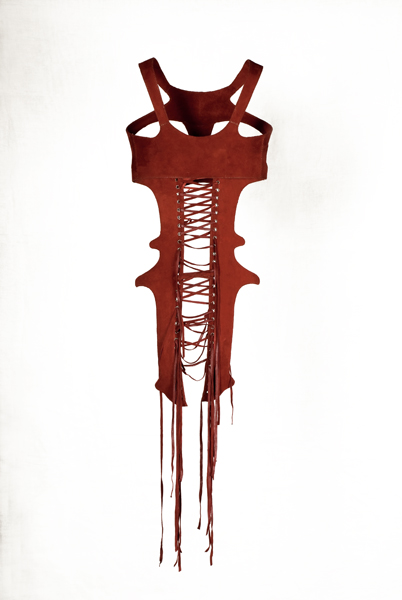
Spine, 2008, Galvanized steel and suede leather, H. 26 x W. 12 5/8 x D. 6 3/8 in. (66 x 32 x 16 cm) Source: Asia Society
The 9th Asia Pacific Triennial of Contemporary Art (APT9)
24 Nov 2018 – 28 Apr 2019 QAGOMA
Stretching from Iraq to Hawai'i, 'The 9th Asia Pacific Triennial of Contemporary Art' (APT9) will bring new and significant art from across the region to Brisbane. QAGOMA's flagship contemporary art series draws visitors with its unique mix of visual spectacle and cross-cultural insight.
Highlights will be a substantial number of newly commissioned works, as well as works by emerging, mid-career and senior artists and influential works that continue to shape contemporary art in the region. The exhibition will feature over 80 artists and groups whose work is notable for making an impact in contemporary art in its local context, including a large representation of Australian artists. Their works will reveal a number of preoccupations, such as the use of innovative approaches to indigenous traditions and modern thought, the re-imagining of histories or poetic narratives and the ability to show our universal yet diverse relations to nature and culture.
APT9 Kids will include interactive artworks, hands-on making, and multimedia activities developed in collaboration with exhibiting artists, especially for children and families. APT9 Kids on Tour will provide children and families throughout Queensland with the opportunity to enjoy a selection of adapted projects at their local venue.
APT9 will also include a symposium and extensive public programs, as well as an APT9 Cinema program.
The artists participating in the ninth Asia Pacific Triennial are: Jananne al-Ani Zico Albaiquni Sadik Kwaish Alfraji Monira Al Qadiri Rasheed Araeen Martha Atienza Kushana Bush Cao Fei Gary Carsley Roberto Chabet Chen Zhe Kawayan De Guia Enkhbold Togmidshiirev Erub/Lifou Project Nona Garcia Simon Gende Lola Greeno Gunantuna (Tolai people), led by Gideon Kakabin Shilpa Gupta Tada Hengsapkul Gavin Hipkins Joyce Ho Hou I-Ting Htein Lin Images of the Crisis Zahra Imani Mao Ishikawa Jaki-Ed Project Jeong Geumhyung Kathy Jetñil-Kijiner Jonathan Jones Karrabing Film Collective Ali Kazim Aisha Khalid Naiza Khan Waqas Khan Kim Beom Meiro Koizumi Kapulani Landgraf Idas Losin Ly Hoàng Ly Gregory Dausi Moah Mochu Yuko Mohri Vincent Namatjira Nguyễn Trinh Thi Anne Noble Aditya Novali Elia Nurvista Shinro Ohtake Donna Ong and Robert Zhao Renhui Alair Pambegan Pangrok Sulap Bona Park Bounpaul Phothyzan Souliya Phoumivong Qiu Zhijie Iman Raad Margaret Rarru and Helen Ganalmirriwuy Lisa Reihana Peter Robinson Handiwirman Saputra Mithu Sen Hassan Sharif Tcheu Siong Jakkai Siributr Soe Yu Nwe Herman Somuk Harit Srikhao Ayesha Sultana Latai Taumoepeau Tungaru: The Kiribati Project, led by Chris Charteris James Tylor Vuth Lyno Munem Wasif Boedi Widjaja Areta Wilkinson Women’s Wealth Sawangwongse Yawnghwe Pannaphan Yodmanee Young-Hae Chang Heavy Industries
In its third edition, the Dhaka Art Summit challenged itself by producing a four day exhibition of art from varying disciplines across most of South Asia. It was a moment of intense pride to witness Pakistani artists in full force throughout the summit – perhaps the greatest part of all.
The Missing One
To begin with, Nada Raza, assistant curator of the South Asian Department at the Tate Modern, mounted an exhibition inspired by the written work of Jagadish Chandra Bose, particularly “The Story of the Missing One” which the exhibition’s title ‘The Missing One’ paid homage to. The story was the first instance of science fiction in Bangla, which was written in 1896, and spoke of a cyclone that terrorized the area by depositing oil into water and was eventually brought to its demise by the former.
‘The Missing One’ was inspired by Bangladesh’s first science fiction story, Jagadish Chandra Bose’s ‘The Story of the Missing One’ – Photos courtesy Dhaka Art Summit’s Facebook page
The show revolved around the work of Gaganendranth Tagore’s “Resurrection,” executed in 1922. The exhibition included artists David Alesworth, Fahd Burki, Ali Kazim, Ifthikhar and Elizabeth Dadi, Mehreen Murtaza Zoya Siddiqui and several others. To see the variety of artists included, from the young BNU graduate, Zoya Siddqui to recent the Jameel Prize nominee David Alesworth, and exhibited on such a large global platform was remarkably refreshing. Visitors including Frances Morris, Director of the Tate Modern, regarded the exhibition in high esteem.
Mining Warm Data
Diana Campbell Betancourt, who has been with the Summit since its inception and plays the key role as Artistic Director and Chief Curator, created an exhibition entitled, ‘Mining Warm Data’. The group show examined how one is viewed through lenses of different methodologies of science, social economics and art.
Black Sites I: The Seen Unseen, 2015-16 – Installation view. Works by artist Mariam Ghani and Chitra Ganesh. – Photo courtesy Dhaka Art Summit’s Facebook page
The work of Mariam Ghani, an artist and writer, became the focal point of the exhibition. She writes, “A warm body is a portrait, not a profile; when a warm data body is erased, the real body remains intact. Warm data is easiest to define in opposition to what it is not; warm data is the opposite of cold, hard facts. Warm data is subjective; it cannot be proved or disapproved, and it can never be held against you in a court of law. Warm data is specific and personal, never abstract…”
Huma Mulji’s work, Lost and Found played a critical role in the show as well, with the examination of the body and how it is perceived, especially in these turbulent times of violence in Pakistan, where citizens reminisce over the past and try to predict the future and what it may hold for the country. While to one audience, the work seem somewhat grotesque; to others it may be fresh point of view towards other aspects of life and how one sees oneself in the future.
Left: A piece from Huma Mulji’s Lost and Found | Right: Dilar Begum Jolly’s installation Tazreen Nama, 2013 – Photos courtesy Dhaka Art Summit’s Facebook page
The other work, which stood out in the exhibition, was by Dilar Begum Jolly, another Bangla artist. Begum Jolly examined the scrutiny against women in the country and how the garment industry takes gross advantage of these women. These women risk their lives in creating clothes for the elite and western market, calling into question at what cost and purpose, the artist skeptical over its benefits for those who struggle to provide for their family.
Rewind
‘Rewind’, was another strong suit for the Pakistani presence in Dhaka. The retrospective took works from all around the world of artists using abstraction in the 1980s in South Asia, which featured Anwar Jalal Shemza and Zahoor ul Akhlaq.
Installation view of works by artist Zahoor Ul Akhlaq – Photo courtesy Dhaka Art Summit’s Facebook page
The exhibition included two works of Akhlaq’s, which were part of the Bangladeshi Embassy, never before being seen in the public eye. The concept of abstraction has only been a minor factor in the South Asian master’s, where most marketed artists have been associated with the figurative work. These artists were using their surrounding environment while going against the grain to create their body of work to develop a larger dialogue. Many artists today, such as Shezad Dawood and Rashid Rana, credit artists such as Shemza and Akhlaq as inspiration for their own contemporary works.
Solo projects
The solo projects, curated by Diana Campbell Betancourt, featured Waqas Khan and Britain-based Pakistani artist Haroon Mirza.
Mirza’s work, The National Apavilion of Then and Now was first exhibited in the 54th Venice Biennale with great acclaim, resulting in his bestowal of the Silver Lion award as the most gifted young artist. Mirza uses the construction and concept of sound and visual perception to shift the audience into reconceptualising the forms they are surrounded by in the physical realm. With a shifting halo of white light, the work provided illumination of the darkness by creating grey pyramid forms, taking over the entirety of the cube-shaped space. The viewer was transported through the buzzing sound and began to focus on the light and form of the entire transcendent work.
Left: Haroon Mirza, The National Pavilion of Then and Now, 2011. Anechoic Chamber, LEDs, Amp, Speakers, Electronic Circuit, 800x700x330 cm approx. Courtesy of the Artist and Lisson Gallery, London | Right: Waqas Khan, The Text in Continuum, 2015. Ink on paper, metal. 239×270 cm. Courtesy of the Artist and Galerie Krinzinger, Vienna
Khan’s work In the Name of God, was comprised of four large books, each with the intricate detailing. With the absence of space, Khan has created a dialogue which would be interpreted by all viewers. Tactfully, Khan displayed the manuscripts in the same orientation that the Holy Qu’ran is displayed. His work very much reflects his momentary emotion at execution, which could be seen in the flow of the lines and dots created by the artist.From the commencement of the Summit, founders Rajeeb and Nadia Samdani had achieved an impressive display of South Asian art in various media, while bringing the global art market and audiences to Dhaka. To see Pakistani artists exhibited so generously throughout the summit was truly awe inspiring; it can only bring more faith to us back home to know we can achieve such acclaim in South Asia and, soon, our own country.
The 13th edition of Frieze London closed on Saturday 17th October and according to the official press release, "the fair, which brought together 164 galleries from 27 countries, attracted a record number of collectors to the preview. Attendance across both fairs was higher this year at over 105,000, up from 100,000 in 2014". But interestingly, the main reason for the increase in number of attendees was due to "an uplift in visitors at Frieze Masters - the fair had nearly 50,000 visitors, up from 37,000 in 2014".
Regardless of the Contemporary and the Masters divide, London attracted a good representation from Pakistani art community for this year's Frieze Art Fair as well as the surrounding events.
Enjoy the images
(Sources for all images are FB/Artist/Gallery pages)
Inspired by Sufi songs and scripture, Waqas Khan toils through the night making vast hypnotic pictures out of tiny dots – and his work is now being snapped up around the world. Jonathan Jones goes drinking with art’s hottest new star
Detail from The Text in Continuum, 2015. Photograph: Waqas Khan/Galerie Krinzinger, Wien
Waqas Khan is talking to me in paradise. Or at least, his art makes me feel as if I’ve been transported there. The artist’s delirious drawings are all around us in Vienna’s Galerie Krinzinger: spirals, waves and circles that shimmer delicately in pink, black and white ink. Some are vast. One resembles a gigantic book. Yet when you walk close up to them, each turns out to be composed of thousands of tiny, extremely precise dots.
They make you feel differently about yourself and the world. Fifteen minutes after arriving at his latest exhibition, I felt cleansed and relaxed – like I’d been in a hammam. And after a couple of hours, I had the same feeling I got when I first walked through the light-as-air tiled wonderlands of the great Islamic buildings of Andalusia.
Khan, 31, is breaking down the barrier between traditional Islamic art and the contemporary art world. His prices are soaring as he shows all over the world, from this cutting edge Austrian gallery to the Frieze art fair, while big institutions – including the British Museum and the V&A – are snapping him up (“while we can still afford you”, one BM curator told him). Yet the really important, urgent thing about this extraordinary young Pakistani artist is his message of peace. The calm emanating from his art is not just an aesthetic effect – it speaks of a spiritual vision rooted in the Sufi side of Islam.
Around the edges, as i see it, 2015, by Waqas Khan.Photograph: courtesy the artist/Galerie Krinzinger
“I deal with the script of the Sufi,” says Khan, as he smokes. “It’s a side of Islam that is peaceful, happy. For me, Sufism is like meditation, that kind of calm.” He first encountered its ideas as a child, having grown up in a village where stories of Sufi mystics are remembered in folklore. “People would come and sit in the communal space and sing about the Sufis,” he says. “I was the kid holding the cups of tea. They would just talk about the good things for everybody in this world – love, peace and kindness. Sufi for me is behaviour, how you are with others.”
So how can you express love in art? One way is to make it with love. Art created by a devoted hand projects its kindness into the space around it and the hearts of those who view it. This, anyway, is what I feel among the works of Khan. Yet he wasn’t born or brought up a mystic and his family definitely did not expect him to pursue an artistic career. “In the village I come from, there are two professions: doctor or engineer. My family wanted me to be a doctor.”
Khan’s father is a businessman, his mother a maths teacher. He always drew as a kid, but when he got it into his head to apply to the National College of Arts in Lahore (whose first principal, he says, was Rudyard Kipling’s father), his family’s worst fears – of a child throwing it all away for art – seemed to be confirmed, especially since it took him three attempts to get accepted. Once in, he says, he was not exactly studious: “I was the one who was always at parties.” Waqas Khan: ‘This work changed me. It pushed me into kindness.’Photograph: Linda Nylind for the GuardianOne of the key influences on his style, which has matured quickly since his graduation in 2008, was the college’s course in miniature painting. The Mughal dynasty, one of whose imperial cities was Lahore, sponsored a superb style of precise and richly coloured figurative art on a small scale in the 17th century. At college, Khan was able to learn its delicate techniques. Even the paper he uses is traditional, thick archival paper like that used for miniatures in the age of Akbar the Great – though Khan’s pens are modern Rotrings. In fact, he’s actually getting a bit bored of being compared to Islamic scribes as if he were a character in My Name is Red, Orhan Pamuk’s novel about Ottoman artists. “It’s a cliche,” he says.
When his work was shown at the V&A in 2013, a magnifying glass was supplied so that people could look, in mind-boggling detail, at the high-definition ink dots with not a single mistake or blot. In reality, though, the all-over shimmer of his art is just as important as its microscopic detail, and he has much in common with western minimalists such as the painter Agnes Martin.
Certainly, when he describes himself at work, it is hard not to think of a secluded scribe. His studio in Lahore is tranquil. He works through the night, by battery-powered light because of the unreliability of Pakistan’s electricity. His desk is a specially adjustable drawing table that he designed and made himself. He bends over the paper using both hands for perfect ink-dot accuracy. “In a miniature painting, you can change a mistake,” he says. “I don’t have that option.” And he works like that for hours, nights, weeks. “My whole body’s hurting but making this art is so lovely. It’s like writing: a dot for me is a word. I can tell by every dot what my mood was. This work literally changed me. It pushed me into some sort of kindness.”
Waqas Khan’s The text in continuum, 2015, on show in Vienna.Photograph: courtesy the artist/Galerie Krinzinger, Wien
The most powerful of all the hypnotic drawings in Vienna is a diptych of two tall sheets resting against each other at an angle, like the pages of a gigantic book. The organic flesh-like pink waves that rise and fall across their surfaces, composed of innumerable dots, give off a powerful feeling of antiquity. This is a book whose words are in a lost language, yet somehow they are clear. The ancient wisdom cannot be read but it can be felt. In a world of terror, fear and violence, this is the book of peace – a vision of harmony and happiness rooted in Islamic art and Sufi scriptures. “One of my teachers used to say, ‘If you get something good from any religion, just take it.’ It’s not about Islam or Sufi – it’s about everybody.”
At 2 am, we’re in a Viennese bar and I don’t know if I am drunk on the cocktails, the Sufism, or the art. There aren’t many young artists around whose vision is as clear as Khan’s. There are even fewer with something of such importance to say. At the restaurant, he noticed the napkin-holders made nice bracelets and, as we were leaving, asked if he could keep one. They happily agreed. There’s just something about this artist that makes you want to say yes.
Sabrina Amrani Gallery opens the season with the the miniature works of Waqas Khan
The pakistani miniature artist Waqas Khan returns to Sabrina Amrani Gallery, two years after his debut in Europe in the same space. These two years have been intense for the artist: He has exhibited in the most prestigious art fairs such as Art Basel, FIAC, Frieze London, Art Basel Hong Kong, Art Dubai, India Art Fair, Art Basel Miami and Art14 London; shown his work in multiple group shows in Vienna, New Delhi, Innsbruck, Madrid, Kraitchal, Kazan and Moscow; and he was shortlisted for the Jameel Prize 3. Furthermore, his work is now part of the permanent collection of the Victoria and Albert Museum.
Waqas Khan continues to impress Artwallaa and the rest of the world. This article is a little dated but still wanted to post it in case you haven't seen it.
There is cosmic majesty in this artist's sensational geometric works, and they've changed the way I think and see and live
The Breath of the Compassionate, 2012, by Waqas Khan. Photograph: Waqas Khan
It was only at the end of 2013 that I encountered my artist of the year. Waqas Khan showed a work at the Frieze art fair this year but, I'm sad to say, I missed it in the hubbub. It was only when I saw his sensational, visonary art in the Jameel Prize at the V&A that I fell head over heels for an artist who reveals the unstable contours of all things.
Waqas Khan makes drawings that start as tiny precise circles and expand, circle by circle, to become vast fields of shimmering light and shade. He spends long hours hunched over big sheets of paper accumulating networks of dot-like marks. Every one has to look just right, and he mustn't spill any ink.
The fascinating thing about these ethereal abstract drawings is the tension between precision and freedom, discipline and chaos. Because every detail is done by hand and with the naked eye, each little constituent part is different. The patterns are mathematical and geometric and yet organic, unpredictable, flawed. Forms constellate and fade. There's a sense of cosmic majesty, as if we were observing an abstract vision of the birth and death of the universe.
Waqas Khan: Jameel Prize 3 from Victoria and Albert Museum on Vimeo.
Khan says his work is about love. When he was a child in a village in Pakistan, he would listen to village elders tell stories of Sufi saints. To him, the great quality of these saints was their universal love. He also says his art is an attempt – partly inspired by the Sufi tradition – to take people out of everyday life for just a few minutes and reveal some other plane of existence.
In other words, here is an artist who matters because he is trying to change how we think and see and live. Working in Lahore, he creates a truly global art whose abstract liberty is ecstatic and compelling.
Late in the year, Waqas Khan made me see again. He showed me that art has a purpose in the age of science and technology, for his magic geometries give life to the universe.
Artwallaa believes that since the sixties, Pakistan visual arts never had a better year than 2013.
"Labyrinth of Reflections: The Art of Rashid Rana 1992 - 2012" is the best exhibition put up in Pakistan in the past decade (and perhaps one of the most under-marketed too). Source: Mohatta Palace.
The year started with the landmark retrospective of Rashid Rana at the Mohatta Palace. It is easily by far the best ever contemporary artists' exhibition put up in Pakistan (the only other coming close to this was Sadequain's Holy Sinner exhibited at the same venue in 2002.
Source: Mohatta Palace
The contrast in the venue and the art displayed couldn't be starker. Mohatta Palace is as old world as it gets; architecture/façade inspired by the stone palaces of Rajhistan, hand-dyed tiles, teak wood windows and multiples domes. The exhibition Mohatta Plalace is holding, Labyrinth of Reflections: The Art of Rashid Rana 1992 - 2012, is as cutting edge and contemporary as it could be.
Source: Mohatta Palace
2013 nonetheless belongs to Imran Qureshi who was chosen for The Artist of the Year award by Deutsche Bank for 2013; an award which is awarded to an artist every year on a global basis and by a very prestigious group of international curators.
Mr Qureshi became not only the first Pakistan but also Asian to receive this award. The artist has never looked back since this announcement in the fourth quarter of 2012 and had been chosen for the Roof Top Commission at the Metropolitan Museum of Art (The Met) in New York (which was independent of the Deutsche Bank award), a separate paintings exhibition at The Met and making it into several 'who is who' lists of international artists. Source: The Met
Other Pakistani artists who continued to make their presence felt on the global scene included Shazia Sikander and Aisha Khalid. Also, the size of the group of artists following the above four established artists continues to grow in 2013. Artists who made significant progress in spreading their wings beyond Pakistan include Khadim Ali, Adeel Zafar, Fahd Burki, Basir Mehmood, Atif Khan, Saira Wasim, Noor Ali, Faiza Butt, Waqas Khan and Risham Syed and many more.
Important year-to-date 2013 Pakistan Visual art events at the global level:
January:
Rashid Rana Retrospective at the Mohatta Palace, Karachi - By far the best exhibition put up in Pakistan for any contemporary Pakistani artist and comparable to Sadequain's 'Holy Sinner' exhibited at the same venue in 2002.
February:
Imran Qureshi - Deutsche Artist of the Year 2013 - Announcement, celebration and exhibition at the NCA. First Pakistan and Asian to be chosen for this award.
Naiza Khan's solo exhibition, "Karachi Elegies" opens at the Eli and Edythe Broad Art Museum, Michigan.
March:
2013 saw a resurgence of Pakistani artists' participation in Art Dubai, after a couple of years's nominal presence. Amongst the participants were Shahzia Sikander with her super-sized video installation at the Sharjah Biennial, Aisha Khalid whose artwork is believed to be picked up by a Saudi royalty, Fahd Burki who received the John Jones Art on Paper Award at the Fair and Basir Mehmood.
April:
Imran Qureshi's Solo exhibition opens at the Kunstahalle in Berlin - as part of the Deutsche Artist of the Year activities. The exhibition opening night was attended by over 1000 people and there were reportedly queues ouside the museum in central Berlin. The exhibition which included Qureshi's new as well as old works, was accompanied by a very comprehensive monograph of the artists encompassing the entire body of his work.
Waqas Khan of NCA got short-listed for this year's Jameel Prize.
May:
Imran Qureshi becomes the first Asian chosen for the Roof Top Commission at the Metropolitan Museum of Art, NYC.
Art Basel Hong Kong had the largest ever representation of Pakistani artists in the Fair's history. Artists exhibiting at the Fair included Shahzia Sikander, Aisha Khalid, Addel Zafar, Imran Qureshi, Risham Syed, Atif Khan, Shezad Dawood, Faiza Butt, Khadim Ali and Imran Channa.
Venice Biennale opened in which Imran Qureshi's works were part of the Main Pavillion at the Arsenale and Faiza Butt's works were exhibited at a satellite event.
June:
Imran Qureshi makes it into the Art+Auction's prestigious 50 Under 50: The Next Most Collectible Artists list for 2013. The magazine publishes its widely followed list in the middle of year and this is the first time that a Pakistani artist has made it to the list. Qureshi is also the only locally based artist from the sub-continent to make it to the list. Other artists with subcontinent connections are the London based Idris Khan and Raqib Shaw.
July:
Imran Qureshi makes the list of 'The Most Important Artists of 2013 (so far)'. Mr Qureshi's inclusion brought himself and Pakistan right in the middle of the truly global contemporary artists. The list includes - Jean-Michel Basquiat, James Turrell, JR, Ai Weiwei, Paul McCarthy, Keith Haring, Jeff Koons, Donald Judd, Tino Sehgal, KAWS, Richard Mosse, Imran Qureshi, FAILE, Marina Abramovic, Barbara Kruger, Tom Friedman, Tracey Emin, El Anatsui, James Franco, Takashi Murakami, Marc Quinn, Kenny Scharf and Brian Eno.
Imran Qureshi's exhibition of miniature paintings opens at The Metropolitan Museum of Art in New York.
August:
Naiza Khan is one of the 11 global recipients of the Prince Claus Fund
The Frieze 2013 and Pakistan: The Frieze Art Fair had a good representation of Pakistan artists including the likes of Imran Qureshi, Aisha Khalid, Shahzia Sikander to younger artists like Waqas Khan and Mehreen Mustaza.
A decade from now, 2013 will surely be seen as a watershed year in Pakistan's visual art history. I hope you enjoyed these developments in 2013 as much as Artwallaa did !
PPS: If you think that our list above has missed out on any important Pakistani visual art development, then please do share with us. The more the merrier.
by Artwallaa Image Source: The Frieze, Little Bird
After four tough years, Amanda Sharp, Matthew Slotover and the rest of the Frieze Art Fair team must be breathing relatively easy. Their strategy of introducing the Frieze Masters seems to have paid off as the recently concluded fair showed the first uptick in the number of visitors (close to 70,000), than in most of the past 5 years and certainly from the 55,000 or so visitors in 2012.
The Frieze Masters clearly was a smart idea as this section looks much better in terms of layout, the quality of works and the general ambiance too. The 'original' Frieze has become too conceptual for our liking. Barring a few good (well-executed) works and a few 'trophy' works, the rest was either poorly executed work or too conceptual and/or both.
Our favourite art work at the Frieze !
Pakistan had a good representation at the Fair but again the works failed to provide any new dimension or execution then the normal works being churned out by artists. From the likes of Imran Qureshi, Aisha Khalid, Shahzia Sikander to younger artists like Waqas Khan and Mehreen Murtaza were represented.
L/ Telegram from the Future, Postcard from Karakorum, 2013 - Postcard (back + front) R/ Telegram from the Future, Letter from Medina, 2013 - Cream colored cotton paper, rubber stamps, postage stamp, quill ink, accompanying envelope, green velvet mount Source: Grey Noise
L1/ Comet Bennet over Delhi, Humayun’s Tomb March 1970; L2/ Telegram from the Future, Radiogram; C/ Floating Stone; R1/ Solstice; R2/ Telegram from the future, Postcards from Karakorum; R3/ Telegram from the future, Letter from Medina. Source: GraeyNoise
This is a beautiful large scale work. The image below does not do justice to the detail, aesthetic proportion and the impact of the work. And by the way, this piece had been sold.