Showing posts with label Gandhara-art. Show all posts

Sunday, October 26, 2014

Local YET global - Adeel-uz-Zafar


Artwallaa believes that the recently opened exhibition ' Stranger Than Fiction' by Adeel Uz Zafar (AUZ) at Gandhara Art Space is local yet completely global in nature. The exhibition is local because it is happening in Pakistan (Karachi) but is truly global in nature in terms of diversity of works, quality of works, curatorial focus, installation of works, the duration of the show, accompanied by a book launch and last but not the least, the presence of the artist himself.


Wet-plate-collodian based work. Source: Gandhara-art

Artwallaa was aware of Mr Zafar's work, but really noticed him through his work in 'The Rising Tide' at the Mohatta Palace Museum in 2010.


You simply can not miss AUZ's works because they draw instant attention. They are very large in size (and hence impact), are usually monochrome (and hence unusual), appear to borrow from familiar natural or fictional characters (and hence affect natural attraction), the bandages make you wonder what the underlying message is and they draw you in because of one's curiosity towards the medium of work.


Once you get close to the work, you are intrigued by the technique and the material used (engraved drawing on plastic vinyl), and by the flawless execution of the technique. Amongst a lot of others, Artwallaa was also not able to avoid these 'temptations' and has enjoyed this series since then.

At the back of my mind, however, was always this question; what will AUZ do next. He cannot keep on doing this series alone (regardless of how enjoyable each of these works are). In the past twelve months, Artwallaa has found multiple answers to those too. AUZ has come up with new series in etching prints, wet-plate-collodian based images and the latest introduction of 3D works. The current exhibition seems culmination of the past two years of this journey of discovery.


Blossom, Painted Fiberglass, 66.04 x 53.34 x17.78 cm, 26 x 21 x 7 in.
Source: Gandhara-art

Artwallaa credits Mr Zafar of bringing pop culture into the Pakistan visual art vocabulary and using them in different mediums. according to trhe artist himself, "Stranger than fiction features a selection of seminal anthropomorphic characters known around the world for their incredible feats and heroic actions. The imagined content is not necessarily based on facts, but it contemplates and interrogates society, politics, philosophy, life and adventure. It highlights the hopes, frustrations, dreams and
disclosure from some of the living experiences of everyday life".

The use of Powerpuff girls in vinyl and also in fibreglass emphasises on feminine issues as well power. Artwallaa assumes Mr AUZ is also a tribute to the ever-increasing list of achievements of Pakistani women (including the Nobel Prize, the Oscars, The Emmys and the Asia Cricket World Cup; and not to forget the powerpuff girls of visual arts - Shahzia Sikander, Aisha Khalid, Naiza Khan and so many others).


Go Pakistani Women ! Go Pakistan Art ! *


Your 'Go Go'


Artwallaa


* these terms should not be misconstrued for the terms used repeatedly in the political apace in Pakistan. To avoid any doubt, the above terms definitely have positive connotations attached to them !


Saturday, October 25, 2014

International exhibitions of Pakistan art are NOT news anymore; but that IS good NEWS.

According to Oxford Dictionary, the definition of 'news' is, 'newly received or noteworthy information, especially about recent or important events'. If that particular incident starts to happen regularly, it stops being 'news'.

The most relevant (though inconvenient) example will be the brown-outs (load-shedding of electricity) in Pakistan. When this cycle of brown-outs started in 2007-08, it was headline news. Now it is not see as 'noteworthy information'.

Putting it in the context of Pakistan art; until a few years (months?) ago, an international exhibition of Pakistan art used to be 'news' as Pakistan art was hardly shown internationally. This has changed significantly to an extent where Artwallaa believes that international exhibitions of Pakistan art, in itself, are not news anymore.

Gone are the days when Pakistan art was promoted internationally by a few dedicated platforms like Green Cardamom, Gandhara-art and Aicon representing a handful of artists. Pakistan art is now being shown regularly outside Pakistan, by a much broader spectrum of art-promoting platforms who are representing a much wider and diverse artist base.

Internationalisation of Pakistan art is now entering its second phase. It has not been an easy ride, it still is not and is not likely to be in future too. But the 'movement' is gathering pace, the trajectory is surely positive and the 'product' is definitely creative and exciting.

To prove our point, as we write this blog, there are at least 10 good Pakistani art based exhibitions/shows either currently already on display or are being planned around the world. These are on top of the works shown in art-fairs (like at The Frieze) and Artwallaa has surely missed a few other exhibitions (if we have, please let us know and we will add to the list)


Important exhibitions of Pakistan Art - September-October, 2014:
     
  • Toronto: Aga Khan Museum, Toronto, September 18 2014 - January 18, 2015

    • The artists presented are Bani Abidi, Nurhajan Akhlaque, David Alesworth, Aisha Khalid, Atif Khan and Imran Qureshi

  • Paris: Imran Qureshi: Nuit Blanc, Paris, Saturday, 4 October 2014
 
  • London: Present Re-inventions,  October 11 – October 27, 2014, Grosvenor Gallery
    • The artists presented are Irfan Hasan, Muzzumil Ruheel and Muhammad Zeeshan.
 
  • Hong Kong: The Importance of Staying Quiet, October 4 – November 3, 2014,  Yallay Gallery
    • The artists presented are Anwar Jalal Shemza, Zahoor ul Akhlaq, Lala Rukh, Rashid Rana, Hamra Abbas, Sara Salman, Ali Kazim, Ayesha Jatoi, Fahd Burki and Iqra Tanveer. 
 
  • Gwangju, Korea - Gwangju biennale - Huma Mulji, September 5 - November 9, 2014
 
  •  New Dehli: Alif, Mohammad Ali Talpur, October 12 – November 10, 2014, Latitude 28
 
  • New York: Ethereal, October 23 - December 13, 2014, Leila Heller Gallery
    • The artists presented are Faiza Butt, Noor Ali, Ali Kazim, Rashid Rana, Irfan Hasan, SairaWaseem, Mohammad Ali Talpur
 
  • Karachi: Stranger Than Fiction - Adeel Uz Zafar, October 21 - December 5, 2014 
 
  • San Antonio: 'Parallax', Shahzia Sikander, October, 2014
 
  • Michigan: {Dis}Comfort Zones, Anilla Quayyum Agha, October 2014, Grand Rapids Art Museum, October


-------------------------------------------------------------------------------------------------------------------------


Toronto: Aga Khan Museum, Toronto, September 18 2014 - January 18, 2015

    • The artists presented are Bani Abidi, Nurhajan Akhlaque, David Alesworth, Aisha Khalid, Atif Khan and Imran Qureshi

'Your way begins on the other side' 2014 by Aisha Khalid (Reverse View). — at Aga Khan Museum [Fan Page].


Paris: Imran Qureshi: Nuit Blanc, Paris, Saturday, 4 October 2014


'And they still seek traces of blood' 2014, Site Specific Installation at Bibliothèque Sainte-Geneviève (BSG) on October 4th, 2014 for Nuit Blanche - Imran Qureshi — at Bibliothèque Sainte-Geneviève (BSG). Source: Gandhara-art


Thursday, January 2, 2014

Khadim Ali in Hong Kong

It felt like Khadim Ali had literally taken over the art waves in Hong Kong in the past two months. The artist was part of Asia Society's exhibition, "No Country: Contemporary Art for South and Southeast Asia", delivered at artist talk, held residencies for children, ran Themed Family Workshop: Storytelling and Art Khadim Ali, was covered in the Asia Art Pacific magazine and held a Solo Exhibition in Hong Kong at Gandhara-art Space.

Artwallaa has been tracking this artist for over 8 years now and the more Artwallaa reads/listens/watches this artist, the more impressed Artwallaa becomes. Artwallaa believes that Khadim Ali has the near perfect mix to become a 'big' artist - a strong technique/ artistic capability, discipline to apply this capability rigorously and consistently, to have the intellect and creativity to conceptualise and implement strong ideas, and to have the personality to drive home a strong story (message) (btw, Artwallaa believes that these four variables/characteristics, in their generic sense, are key to becoming successful in any profession).

Add to this mix his background - belonging to a community which is being ruthlessly persecuted and the Afghan connection - he is bound to get attention.

Put this artist on your radar .... if you already haven't


Click here to watch the lecture


 Khadim Ali's residency programs at Asia Society - Source: Asia Society


Interview: In Conversation Khadim Ali (Asia Society)

December 2, 2013, by Natalie Lai
 
Khadim Ali is a contemporary Pakistani artist who lives and works in Sydney, Quetta and Kabul. His work is featured in No Country: Contemporary Art for South and Southeast Asia the inaugural Guggenheim UBS MAP Global Art Initiative touring exhibition, which is currently being presented at the Asia Society Hong Kong until 16 February 2013.

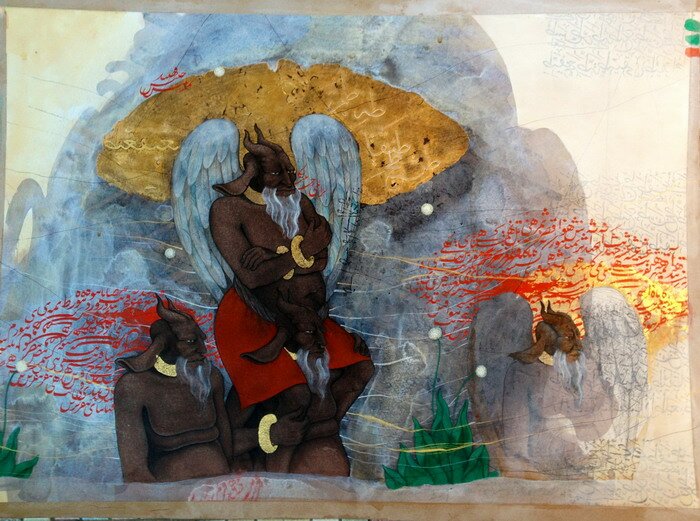
The title of Khadim Ali’s Rustam Series (2011–12) references the hero of the Persian Shahnameh (Book of Kings) in Ferdowsi’s 11-century epic poem. Ali’s paintings recall only his name, alluding instead to the displacement and persecution of the Hazara minority in Afghanistan and Pakistan, a community to which Ali traces his heritage.


Q: Your family left Afghanistan at a turbulent period in the country’s history. How does this affect your feelings towards the country and your place of birth?
A: My family left Afghanistan in the 1890s when the first grand massacres of Hazara started by King Amir Abdul Rahman and he massacred over 62% of the entire population of Hazaras and captured their land and took their children and ladies as slaves and sold Hazaras to India – almost 10 000 Hazaras were sold to India and all the taxes were given to the government. So it was then my grandparents left Afghanistan and moved to India, before the partition of Pakistan in India, so they chose to live at the border of Pakistan and Afghanistan with the hope that someday Afghanistan will be a free land and they are going to claim their land back, but it never happened.

Q: Hong Kong is a very multi-cultural city, home to over 7 million people of many nationalities. What are your impressions of the city?
A: I felt like everything is pointing skywards and it’s like a compressed version of New York and I was thinking I am going to have extreme problems here because I don’t speak Mandarin or Cantonese, but then almost every second person is a really good English speaking person.

Q: What do you hope audiences will take away from your work? 
A: When audiences ask me what is the meaning of that particular artwork, I always think that a work of art is like a poem – when you read a poem, a poem is so versatile, you just own it and personalize it. It goes into your very personal moments and stays in you, if you like, and you translate it according to your own feeling. I think a work of art – of visual art – should be like that and having that versatility of a poem or versatility of music.

Q: Your work is informed and inspired by storytelling and ancient texts – could you elaborate on that?
A: I don’t want people to come in and look at the work the way I am looking at the work. They are free to have whatever meaning they want to – my work is part of my life and part of my career with the storytelling culture but my work is not a story. There is no story behind the work. I think there shouldn’t be any story behind any visual artwork – it should be as free as music, it should have the versatility of music.

Q: Which artists inspire you?
A: I always ask myself which artists I am inspired by but I only look at my work and can say which artists I am inspired by. I am inspired by the 15 century old master Muhammad Siyah Qalam who was also painting demons and I am really inspired by his works.

 
 Click here to read more on the subject: Pakistan in Hong Kong through Asia Society


Sunday, November 3, 2013

Pakistan in Hong Kong through Asia Society


(Source: Title, intro and magazine shots at the bottom: Gandhara-art-Space; Main section: Asia Sciety)

Guggenheim Museum NYC's exhibition 'No Country'(Art from South and South East Asia) opens at the Asia Society Museum Hong Kong. Works by Khadim Ali and Bani Abidi represent Pakistan in this exhibition, featuring works from Singapore, Malaysia, Thailand, Indonesia, Cambodia, Vietnam, India and Bangladesh.


-----------------------------------------------------------------------------------

The Asia Society Hong Kong Center will present No Country: Contemporary Art for South and Southeast Asia, the inaugural touring exhibition of the Guggenheim UBS MAP Global Art Initiative, from October 30, 2013, to February 16, 2014. Featuring recent work by 13 artists from Bangladesh, Cambodia, India, Indonesia, Malaysia, Myanmar, Pakistan, the Philippines, Singapore, Thailand, and Vietnam, No Country presents some of the most compelling and innovative voices in South and Southeast Asia today. The exhibition was first seen in New York at the Solomon R. Guggenheim Museum (February 22–May 22, 2013) as part of the Guggenheim UBS MAP Global Art Initiative, a multi-year collaboration that charts contemporary art practice in three geographic regions—South and Southeast Asia, Latin America, and the Middle East and North Africa—and encompasses curatorial residencies, international touring exhibitions, audience-driven educational programming, and acquisitions for the Guggenheim’s permanent collection.  All works have been newly acquired for the Guggenheim’s collection under the auspices of the Guggenheim UBS MAP Purchase Fund. Following its presentation in Hong Kong, the exhibition will travel to Singapore.
 

Bani Abidi

The Ghost of Mohammed Bin Qasim, 2006. Nine inkjet prints, edition 5/5, six prints: 14 1/2 × 18 1/4 inches (36.8 × 46.4 cm) each, and three prints: 18 1/4 × 14 1/2 inches (46.4 × 36.8 cm) each. Solomon R. Guggenheim Museum, New York, Guggenheim UBS MAP Purchase Fund, 2012, 2012.139.1. © Bani Abidi


This Video Is a Reenactment, 2006. Color video, silent, 58 sec. loop, and inkjet print, edition 3/5, 18 1/4 × 14 1/2 inches (46.4 × 36.8 cm). Solomon R. Guggenheim Museum, New York, Guggenheim UBS MAP Purchase Fund, 2012, 2012.139.2. © Bani Abidi

Abidi explores historical and contemporary representations of the figure of bin Qasim, and the proliferation of this narrative in state history and shared culture, through her fictional depictions of the hero in his emblematic form—wearing the Arabic keffiyeh, brandishing a sword, and riding a charging horse. In The Boy Who Got Tired of Posing, the artist plays on the trend of popular studio photography in 1980s Pakistan, which saw parents encourage their sons to dress up as bin Qasim for portrait shots. In the work’s final image, the subject, tired of performing, mischievously elects to exit the frame. In This Video is a Reenactment, the artist recalls Labbaik, a televisual dramatization of the colonial founder’s conquest, by excerpting a sequence showing the hero’s momentous horseback ride.

In Abidi’s video, however, the act is slowed down, accentuating its histrionic impact on the nation. Finally, in a suite of eight monochrome photographs, The Ghost of Mohammed Bin Qasim, the artist monumentalizes the figure, who appears to haunt various sites of national significance around Karachi including the Lahore Fort, the tomb of Emperor Jahangir, and the National Mausoleum of the founder of Pakistan, Mohammad Ali Jinnah, or Mazar-e-Quaid. Yet on closer examination, these glimpses of the return of the historical figure contain various incongruities and awkwardnesses. A short fictional text reveals the story of how the haunting began with the conversion of a young man, Yusof Masih, to Islam, and his imagining himself as bin Qasim. The figure, juxtaposed with iconic contexts, raises questions of the roles of nationhood, nationalism, and narratives of origin in the trajectory of history.


The Boy Who Got Tired of Posing, 2006. Three chromogenic prints and one inkjet print, edition 3/5, three prints: 40 3/4 × 30 3/4 inches (103.5 × 78.1 cm) each and one print: 18 1/2 × 14 1/2 inches (47 × 36.8 cm). Solomon R. Guggenheim Museum, New York, Guggenheim UBS MAP Purchase Fund, 2012, 2012.139.3. © Bani Abidi


Khadim Ali


Untitled 1, Rustam Series, 2011–12. Watercolor, gouache, and ink on paper, 27 1/2 × 19 5/8 inches (69.9 × 49.8 cm). Solomon R. Guggenheim Museum, New York, Guggenheim UBS MAP Purchase Fund, 2012, 2012.143. © Khadim Ali

The title of Khadim Ali’s Rustam Series (2011–12) references the hero of the Persian Shahnameh (Book of kings). The protagonist of Ferdowsi’s 11th-century epic poem is recognized for his valor and strength, but Ali’s work recalls only his name; the paintings allude to the persecution of the Hazara minority in Afghanistan and Pakistan, a community that finds itself displaced on both sides of the border. The work depicts demons, and suggests that the legendary character of the Rustam has been usurped in contemporary times as justification for hostility and bloodshed, his heroism now ascribed to those who perpetrate violence and domination. In a broader sense, the work reflects on the upheavals and crises that emerge from lingering difference.


Untitled 2, Rustam Series, 2010. Watercolor, gouache, and ink on paper, 19 5/8 × 16 3/4 inches (49.8 × 42.5 cm). Solomon R. Guggenheim Museum, New York, Guggenheim UBS MAP Purchase Fund, 2012, 2012.144. © Khadim Ali

Successive cycles of violence and aggression are not limited to this particular minority community, but recur in oppressive circumstances elsewhere. In its reference to the narrative and lyrical traditions of the Persian people and the region, Ali’s work recollects both the triumph of civilizations past and the turmoil and aftermath of conquest. Yet in spite of loss, there linger traces of individual and cultural memory, of which the return of the Rustam is one. Layered in these works are excerpts from epic poems and literary references to Persian and Afghan history and culture, keys to meaning that the violence of contemporary conflict cannot efface. Also depicted in the series of paintings are the silent and empty alcoves in cliffs that were once occupied by the Bamiyan Buddhas in Afghanistan. Though these 6th-century statues were destroyed in 2001, their physical absence, like that of the Rustam, has a haunting aura of its own.


Untitled 3, Rustam Series, 2011–12. Watercolor, gouache, and ink on paper, 19 7/8 × 16 15/16 inches (50.5 × 43 cm). Solomon R. Guggenheim Museum, New York, Guggenheim UBS MAP Purchase Fund, 2012, 2012.145. © Khadim Ali

Following the style of miniature painting, and in particular the technique of neem rang (half-color), the artist uses traditional methods of production including pigmentation with gold and silver leaf. This traditional South Asian aesthetic, now also marked by Persian influences, is a form of Mughal painting that was once used in illustrated texts, primarily to represent royalty, battles, and legends. The rich and sensitive detailing of these historical portraits is, like the literary epic, revived in Ali’s work, which accords the traditional practice a contemporary relevance by aligning its cultural significance with the circumstances of today.

 
------------------------------------------------------------------------------------------------------------------------


Saturday, August 17, 2013

Art+Auction's : 50 Under 50: The Next Most Collectible Artists - Imran Qureshi

Imran Qureshi makes it into the Art+Auction's prestigious 50 Under 50: The Next Most Collectible Artists list for 2013. The magazine publishes its widely followed list in the middle of the year and this is the first time that a Pakistani artist has made it to the list. Qureshi is also the only locally based artist from the sub-continent to make it to the list. Other artists with subcontinent connections are the London based Idris Khan and Raqib Shaw.


50 Under 50, Part 2
Source: blouinartinfo.com

Art+Auction June 2013
"Last year we set out on what some might call a fool’s errand by selecting the 50 most collectible living artists. Hoping to elevate this sort of list-making beyond a parlor game, we defined the parameters and embarked on research to find those artists who have a proven record in the market and also show promise of the continuing innovation and devotion to craft that will warrant attention for decades to come. The result was a list that peered beyond the headlines. A year is no time at all in the long game that is serious collecting. For this second outing we decided to add to the challenge by focusing on artists under the age of 50. For such a group, auction stats can be erratic, and artists may just be adding a major museum solo to their exhibition history.
 

Monday, June 3, 2013

Pakistan @ Art Basel Hong Kong 2013


by Artwallaa

 Source: Artwallaa, Little Bird, Respective Gallery Websites
Whether you call it the power of the brand or it actually is the case – the first art fair after Art Basel had taken over the Hong Kong Art Fair decidedly looks better.  The layout was more fluid rather than straight lined, the first floor hall had a feel of a more curated show rather than the glitziest of pieces getting the centre stage, and the supporting infrastructure around the fair appeared definitely a couple of notches above the previous years.

With Hong Kong becoming the third destination for Art Basel after Basel and Miami, the city has undoubtedly become the international hub for the visual arts in Asia.

Pakistan had a very strong presence at the Art Basel Hong Kong. Gandhara-art (Hong Kong, Karachi) continued to be the unrelenting gallery showcasing Pakistani artists at the fair since its inception in 2008. This year it presented works of Imran Qureshi, Aisha Khalid, Atif Khan, Adeel-ul-Zafar and Khadim Ali.
We also had works from Risham Syed (Project 88, India), Faiza Butt (Vadhera Art Gallery, India), Shazia Sikander (Pillar Corias Gallery, London), Imran Channa (XVA Gallery, Dubai) and Shezad Dawood (Paradise Row, London). Green Cardamom (London), the other regular participant focussing on Pakistan, was missed this year as the gallery had closed down some six months ago.

The focal point of attraction continued to be Imran Qureshi given his recent successes as Deutsche artist of the Year, 2013 and his Roof Garden Commission at The Metropolitan Museum of Art, New York. His work at Art Basel, took a new direction where his Portrait Series reappeared after a space of a few years, combined with his, now trade mark, blood coloured floral motifs. Besides his work, Imran’s monograph was in big demand too and the bookstore had run out of stock on the second day.

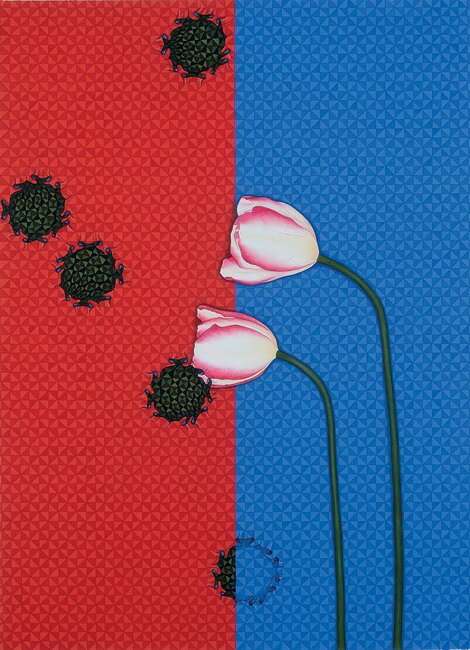
Also at Gandhara was Aisha Khalid’s who returned to her tulips with the politically laced works titled ‘West looks East’. While may be too subtle for most visitors, the depth of Aisha’s trademark ‘bullet holes’ in the East and the lifeless and robotic depiction of the tulips and their stems (very different from her previous tulips) are worth noticing and enjoying.


Faiza Butt’s work ‘My Love Plays in Heavenly Ways 2’, set in a light box and shown at the India Art Fair earlier this year too, grabbed attention due to its pointillism technique and the aesthetically pleasing execution. Slaying of a dragon (depicted in the work), though an act of myth and folklore in the West may not be seen as good Feng Shui in the Orient.


Risham Syed’s ‘Lahore Series’ is one of my favourite works from the artist. Small canvases, the size of a postcard, beautifully depict ordinary Lahore houses and are very nostalgic for non-resident Pakistanis. This is the same series which was shown at Rohtas Lahore a few years ago.
Khadim Ali’s star continues to rise and his work got a lot of attention especially from the Australian visitors (Khadim resides in Sydney). The artist continues to get significant international attention, with Guggenheim recently adding his work to its collection. His ‘Rustam’ series at the Art Fair were an instant hit.
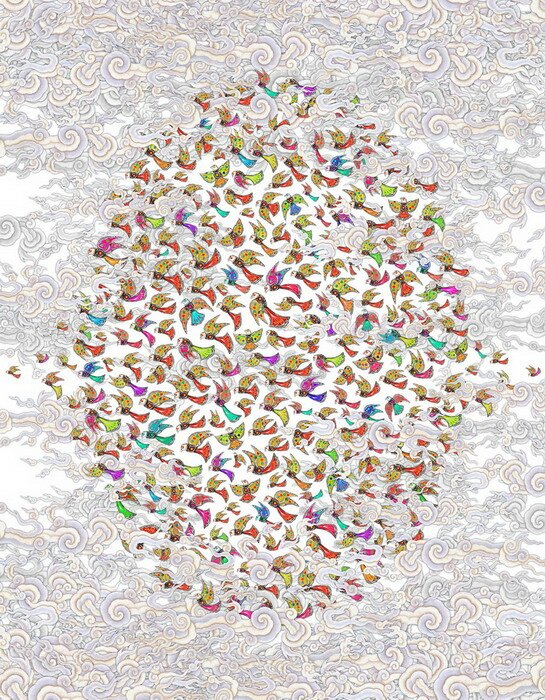
Imran Channa had a whole booth to himself and had works ranging from print, canvas and video. Atif Khan's 'Conference of Birds' got a lot of attention.

While Hong Kongers should be happy that with the success of the Art Basel, the city has now decidedly found a permanent place in the calendar of the closely knit international art fraternity; Pakistanis should be equally happy that Pakistani art and artists are very well represented at the most important art fair in the East.


Monday, April 15, 2013

Khadim Ali's MFA Thesis Show in Sydney

Source: Gandhara-art Space


See details here

Monday, December 24, 2012


Picasso in Pakistan at Gandhara-art Space

Dec 24 - Feb 2, 2013


For the first time in Pakistan, 13 works of Picasso on exhibition at the Gandhara art Space in Krachi.


“Abstract art is only painting. And what’s so dramatic about that? There is no abstract art. One must always begin with something. Afterwards one can remove all semblance of reality; there is no longer any danger as the idea of the object has left an indelible imprint. It is the object which aroused the artist, stimulated his ideas and set of his emotions. These ideas and emotions will be imprisoned in his work for good... Whether he wants it or not, man is the instrument of nature; she imposes on him character and appearance. In my paintings of Dinard, as in my paintings of Purville, I have given expression to more or less the same vision... You cannot go against nature. She is stronger than the strongest of men. We can permit ourselves some liberties, but in details only.” – Pablo Picasso
Boisgeloup, Winter 1934, Quoted in Letters of the great artists – from Blake to Pollock -, Richard Friedenthal, Thames and Hudson, London, 1963, pp. 256-257 (translation Daphne Woodward)

Monday, February 21, 2011

The Asia Society Collectors Series: Amna & Ali Naqvi Art Collection

Amna and Ali Naqvi's art collection began 17 years ago with the purchase of a painting, the first thing the couple ever bought together and now comprises of over 700 works. The collection began with Pakistani contemporary and modern art, and then evolved into an Asian collection with art from China, India, Indonesia, and Japan as they moved and traveled through Asia. Starting with 3rd century Gandhara Buddhist sculptures, Amna Naqvi will take us through her Pakistani art collection as well as contemporary pieces by artists like Shahzia Sikandar, Aisha Khalid, Takashi Murakami, Imran Qureshi and Rashid Rana. While highlighting the artists’ contribution and significance to Pakistani contemporary art, Amna will also discuss their personal motivation to add the piece to their collection. In Amna's own words, "... what excites us most about collecting contemporary work, is that they speak in the voice of our time and our generation, and continually stretch and break boundaries." Amna Naqvi worked in the corporate world for many years before trading in her career to raise a family. A few years ago, she started a gallery to introduce Pakistani contemporary art into the international art scene. Several pieces from the collection have been loaned to museums around the world.

Thursday, May 27, 2010

Pakistan at Hong Kong Art Fair 2010


Pakistan is well respresented at the Hong Kong Art Fair 2010 - ArtHK10 with Gandhara art and Green Cardomam representing Pakistan Galleries. Artists represented are Aisha Khalid, Imran Qureshi, Bani Abidi, Faiza Butt, Imran Mudassar, Attiya Shaukat, Hamra Abbas; amongst others.

Shazia Sikander is also represented in the Fair by a London based gallery.


Monday, March 29, 2010

AMNA NAQVI OF GANDHARA-ART, KARACHI AND HONG KONG, DISCUSSES WHAT TO EXPECT AT ART DUBAI 2010

AMNA NAQVI OF GANDHARA-ART, KARACHI AND HONG KONG, DISCUSSES WHAT TO EXPECT AT ART DUBAI 2010

Aisha Khalid, Divided, 2009, Gouache on Paper (36 X 24 inches each) X 3(Triptych)

Gandhara-art is a curatorial and art publishing organisation, based in Hong Kong, engaged in showcasing the work of Pakistan's pioneering Modern artists, as well as the Contemporary Art of Pakistan's next generation. Gandhara runs its gallery program in Karachi as well as Hong Kong and also works on collaborative projects with art institutions and runs an active art-publishing program. Gandhara–art will be exhibiting Pakistani Contemporary Art as well the work of one of Pakistan's modern artists.

Gandhara-art's contemporary focus will be on showcasing the works of the pioneers of the neo-contemporary miniature painting including Imran Qureshi & Aisha Khalid. Their work is instrumental in the contemporary resurrection of this traditional art form. Their oeuvre is all encompassing. It include paintings, sculptures as well as large scale installations which are exhibited in galleries, museums, art fairs and biennales in Europe, Asia, the UK and the US and was most recently shown at at the East-West Divan at the Venice Biennale (2009).


Gandhara-art also be showcasing the work of Faiza Butt, a UK based Pakistani artist, whose paintings are beautifully rendered and engage the viewer with their ironic dialogue. Butt also exhibits widely internationally and her work was just recently shown in Hanging Fire at the Asia Society Museum in New York (2009).


Imran Qureshi, Story of two, 2009, Gouache & Gold Leaf on Wasli, 21cm X 30cm

Along with these stalwarts of Pakistani Contemporary Art, Gandhara-art will also be showcasing the work of younger artists such as Attiya Shaukat whose paintings has been compared to those of Freida Kahlo for their powerful imagery. Shaukat has also been shown internationally and her work is currently being shown at the Devi Art Foundation - an exhibition of Pakistani Contemporary Art (2010), which was curated by contemporary artist, Rashid Rana.

Gandhara-art will also be showing the work of one of the icons of the Pakistani Modern Art. Ismail Gulgee, lived large on the landscape of post-independence Pakistani Art. His forte was abstract expressionism, but he differed from his pioneering American counterparts as this art form was not limited to abstraction for him. He introduced Islamic Calligraphy and the gestural flow of this calligraphy has resulted in some uniquely powerful works.

The work of these artists is unique in its painstaking skill as well as its metaphors, which are the manifestation of their social, political, religious and national identities.