Showing posts with label Mohsin Hamid. Show all posts

Friday, August 31, 2018

Aspen: Literary Prize Winner Mohsin Hamid in conversation with Dan Porterfield

Don't miss the emcee's introduction of Mohsin.

It is a fantastic reminder for all of us of how accomplished he is and how proud as Pakistanis we all should be because of him!

Enjoy the video!

Your 'very proud' Artwallaa


Aspen Words Presents: Literary Prize Winner Mohsin Hamid in conversation with Dan Porterfield

Source: The Aspen Institute


See related article: Another accolade for Mohsin, another accolade for Pakistan!

Monday, August 27, 2018

Pakistan’s unexpectedly rich English literary evolution


The development of English literature in Pakistan evolved its own identity and has become the socio-cultural document of an era of aspirations and austerity for the past seventy years. Authors have a third eye which venerates curiosity, inspiration, imagination, where seeing is a synecdoche and synesthetic gerund. The disbandment of the British throne in the Subcontinent in 1947, and the accompanying mass migration across the new borders between the newly independent states of India and Pakistan, stands out as one of the momentous developments in socio-cultural history.
 
It subsequently categorized issues of class, community formation, ideological fissures and cultural separatism, however with the absence of women and ordinary people playing any role. In the post-1947 inception of Pakistani English literature, authors tried to hold their ground for the leftist and liberal issues of class and people, in a discourse which simply portrayed a pivotal and exclusive role in the literary backdrop for novels of partition horrors. However, these historical accounts never acquired the discipline of art and no literature based on hate and prejudice can be great.

Thursday, April 12, 2018

Another accolade for Mohsin, another accolade for Pakistan!


Another accolade for Mohsin, another accolade for Pakistan. Exit West, 
Mohsin's latest novel, wins the first ever Aspen Words Literary Prize! 

Source: AspenInstitute


Image result for aspen institute mohsin hamid


Contact: Caroline Tory
Program Manager | Aspen Words

New York, NY, April 10, 2018 ––Tonight, Mohsin Hamid was awarded the inaugural $35,000 Aspen Words Literary Prize (AWLP) for his novel “Exit West.” The award, which is one of the largest literary prizes in the United States, was established by the Aspen Institute to honor a work of fiction “that illuminates a vital contemporary issue and demonstrates the transformative power of literature on thought and culture.”
 
“The book is my attempt to write against this growing anti-migrant sentiment,” said Hamid. “I wanted to portray migrants as heroes, not criminals. But more than that, I wanted to show that everyone is a migrant, even those who never move geographically, because moving through time, aging, is itself a form of migration.”
“Mohsin Hamid’s sentences are exquisite, capable of jaw-dropping surprise, elegant emotional exploration, and bone-chilling horror within a few clauses,” said the AWLP jury. “And by bringing the contemporary refugee crisis into countries that have mostly ignored the suffering beyond their borders, he forces us to ask ourselves how we are reacting to the crisis, and what potential we have to do better. In a world with 50 million displaced people, this is a novel that affects us all.”


Saturday, September 12, 2015

Award-winning novelist Mohsin Hamid talks cultural identity


Award-winning novelist Mohsin Hamid applied his life and work to the exploration of globalization while speaking to Lehigh students on the evening of Sept. 9.

“Things are changing much more rapidly than they once did and that creates in us an anxiety,” Hamid said. “We often speak of globalization as a way of talking about that anxiety.”

To explore this transnational and cross-cultural anxiety, Hamid shared life experiences and used his novels Moth Smoke, The Reluctant Fundamentalist and How to Get Filthy Rich in Rising Asia. With dual citizenship in Pakistan and the United Kingdom, along with 18 years of residency in the United States, Hamid has related his personal findings to characters within his books to further examine one’s self and personal identity.

“In this face of a globalized life, I wanted to make sense of things,” Hamid said.

It was with that inspiration that gave birth to his first novel, Moth Smoke, which follows a Pakistani man through various life struggles. Hamid’s ability to write about a Pakistani man through the perspective of an American made him aware of what he calls the “similarity phenomenon.”
He said due to globalization, the superficial comparisons that often happen with cultural differences are being replaced with the idea that young Americans do act similarly to young Pakistanis.
However, after the events of Sept. 11, Hamid’s world dramatically changed as he saw the “reassertion of tribalism” ensue on a global level. Being a hybridized Pakistani American was no longer socially acceptable. He was forced to pick a side just as Islamism and Americanism become two mutually exclusive entities.

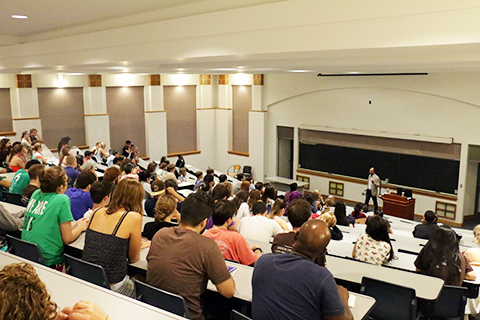
Distinguished author Mohsin Hamid gives a talk to Lehigh students in the Rauch Perella Auditorium on Wednesday, Sept. 9, 2015. The presentation was part of the Critical Globalization lecture series that is promoting a social change initiative. (Nadine Elsayed/B&W photo)


Living as a Pakistani American in a post-Sept. 11 world inspired The Reluctant Fundamentalist. The format of the novel forces readers to trust their gut and make a decision, without enough information, about the main character. Hamid compares this decision one must make as a reader with the decisions all humans must all make as they all face a world where decisions must be made with incomplete information. He said it is through these decisions that we find our true self and identity.
“It was interesting hearing him speak about the effect Sept. 11 had on his everyday life and how those experiences shaped The Reluctant Fundamentalist even though he began writing the book before the event,” Ellen Moroney, ’16, said.


Wednesday, September 2, 2015

Wonders of Pakistan - Google Cultural Institute


Artwallaa is catching up on events after summer. 

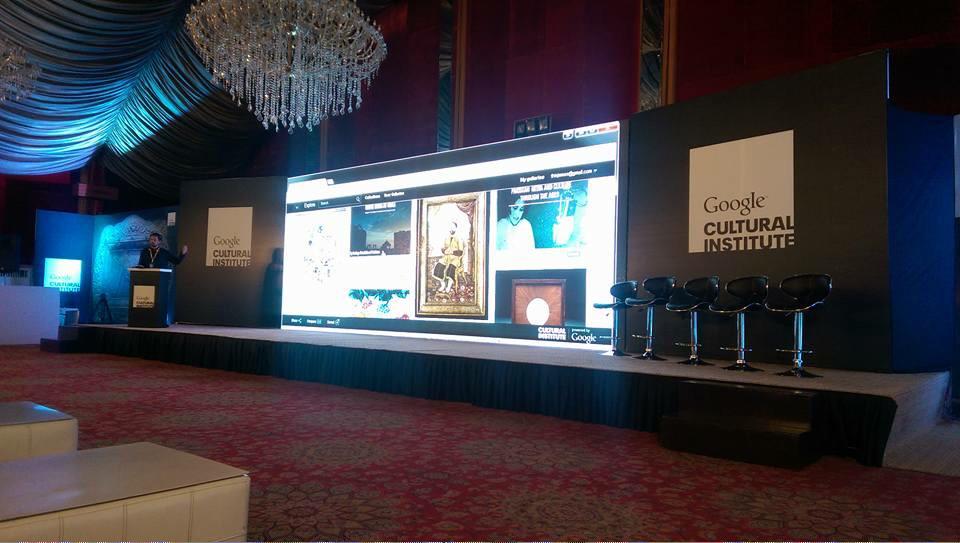
The launch of the Google Cultural Institute's Pakistan chapter is indeed another step in bringing Pakistani arts into the global main stream.

The launch had a good representation of all types of cultural variables including architecture, old civilisations, works of masters as well as contemporary art.


Source: Google Cultural Institute


Source: Little Bird / FB


Source: Little Bird / FB


Source: Little Bird / FB


Source: Little Bird / Twitter


Source: Reportrr.com / FB

Google uploads Pakistan’s cultural treasures online

Source: Tribune
 

The six exhibitions can be viewed at g.co/pakistanculture.
 
 
“Pakistan is brimming with a rich historical and cultural heritage, with stories and artifacts that we are keen to preserve for future generations,” Google Asia Pacific Public Policy and Government Affairs Director Ann Lavin said on Thursday at a ceremony to unveil six online exhibits from Pakistan that have been added to the Google Cultural Institute platform.

The collections at the Lahore Museum, the Mohatta Palace Museum, the Walled City of Lahore Authority, the Heritage Foundation of Pakistan, the Fakir Khana Museum and the AAN Collection have been uploaded online to g.co/pakistanculture. The exhibit features more than 400 items and 12 special exhibits, including the rare Fasting Siddartha sculpture dated to 200 BCE and re-discovered in a 19th century excavation.


Saturday, February 28, 2015

Today, in search of Pakistan

Some more on Salima Hashmi's latest book .....

.... and nice to see that our thought leaders are moving away from stereotyping ......

"To think ‘Pakistan’ is to think of its turbulent history and the violence it endures with alarming regularity even today. So, it is a departure from norm when it barely resurfaces in a conversation with Salima Hashmi, Pakistani artist and editor of The Eye Still Seeks."


Source: Mid Day (for all text and images)


Today, in search of Pakistan


A new book looks at contemporary art in Pakistan, which reflects the country’s turbulent, provocative relationship with its political and social fabric, writes Kareena Gianani

Even before a reader could run her finger down the contents of the book, The Eye Still Seeks, which looks at Pakistan’s contemporary art scene, she is greeted by an artwork of a cherubic child, barely three, holding a pistol. His glee is unmistakable, as is the background in artist Faiza Butt’s artwork, splattered with scenes of violence.

An artwork by Pakistani contemporary artist Faiza Butt. (Below, L-R) Some eclectic artwork by Hamra Abbas and artist Salman Toor


To think ‘Pakistan’ is to think of its turbulent history and the violence it endures with alarming regularity even today. So, it is a departure from norm when it barely resurfaces in a conversation with Salima Hashmi, Pakistani artist and editor of The Eye Still Seeks.


Pakistan and surprises
To the naked eye, The Eye Still Seeks is about Pakistani contemporary artists’ experiments with a range of media such as digital, video, sculpture, painting and installations. But, look deeper, and these are experiments with naked truth. Religion, gender and politics are as unmistakable as colours mixed together, as if never to be separated from Pakistan’s fabric. Yet, when Hashmi began curating this book, she had her eye on only one idea — what are Indians curious about when it comes to Pakistani art? She decided not to pay much heed to the oft-discussed what-is-common-between-Indian-and-Pakistani-art question. “Indian and Pakistani Modernists had much in common. In fact, Indian artist SH Raza’s younger brother is a Pakistani artist. But this commonality wasn’t of interest to me, because it is Pakistan’s contemporary art which is bold and holds more surprises for the world,” says Hashmi over a telephone call from Lahore.


Salima
Artist and writer Salima Hashmi


The Eye Still Seeks takes a refreshing approach — it has Pakistan’s best fiction writers writing about artists they admire, looking into their work and then looking inward to place the art in personal and political context. So, Kamila Shamsie writes on Naiza Hasan’s art, while Mohsin Hamid writes a beautiful meditation on the work of Rashid Rana. Another experiment is one wherein artists and partners Aisha Kahled and Imran Qureshi explore their works in a conversation. “My initial idea was to get Pakistan’s political scientists to write, but none of them were interested in art. That’s when I hit upon this idea, because they are such relevant parallels —crisscrossing Pakistan’s fiction and art. I selected authors who are not only interested in art, but could also articulate why the artists they chose resonate with them,”  says Hashmi.


Saturday, February 7, 2015

So Lounge: New age Pakistan - New Art Book

Unlike a lot of other countries, Pakistan, by no stretch of imagination, has witnessed an 'excess' of art books. So a publication of a new art book is nearly a story in itself in the land of the pure. On top, add Salima Hashmi's name to a book and it becomes a 'must see'. 'The Eye Still Seeks' seems to extend its scope and importance even beyond that.
 
 
Visual beauty combined with the beauty of the word
 
Apart from the normal coverage of the contemporary art scene in the country, the book has beautifully combined some of the best visual artists in the country with the leading literary figures of the country. Mohsin Hamid has written on Rashid Rana's work, Kamila Shamsie on Naiza Khan's and Mohammad Hanif on Asim Butt's.
 
For those amongst us, who enjoy both visual beauty as well as the beauty of the word ...... this is a double treat indeed !
 
Enjoy !
 
 
-----------------------------------------------------------------------------------------------
So Lounge: New age Pakistan
 
A lavishly-produced book on the contempoary art scene in the country  
Source: Livemint
          
So Lounge: New age Pakistan
Faiza Butt’s Between Me And Yourself
 
 
There’s little serenity in contemporary art by Pakistani artists. In a country that has seen turbulence in both its political and social worlds since its very birth, the artists’ responses have been courageous, provocative even.
photo
The Eye Still Seeks—Pakistani Contemporary Art: Edited by Salima Hashmi, Penguin Studio, 303 pages, Rs 4,999
 
 
As artist, critic and curator Quddus Mirza says in his write-up on artist Adeela Suleman, “the acts of violence are… deep- rooted in our ideas, psyches and selves”. That is what one sees in the works that have been published in this coffee-table book edited by artist and teacher Salima Hashmi (also, incidentally, the daughter of poet Faiz Ahmed Faiz).
 
The writings that accompany the images of artworks are a great introduction to Pakistani art in its most vibrant phase—there is Kamila Shamsie on Naiza Khan, Mohsin Hamid on Rashid Rana, Mohammed Hanif on Asim Butt and the provocative language of graffiti art, a recorded conversation between artists and partners Imran Qureshi and Aisha Khalid which touches, among other things, on domesticity and keeping the artist’s ego aside in their marriage, and Nafisa Rizvi on the hugely influential output of female artists.
 
This book was conceived along with a Pakistan contemporary art show in Delhi that has now been “indefinitely postponed”. The book is a reminder that that time has to come soon.