Sunday, April 12, 2020

Salman Toor’s Intimate Paintings Are a Salve for Our Isolated Times

Source: Artsy

By: Alina Cohen 
April 3, 2020


View of Salman Toor’s studio with works in progress. Courtesy of the artist.


Portrait of Salman Toor. Courtesy of the artist.

Salman Toor’s small-scale, emerald-tinged paintings of queer bohemian gatherings are particularly poignant in our socially distanced time. Remember get-togethers in friends’ cramped city apartments? Remember their indoor strings of Christmas lights, tilting stacks of books, and lamps with exposed bulbs? Or the abundance of empty wine glasses and impromptu vamping for Instagram-ready shots? Remember going to a bar where people danced under a disco ball, and the bartender had all the right ingredients to make a perfect cocktail? Toor paints these elements of comfort and communal joy with an unsentimental nostalgia that makes me yearn for the time before video-chatting became the predominant way to socialize.

Toor’s lush, intimate works were supposed to get their due this month. The Whitney Museum of American Art planned to open the artist’s first-ever institutional solo show, “How Will I Know,” on March 20th, but due to the COVID-19 pandemic, the exhibition has been indefinitely postponed. After seeing Toor’s work on view at “Xenia: Crossroads in Portrait Painting,” Marianne Boesky’s recent portraiture show in Chelsea, I was really looking forward to the presentation. Instead, I got the next-best thing: speaking with Toor via phone about fashion, South Asian representation, and art history—three of the defining elements of his oeuvre.


Toor was born in Lahore, Pakistan, in 1983. His community, he said, shared “pretty conservative, moral values.” He was always painting and drawing as a child, finding his friends in the art room of his macho all-boys prep school. Early on, art became a way for him to communicate.

In the early 2000s, Toor moved to the United States to attend college at Ohio Wesleyan University. He experienced major culture shock. “It was insane,” he said of his move to the Midwest. He compared his first year in the States to one of his “silent paintings,” where there’s so much going on, most of it unspoken. The canvas he referred to, Tea (2020), features a man and a woman sitting in a fenced yard, drinking tea. The starry cobalt sky glimmers above them. Toor’s far-off perspective details the potted plants on the patio steps, the white car in the driveway, and the lighted windows of the buildings beyond. Yet the central conversation remains guarded, intimate, and ambiguous in topic and tone.


Salman Toor, The Star, 2019. Courtesy of the artist and Whitney Museum of American Art.

Toor initially connected with the conservative values in his adoptive city. They reminded him of home. Soon enough, however, he was seeking a more radical, creative milieu. He moved into a hippie commune for the last three years of college, then left for New York. At Brooklyn’s Pratt Institute, where he enrolled in an MFA program in 2007, Toor focused on academic painting. “You can really spend your whole life trying to be as good as those white guys,” he said. His early post-graduate paintings used 17th-century styles to represent contemporary South Asian subjects. At the time, he was painting from models and exhibiting work back in Lahore and Karachi; he was making enough money from sales to pay rent.

Yet the artist soon tired of old formulas. He stopped working from life, and instead began generating imaginary characters tinged with elements of illustration and fairy tales. He thought of wooden dolls, Pinocchio, and stories of innocent children. It excited Toor to distort his new figures, which featured a cobbled-together, patchwork essence.


Salman Toor, Bar Boy, 2019. Courtesy of the artist and Whitney Museum of American Art.

Skinny, brown, hairy men became dominant in Toor’s work—and still prevail today. “I saw myself in that figure. I see myself as an amalgam of different cultures and things I’ve grown to like,” he said. Such characters appear in Toor’s recent canvases of men stopped at customs in airports. The artist portrays these subjects standing behind gray tables laden with their personal belongings, such as shoes or a cell phone.

Toor inserts grace and ambiguity into these fraught scenes. His men are dignified, their clothing (a long brown vest, a shaggy turtleneck) deftly sketched. “Fashion is a tool of empowerment or of describing poverty or humiliation on someone foreign,” Toor said. People of color, when stopped in an airport, often don’t receive much care or positive attention. Toor provides it through his art.


These paintings address the idea of “being anywhere, or being nowhere,” said Whitney curator Christopher Y. Lew. Against “drab bureaucratic backgrounds,” Toor creates figures who are “moving from one country to another, across borders, presented in space that has no grounding,” Lew added.

Toor pays as much attention to clothing in his party scenes as he does in his immigration canvases. He noted how important depictions of fabric were in paintings of the 17th and 18th centuries, when they were markers of luxury and bourgeois comfort. “I want to recreate that historical excitement—that sheen of satin or lightness of linen,” Toor told me. He’s particularly enamored with big waistcoats, layered clothing, intriguing color combinations, and lots of buttons.


The artist updates old art traditions in more humorous ways, as well. In Bedroom Boy (2019), he’s painted a man in the position of a traditional, reclining odalisque, snapping a nude with his phone. The Bar on East 13th Street (2019) riffs on 

Édouard Manet ’s famous A Bar at the Folies-Bergère (1882) by giving the central, gender-bending bartender dark painted nails and pigtail braids.

Lew’s collaborator in organizing the show, curatorial assistant Ambika Trasi, first saw Toor’s work about five years ago at New York’s Aicon Gallery. “Salman talks about entering the brown body into the language of the humanities. It felt really fresh,” Trasi said. She admires Toor’s ability to simultaneously represent reality and reference art history, while “tapping into the experience of living in New York City for people of color,” she said.


Detail of Salman Toor, The Green Room, 2019. Courtesy of the artist.


Salman Toor, Four Friends, 2019. Courtesy the artist, Whitney Museum of American Art, and Collection of Christie Zhou.

The term “people of color” takes on new meaning in Toor’s paintings, where figures are bathed in emerald light. “I’ve thought of green as glamorous, poisonous, nocturnal, nostalgic, but not sentimental,” he said. The hue, for him, relates less to the absinthe in old Parisian cafés than to the aura of Slytherin (the artist himself, however, identifies as Ravenclaw or Hufflepuff). 

Picasso long ago colonized blue and rose. Toor has made a green period all his own.

Since confinement started in New York, the East Village–based artist hasn’t ventured out to his Bushwick studio. Oil paint is too toxic to use in his apartment, he explained. Toor has made hundreds of little drawings, though, which he thinks of as lists. And he’s been cooking, too. He enumerated the traditional Pakistani Indian dishes he’s made, including vegetable curry, daal with roti, chutneys, and yogurt-based raitas.

Throughout his life, Toor has adapted to a new continent and to imaginative new ways of artmaking. He’s swiftly adapted his own creativity, enjoying the pleasures of time and solitude while waiting for life—and his Whitney show—to carry on where they left off. 


Saturday, April 4, 2020

Pakistani-origin, New York-based artist Salman Toor wants to paint a world where the East and West harmonise

Source: GQIndia


© "The Green Room", (2019); courtesy of Salman Toor

Pakistani-origin, New York-based artist Salman Toor wants to paint a world where the East and West harmonise 

 Brooklyn, for Salman Toor, “is a community of conscientious small businesses, flourishing among graffitied industrial spaces, where people dress eccentrically and growing up is optional.” The NYC borough is also home to Toor’s studio: A cramped loft where a wall is studded with his paintings, both finished and in progress; and a makeshift shelf in a corner is piled high with paints and brushes, books and trophies, an opened bottle of champagne and paper. 

This is where Toor, a 30-something, Lahore-born artist who resides in the East Village, spends most of his day working alone – “until I miss my friends. Then I hang out at local dive bars with them, babbling away over drinks about our weekend woes, despairing over Trump’s latest tweet and the effect of living between cultures on our weirdly jeopardised and liberated inner selves.” 

That in-betweener aura bleeds through Toor’s figurative paintings too. From a distance, his paintings – small scale and mostly done in oil on canvas – look like they belong to a long gone era, evoking the air-brushed detailing of Rubens or Vermeer. Look closer and you see his preoccupations are very much of our zeitgeist. 

“In the past, my paintings were more about life in South Asia, the anxiety around class and caste,” says the Pratt Institute alumnus, who left Pakistan in the early 2000s to study art at Ohio Wesleyan. Now, he seeks to offer an intimate view into the lives of queer, brown men living in the US and South Asia.

Lunch, Salman Toor

This painting above, for instance, is called Lunch: A tondo panel featuring three friends, their skin and hair colour as individual as their fashion choices, draped in long snaky limbs and clergyman’s hats, feasting on coffee and pasta, and peering into a smartphone. When Toor put it up on his Instagram, he added hashtags like #feather, #queer and #reverie.

Another painting, called Mehfil/Party depicts a house party that could be a scene out of a Sofar Sounds concert. Young men play the harmonium and sitar in a corner, another in a rapper’s hat appears to be singing a ghazal. Their audience sit, stand, lie scattered all over the room, in twos and threes. It went up on Instagram filed under #safespace, #matinee and #culturevulture. 

In these rooms, bars and streets, against broad brushed-backgrounds, straggly men dance, lounge, kiss, laugh, talk, dress up, eat, stream and exist at peace in their environments. For the most part, there are no victims here. Nor are these tableaux of a gentle urban life staged or modelled for: Toor says he paints from memory and imagination. 

In all of the artist’s work, currency and nostalgia, belonging and alienation coexist: And it’s perhaps that paradoxical quality that’s earned him a growing base of followers everywhere, from NYC to Lahore to Delhi. Toor remembers receiving a “ton of love” for his show at Nature Morte in Delhi, in January, titled I Know A Place. From Instagram stories, he gleaned that “a lot of people who went to see it were going straight from the protests” and found that heartening. This month, as he gets set for his first solo museum exhibition at the Whitney Museum of American Art in New York, he talks to GQ about his extraordinary life and where he’s finding inspiration these days. 

The artist at his studio in Brooklyn

Sunday, March 29, 2020

Two Artists (incl Salman Toor), Two Views of the Human Figure - NYT


Two Artists, Two Views of the Human Figure

Salman Toor’s show in New York and Christina Quarles’s in Chicago reveal the enduring — but continually evolving — style of the centuries-old art form known as figuration.


Source: NYT

This article is part of our latest special report on Museums, which focuses on the intersection of art and politics.


Until fairly recently, the world of contemporary art went through a period of turning up its nose on figurative art — works that have a strong resemblance to the real world, especially the human figure.


But two new exhibits by two queer artists on opposite coasts help demonstrate how much that attitude has changed — and how much the change is fueled by fresh perspectives.


The exhibitions — “Salman Toor: How Will I Know” at the Whitney Museum of American Art and “Christina Quarles” at the Museum of Contemporary Art Chicago — present two artists around the same age and at similar career stages with strikingly different styles of figuration.


But Mr. Toor, based in New York, and Ms. Quarles, who lives in Los Angeles, both use a brush to tell previously obscure stories, proving that traditional representational art has the durability to be constantly reinvented, played with and recharged.


“It’s an exciting moment,” said Christopher Y. Lew, the Whitney curator who organized Mr. Toor’s show with Ambika Trasi, a curatorial assistant. “Younger painters are reinvesting energy in figuration.”

Thursday, March 26, 2020

Visual artist Shahzia Sikander’s artworks find many faces to feminism

Source: Stir World

Visual artist Shahzia Sikander’s artworks find many faces to feminism

New York-based Shahzia Sikander celebrates womanhood and oneness with nature through her practice spanning three decades.

by Dilpreet Bhullar Mar 12, 2020 

Amongst the vast variety of genres available within the discipline of literature, ‘children literature’ is a sincere promise of complexity punctuated by signs and symbols. The folk-cum-fantasy tale of the Little Red Riding Hood epitomises the same intricate network of literary devices. Multimedia artist Shahzia Sikander, with her visual language adds wings to Little Red Riding Hood, metaphorically, that lets her fly to enjoy gymnastics in the red and white striped suit or even carry a face of the woman from Indo-Persian miniature painting. Many artists draw influence from mythology and other creative arts, but a few of them truly blend the aesthetic of the two successfully with their artistic oeuvre.


Red Riding Hood, 1997Image Credit: Courtesy of Shahzia Sikander


Sikander has a vast variety of critically engaging works that are rooted in her feminist and Muslim perspectives, never far from her transnational Pakistani-American identity. Currently living and working in New York, Sikander talks about her passion for literature in an interview, “I see myself as a thinker. Literary histories, poetry, ghazal, rap, fiction, opera are magical places of departures for me. Such an interface with language has been hand in hand with my growth as a visual artist and an individual interested in story-telling and collaborative works.”


Shahzia Sikander; Image Credit: Courtesy of Matthias_Ziegle

The accomplishment of the art forms does not limit its demands to admiration, but its sustenance is dependent on expanding its scope to let the artists experiment with its language. In a similar vein, given the finesse and intricate work of Indo-Persian miniature paintings, Sikander has persistently strived to re-examine its patronage, origin and ownership. The richness of the illuminated manuscripts and unarchived materials has been a repository of signs and symbols to add to her contemporary visual idiom. Interestingly, the wide usage of media and scales of her artworks – from murals, multichannel single-image video to permanent public-art, allow her to effectively translate these knowledge-systems to the artworks.


Gopi-Contagion, 2015. HD video animation on digital LED billboards Image Credit: Courtesy of Shahzia Sikande

Within the socio-cultural fabric of South Asia, the history of British imperialism creeps in to shape the politics of representations. History is not accepted as a clean slate but regularly negotiated and reconciled with to raise multiple realities. Sikander poses a pertinent question on the layers of history when she asks, “When one thinks in terms of narratives, and how history, including art history, is determined, how real is that account?” To counter the colonial amnesia, Sikander’s works challenge patriarchal and colonial narratives to give a voice to women who are relegated to the margins of the history. She adds, “It is inspiring to see how a young demographic of women is opening the political discourse towards a more participatory space for non-white people. In that spirit of empowerment, many young women are fighting for equal rights and representation and climate change.”


Parallax, 2013. Three-channel, single-image HD video animation; Image Credit: Courtesy of Shahzia Sikander

Her complex mosaic portrait Mary-Am at Midtown Houston celebrates the presence of the feminine force 
in nature, cultures and religions across the globe. If human life on the earth came from water, then the face of the woman with its painterly marks, as seen through the rushes of water, is looking at the open sky to symbolically lay bare the truth of abundance of life and harmony. Resonating with the contemporary times of shrinking cultures and shifting borders, Sikander’s artistic journey is a careful craft of experimentation with the technical and aesthetic aspect of the art to let the viewers partake the pleasure of criticality and sensitivity towards the surrounding.

Mary-Am, a permanent public art fountain; Image Credit: Courtesy of Shahzia Sikander

Sunday, July 21, 2019

A Sprawling Show of Art by All-Star MacArthur Fellows - including Shahzia Sikander - in Chicago in 2021


A Sprawling Show of Art by All-Star MacArthur Fellows, From Njideka Akunyili Crosby to Mark Bradford, Will Take Over Chicago in 2021

The show celebrates the 40th anniversary of the fellows program.
Shahzia Sikander, Quintuplet Effect (detail) (2016). Princeton University. © Shahzia Sikander / Photo: Ricardo Barros.

The University of Chicago’s Smart Museum of Art has just unveiled plans for an ambitious multi-site show with work by MacArthur fellow artists including Ndijeka Akunyili Crosby, Mark Bradford, Rick Lowe, Iñigo Manglano-Ovalle, Fazal Sheikh, and Shahzia Sikander.


Saturday, July 13, 2019

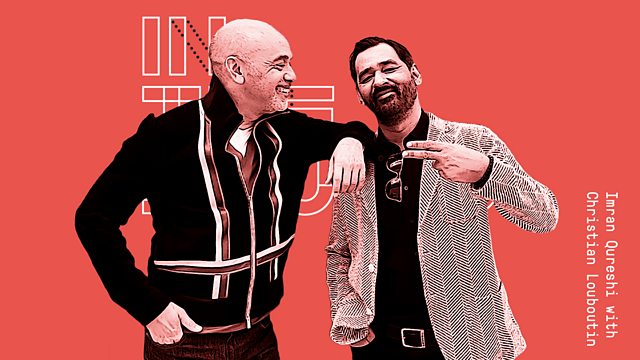
Imran Qureshi with Christian Louboutin on BBC Radio

Imran Qureshi: Beauty and carnage

 BBC Radio
Source: BBC Radio 

Listen to the discussion here


An internationally renowned artist from Lahore in Pakistan, Imran Qureshi is a master of the very delicate and the very brutal: combining tiny brushstrokes inspired by the 16th Century Mughal masters with large-scale installations evoking the carnage left after a bomb attack, his work has the power to shock and intrigue in equal measure. An unlikely friendship connects him with Christian Louboutin, one of the world’s best-known shoe designers, whose trademark red-soled, beautifully crafted pumps are worn by the likes of Gwyneth Paltrow and Rihanna. For this programme, Christian meets Imran at Galerie Thaddaeus Ropac, a huge warehouse turned art gallery in Paris. It is the venue of a major solo exhibition, and Christian joins Imran as crates are unpacked and last-minute changes made to individual paintings and the exhibition as a whole, with some new work inspired by the bomb attacks on two mosques in New Zealand in March 2019. “There is an element of violence in the work,” Imran says, “at the same time, when you get close to it, it becomes poetic as well.” He has even brought a piece of his studio with him from Lahore, which becomes part of his installation in its own right – and as he and Christian discuss each other’s art, it emerges that these two creative giants have a surprising amount in common.

Sunday, July 7, 2019

France returns 445 stolen 4000 BC old artifacts to Pakistan #ProtectNationalTreasures

French Police Intercepted Some Suspicious Pots at the Airport. The Investigation Led to the Return of a Huge Cache of Pakistani Artifacts

Many of the 445 artifacts, including ancient vases, busts, and goblets, date back to 4,000 BC.
French Customs official Anne-Sophie Vitoux (L) hands over an artifact to a Pakistani embassy official at the Customs department at Roissy airport outside Paris on June 24, 2019. Photo: Christophe Archambault/AFP/Getty Images.

Almost 500 stolen artifacts, many of which date back to 4,000 BC, were returned to Pakistan this week after being confiscated by French officials more than a decade ago.  
The saga stretches back to 2006, when customs agents at Charles de Gaulle Airport in Paris intercepted 17 terra cotta pots en route to a local gallery. Though identified modestly at the time as being more than 100 years old, it turns out the relics were much older than that. Experts dated the pots back to the second or third millennium BC and determined that they had likely been looted from ancient burial sites in Pakistan’s Balochistan province.
An investigation into the gallery in question—which has not been named publicly—turned up 445 objects in total, including ancient vases, busts, and goblets. Collectively, the artifacts are valued at roughly €139,000 ($157,000). French officials noted that the gallery will be slapped with a fine between €100,000 and €200,000 ($112,000 and $226,000) for trafficking in stolen goods. 
The objects were returned in an official handover ceremony held yesterday at the Pakistani embassy in Paris.

Sunday, February 10, 2019

Shahzia Sikander and Ambreen Butt in the US


Two Pakistani American women reinvent traditional art with unconventional subjects


Source: Washington Post 


Ambreen Butt’s mixed-media artwork, “Shoaib (8),” takes its title from the name and age of a young victim of an American drone strike. (Photo by Kevin Todora/Ambreen Butt)
Ambreen Butt makes a striking first impression.
In the Pakistani American artist’s first solo exhibition in Washington, two large images hang on the wall just opposite the entrance to her show, “Mark My Words,” at the National Museum of Women in the Arts. Titled “Pages of Deception,” the diptych appears, from a distance, like facing folios of paper in a calligraphic Islamic manuscript, with traditional filigree borders. On closer inspection, however, these 70.5-by-45-inch “pages” are taken up with overlapping circles of shredded and collaged snippets of paper: the transcript of the 2011 terrorism trial of Egyptian American Tarek Mehanna, who was sentenced to 17 years in prison by a Boston jury. The thousands of indecipherable text fragments — the left side representing the prosecution’s closing argument, with the defense’s statement on the right — seem to swirl almost into meaninglessness, in a powerful commentary on the inscrutability of justice.
All of the exhibition’s 13 works on paper reward such close examination and engagement. The artist builds on her training in classical Indo-Persian miniature painting, incorporating an array of other techniques to explore contemporary political narratives.

Saturday, December 22, 2018

Shahzia Sikander at the Smithsonian - Hyperallergic

'Eye to I: Self Portraits from 1900 to Today' opened at the National Portrait Gallery, Smithsonian on  November 2 and will continue till August 18, 2019, Shahzia is the first Pakistani artist in the 


collection of the National Portrait Gallery. Below is a good review of her work 'Portrait of the Artist' 
which is part of the exhibition. 


Keep rocking Shahzia! 


Contemporary Visions of Mystical Indo-Persian Miniatures

The night of “Ascension,” one Islam’s most mystical and striking themes, has inspired Sikander, whose
self-portraits are artistic manifestations of this magical journey. 


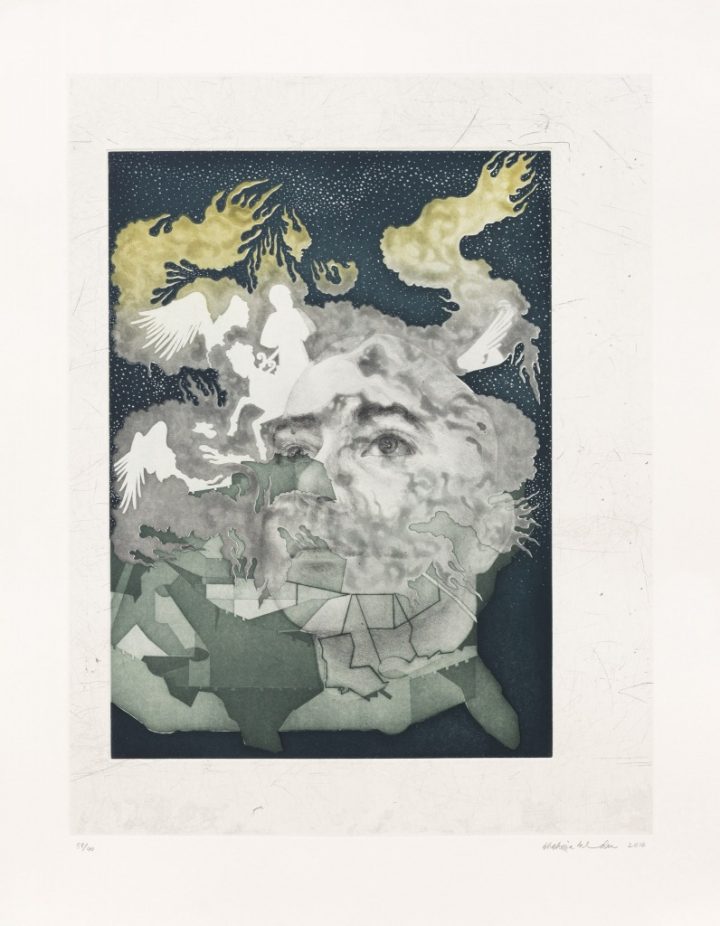
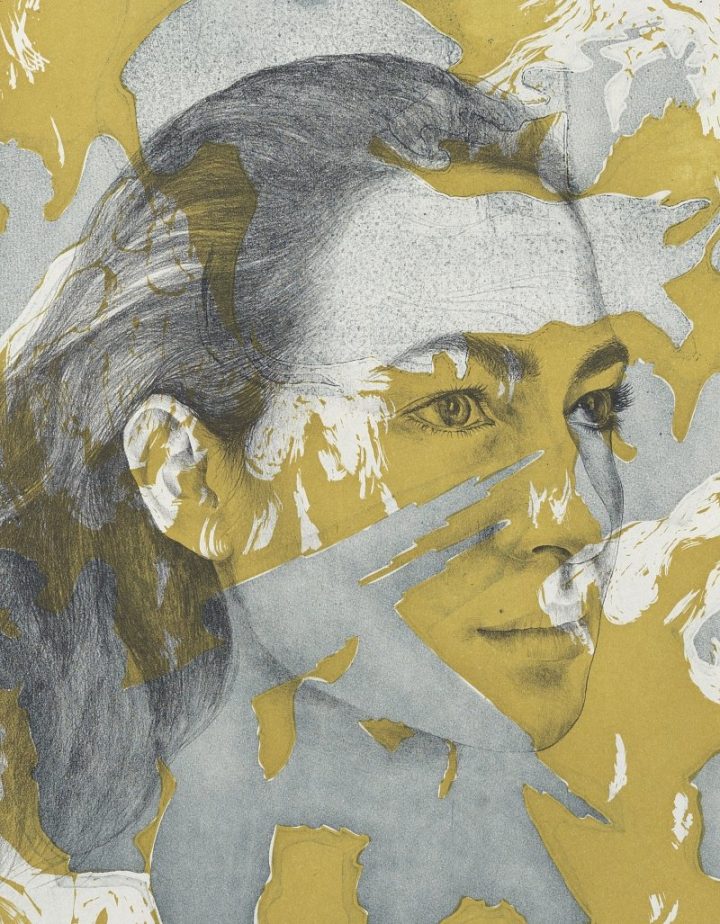
Shahzia Sikander, “Portrait of the Artist” (2016), a suite of four etchings, with accompanying collaborative text with Ayad Akhtar. Paper size: 68.5 x 53 cm; image size: 56 x 43 cm. National Portrait Gallery, Smithsonian Institution: Acquired through Federal support from the Asian Pacific American Initiatives Pool, administered by the Smithsonian Asian Pacific American Center. Published by Pace Editions, Inc.
WASHINGTON, DC — Eye to I: Self Portraits from 1900 to Today at the National Portrait Gallery in Washington explores how American artists have viewed themselves in relation to American history and culture. It also includes a first: Shahzia Sikander is the first Pakistani-born artist to be collected by and exhibit works in the renowned gallery. The artist’s work is displayed alongside over 70 pieces by such American luminaries as Elaine de Kooning, Jacob Lawrence, and Josef Albers.
Spanning nearly three decades, Sikander’s body of multimedia art focuses on Indo-Persian miniatures, a genre that fuses Central Asian and Mughal painting. Since the 16th century, miniature painting in the Indian subcontinent (now Pakistan, India, and Bangladesh) has followed traditional pictorial laws and thematic content. Lyrical tales of romance from epic Hindu texts, darbaars (essentially Mughal emperor courts), holy wars, and flora and fauna dominate the bright, lavish manuscripts. Miniature painting popularized illustrations of the Mairaj (Arabic for ladder) from the life of the Muslim prophet Muhammad, where the creature Buraaq takes the Prophet above the skies and beyond the heavens. Muhammad is said to have met angels and past prophets. The night of “Ascension” is one Islam’s most mystical and striking themes. It has enthralled and inspired Sikander, whose self-portraits are artistic manifestations of this magical journey.
Shahzia Sikander, “Portrait of the Artist” (2016), a suite of four etchings, with accompanying collaborative text with Ayad Akhtar. Paper size: 68.5 x 53 cm; image size: 56 x 43 cm. National Portrait Gallery, Smithsonian Institution: Acquired through Federal support from the Asian Pacific American Initiatives Pool, administered by the Smithsonian Asian Pacific American Center. Published by Pace Editions, Inc.

Friday, November 2, 2018

Is Collecting Art Another Way for Collecting Stories? | Amna Naqvi | TEDxLahore


Why are people motivated to collect objects? These could be shells or stones as a child or art and books as an adult. What motivates and energises them to take on this task? Amna Naqvi, the founder of AAN Collection and AAN Foundation talks about her journey of collecting art and speaks of not only collecting objects of art but art experiences as well. Amna Naqvi is the founder of AAN Foundation and AAN Collection. She is an avid art collector, philanthropist, publisher, supporter and collaborator of art projects and initiatives. These projects have led to the development of the contemporary Pakistani art space both locally as well as globally over the last fifteen years. The AAN Collection comprises of over 800 works of art ranging from 3rd Century Gandhara sculptures, 17th Century Mughal miniatures and contemporary art. Works from the collection have been part of major exhibitions at institutions such as The Metropolitan Museum of Art, in New York, The Venice Biennial and The Guggenheim Museum Bilbao. The collection is complimented by the AAN Foundation which supports art exhibitions and projects in Asia as well as globally. 

This talk was given at a TEDx event using the TED conference format but independently organized by a local community. Learn more at  https://www.ted.com/tedx


Sunday, October 28, 2018

Mural by major Pakistani artist installed at Philly community college

Peter Crimmins October 22, 2018

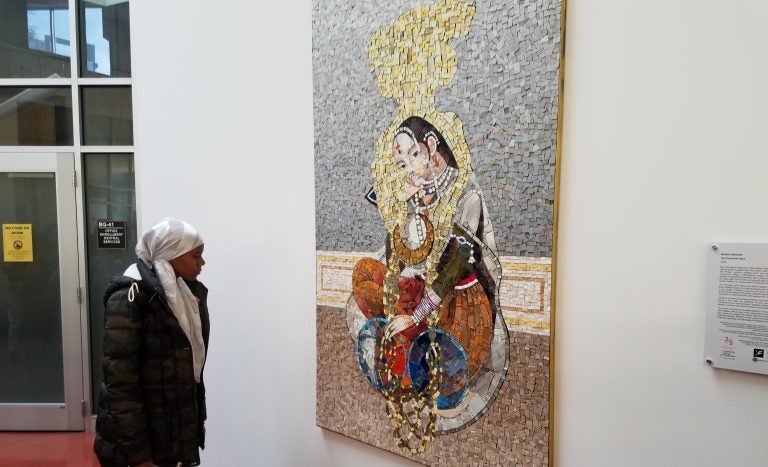
A passer-by looks at
A passer-by looks at "The Perennial Gaze" by Shahzia Sikander, installed in the Bonnell Building of the
 Community College of Philadelphia. (Peter Crimmins/WHYY)

A prominent Pakistani-American artist has created a new public mural at the Community College of Philadelphia. 
Shahzia Sikander designed a tile mosaic for one of the college’s largest facilities, the Bonnell Building.
The mural is one of the city’s few pieces of public art related to South Asia.
Sikander was born in Pakistan and comes out of a traditional art practice. She studied miniature paintings, 
a style that goes back about 1,500 years in South Asia. A resident of the United States for at about 25 years now, she 
described her art as contemporary and not necessarily Pakistani.
“To have that narrative — that one is from another culture, so one is supposed to represent that culture or be a spokesperson 
for that culture — that is unfair,” she said.

Saturday, September 8, 2018

Imran Qureshi at Abu Dhabi Art in November

Imran Qureshi is amongst the three artists (Moataz Nasr, Ammar Al Attar, and Imran Qureshi) who have been commissioned to make work in historic locations in Al Ain for the 10th anniversary events of Abu Dhabi Art.
Also, Hammad Nasar will be curating a special exhibition, as part of the anniversary events, looking at artists’ responses to the built environment, including Abdullah al Saadi, Marysia Lewandowska, Rachel Whiteread and Lantian Xie.
November 14 - 17 in Al-Ain !


Abu Dhabi Art announces public line-up for its 10th anniversary event

We look at the four-day art event which celebrates its tenth anniversary this year

The four-day fair features displays and talks. Courtesy Abu Dhabi Art

The public and curatorial programming has been announced for the art fair Abu Dhabi Art, which turns ten this year. Set up by the Department of Culture and Tourism – Abu Dhabi (DCT Abu Dhabi), the fair has expanded to include more public programming for non-art buyers.


Sunday, September 2, 2018

Nur Jahan - The Mughal queen who became a feminist icon


Nur Jahan - the many facets of Nur Jahan's personality - Empress, poet, an expert hunter, an innovative architect, and also led an army when her husband was made captive.

"She was born only a few decades after Queen Elizabeth I, yet she ruled a territory far more diverse than that of her British counterpart."

Nur Jahan ruled a bigger empire than Queen Elizabeth and had a much stronger impact on arts, culture and architecture.

Time to recognise AND cherish our own icons!

Your 'cherishing our icons' Artwallaa


The Mughal queen who became a feminist icon

Source: BBC
 
 
 Image copyright Penguin - Nur Jahan was the only female ruler in the Mughal dynasty                


Empress Nur Jahan was the most powerful woman in 17th Century India. She played an unprecedented role in running the vast Mughal empire. Historian Ruby Lal explains why the history of her leadership is important to understand today.
 
She was named Mihr un-Nisa at birth and was later named Nur Jahan (light of the world) by her husband, the Mughal emperor, Jahangir. She was born only a few decades after Queen Elizabeth I, yet she ruled a territory far more diverse than that of her British counterpart.
 
The Mughals ruled much of the Indian subcontinent for more than 300 years after they came to power early in the 16th century. It was one of India's biggest and most powerful dynasties. Many of its emperors and royal women, including Nur Jahan, were patrons of art, music and architecture - they built grand cities and majestic forts, mosques and tombs.
 
And as the dynasty's only woman ruler, Nur Jahan is omnipresent in the folklore of India, Pakistan and Bangladesh.
 
Stories about her abound in the homes, and near monuments, in Agra in northern Indian and Lahore in northern Pakistan - two major cities in the Mughal era, especially during her reign. Older men and women, tour guides and history aficionados tell stories of how Nur and Jahangir met and fell in love; of how she saved a village tormented by a man-eating tiger - she shot it deadwith a musket from her perch on top of an elephant.
Though people have heard stories about her romance and, infrequently, of her bravery, little is known about her dynamic world, political acumen and powerful ambitions. She was a fascinating woman who came to rule an empire against extraordinary odds.

She was a poet, an expert hunter and an innovative architect. Her design for her parents' tomb in Agra later inspired the construction of the Taj Mahal.

A remarkable leader in a male-dominated world, Nur didn't come from royalty. Yet she ascended from the emperor's harem to great heights as an astute politician and the favourite wife of Jahangir, ruling the vast Mughal empire as a co-sovereign.
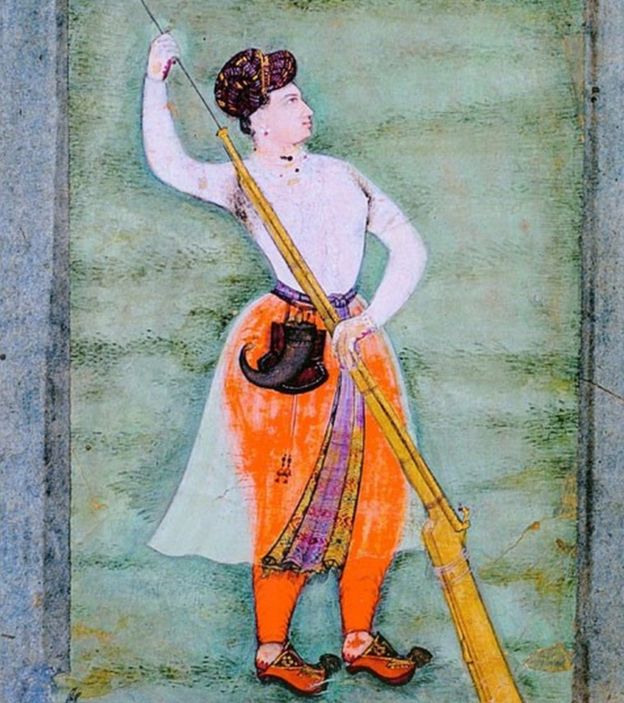
Portrait of Nur Jahan holding a gunImage copyright Courtesy of Rampur Raza Library
Image caption An artist's impression of Nur Jahan holding a gun


Friday, August 31, 2018

Aspen: Literary Prize Winner Mohsin Hamid in conversation with Dan Porterfield

Don't miss the emcee's introduction of Mohsin.

It is a fantastic reminder for all of us of how accomplished he is and how proud as Pakistanis we all should be because of him!

Enjoy the video!

Your 'very proud' Artwallaa


Aspen Words Presents: Literary Prize Winner Mohsin Hamid in conversation with Dan Porterfield

Source: The Aspen Institute


See related article: Another accolade for Mohsin, another accolade for Pakistan!

Monday, August 27, 2018

Pakistan’s unexpectedly rich English literary evolution


The development of English literature in Pakistan evolved its own identity and has become the socio-cultural document of an era of aspirations and austerity for the past seventy years. Authors have a third eye which venerates curiosity, inspiration, imagination, where seeing is a synecdoche and synesthetic gerund. The disbandment of the British throne in the Subcontinent in 1947, and the accompanying mass migration across the new borders between the newly independent states of India and Pakistan, stands out as one of the momentous developments in socio-cultural history.
 
It subsequently categorized issues of class, community formation, ideological fissures and cultural separatism, however with the absence of women and ordinary people playing any role. In the post-1947 inception of Pakistani English literature, authors tried to hold their ground for the leftist and liberal issues of class and people, in a discourse which simply portrayed a pivotal and exclusive role in the literary backdrop for novels of partition horrors. However, these historical accounts never acquired the discipline of art and no literature based on hate and prejudice can be great.