The University of Chicago’s Smart Museum of Art has just unveiled plans for an ambitious multi-site show with work by MacArthur fellow artists including Ndijeka Akunyili Crosby, Mark Bradford, Rick Lowe, Iñigo Manglano-Ovalle, Fazal Sheikh, and Shahzia Sikander.
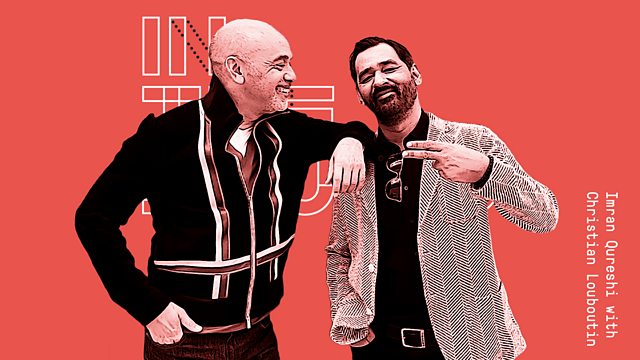
An internationally renowned artist from Lahore in Pakistan, Imran Qureshi is a master of the very delicate and the very brutal: combining tiny brushstrokes inspired by the 16th Century Mughal masters with large-scale installations evoking the carnage left after a bomb attack, his work has the power to shock and intrigue in equal measure.
An unlikely friendship connects him with Christian Louboutin, one of the world’s best-known shoe designers, whose trademark red-soled, beautifully crafted pumps are worn by the likes of Gwyneth Paltrow and Rihanna.
For this programme, Christian meets Imran at Galerie Thaddaeus Ropac, a huge warehouse turned art gallery in Paris. It is the venue of a major solo exhibition, and Christian joins Imran as crates are unpacked and last-minute changes made to individual paintings and the exhibition as a whole, with some new work inspired by the bomb attacks on two mosques in New Zealand in March 2019.
“There is an element of violence in the work,” Imran says, “at the same time, when you get close to it, it becomes poetic as well.”
He has even brought a piece of his studio with him from Lahore, which becomes part of his installation in its own right – and as he and Christian discuss each other’s art, it emerges that these two creative giants have a surprising amount in common.
French Customs official Anne-Sophie Vitoux (L) hands over an artifact to a Pakistani embassy official at the Customs department at Roissy airport outside Paris on June 24, 2019. Photo: Christophe Archambault/AFP/Getty Images.
Almost 500 stolen artifacts, many of which date back to 4,000 BC, were returned to Pakistan this week after being confiscated by French officials more than a decade ago.
The saga stretches back to 2006, when customs agents at Charles de Gaulle Airport in Paris intercepted 17 terra cotta pots en route to a local gallery. Though identified modestly at the time as being more than 100 years old, it turns out the relics were much older than that. Experts dated the pots back to the second or third millennium BC and determined that they had likely been looted from ancient burial sites in Pakistan’s Balochistan province.
An investigation into the gallery in question—which has not been named publicly—turned up 445 objects in total, including ancient vases, busts, and goblets. Collectively, the artifacts are valued at roughly €139,000 ($157,000). French officials noted that the gallery will be slapped with a fine between €100,000 and €200,000 ($112,000 and $226,000) for trafficking in stolen goods.
The objects were returned in an official handover ceremony held yesterday at the Pakistani embassy in Paris.
Ambreen Butt’s mixed-media artwork, “Shoaib (8),” takes its title from the name and age of a young victim of an American drone strike. (Photo by Kevin Todora/Ambreen Butt)
Ambreen Butt makes a striking first impression.
In the Pakistani American artist’s first solo exhibition in Washington, two large images hang on the wall just opposite the entrance to her show, “Mark My Words,” at the National Museum of Women in the Arts. Titled “Pages of Deception,” the diptych appears, from a distance, like facing folios of paper in a calligraphic Islamic manuscript, with traditional filigree borders. On closer inspection, however, these 70.5-by-45-inch “pages” are taken up with overlapping circles of shredded and collaged snippets of paper: the transcript of the 2011 terrorism trial of Egyptian American Tarek Mehanna, who was sentenced to 17 years in prison by a Boston jury. The thousands of indecipherable text fragments — the left side representing the prosecution’s closing argument, with the defense’s statement on the right — seem to swirl almost into meaninglessness, in a powerful commentary on the inscrutability of justice.
All of the exhibition’s 13 works on paper reward such close examination and engagement. The artist builds on her training in classical Indo-Persian miniature painting, incorporating an array of other techniques to explore contemporary political narratives.
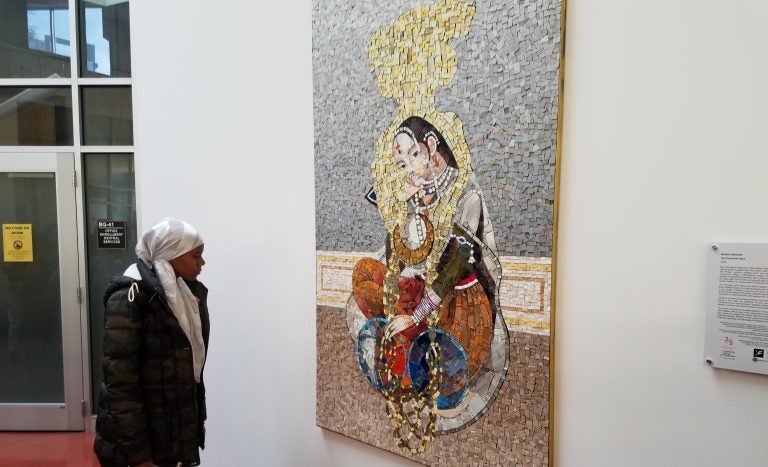
'Eye to I: Self Portraits from 1900 to Today'opened at the National Portrait Gallery, Smithsonian on November 2 and will continue till August 18, 2019, Shahzia is the first Pakistani artist in the
collection of the National Portrait Gallery. Below is a good review of her work 'Portrait of the Artist' which is part of the exhibition.
Keep rocking Shahzia!
Contemporary Visions of Mystical Indo-Persian Miniatures
The night of “Ascension,” one Islam’s most mystical and striking themes, has inspired Sikander, whose
self-portraits are artistic manifestations of this magical journey.
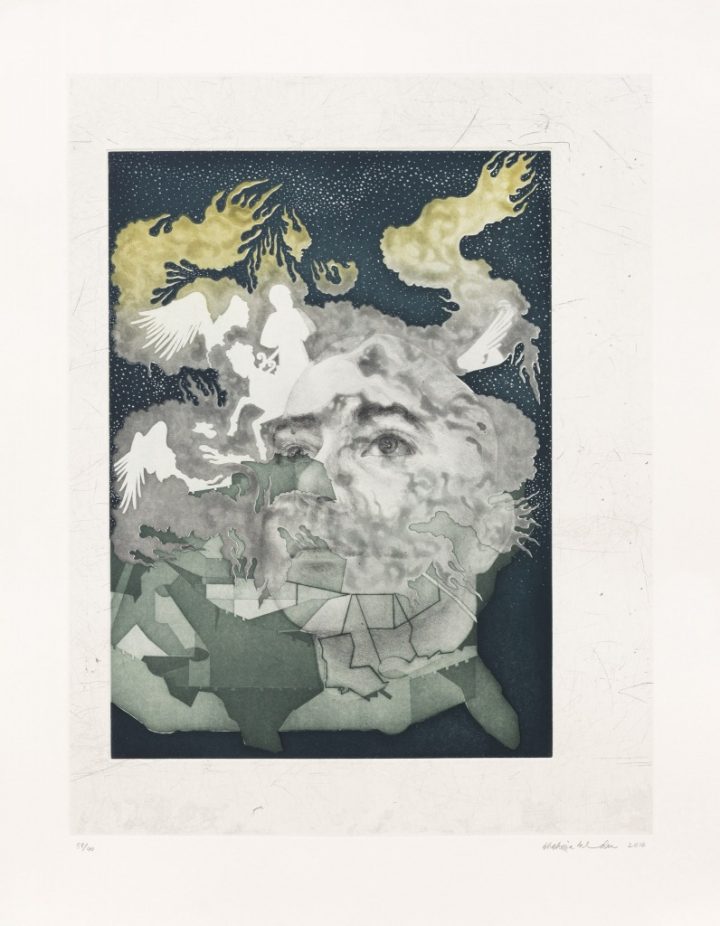
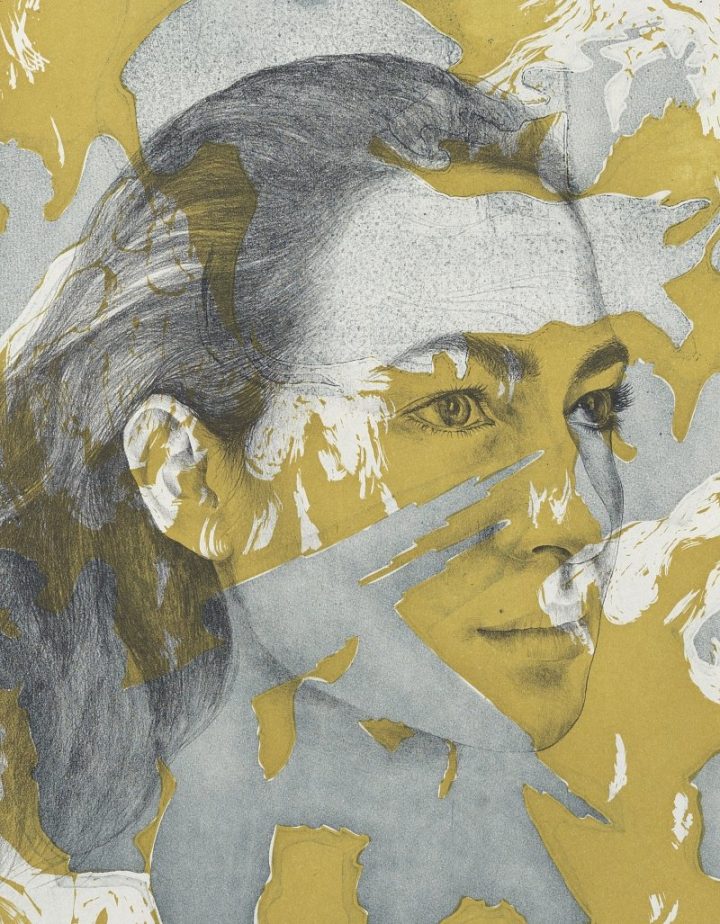
Shahzia Sikander, “Portrait of the Artist” (2016), a suite of four etchings, with accompanying collaborative text with Ayad Akhtar. Paper size: 68.5 x 53 cm; image size: 56 x 43 cm. National Portrait Gallery, Smithsonian Institution: Acquired through Federal support from the Asian Pacific American Initiatives Pool, administered by the Smithsonian Asian Pacific American Center. Published by Pace Editions, Inc.
WASHINGTON, DC — Eye to I: Self Portraits from 1900 to Today at the National Portrait Gallery in Washington explores how American artists have viewed themselves in relation to American history and culture. It also includes a first: Shahzia Sikander is the first Pakistani-born artist to be collected by and exhibit works in the renowned gallery. The artist’s work is displayed alongside over 70 pieces by such American luminaries as Elaine de Kooning, Jacob Lawrence, and Josef Albers.
Spanning nearly three decades, Sikander’s body of multimedia art focuses on Indo-Persian miniatures, a genre that fuses Central Asian and Mughal painting. Since the 16th century, miniature painting in the Indian subcontinent (now Pakistan, India, and Bangladesh) has followed traditional pictorial laws and thematic content. Lyrical tales of romance from epic Hindu texts, darbaars (essentially Mughal emperor courts), holy wars, and flora and fauna dominate the bright, lavish manuscripts. Miniature painting popularized illustrations of the Mairaj (Arabic for ladder) from the life of the Muslim prophet Muhammad, where the creature Buraaq takes the Prophet above the skies and beyond the heavens. Muhammad is said to have met angels and past prophets. The night of “Ascension” is one Islam’s most mystical and striking themes. It has enthralled and inspired Sikander, whose self-portraits are artistic manifestations of this magical journey.
Shahzia Sikander, “Portrait of the Artist” (2016), a suite of four etchings, with accompanying collaborative text with Ayad Akhtar. Paper size: 68.5 x 53 cm; image size: 56 x 43 cm. National Portrait Gallery, Smithsonian Institution: Acquired through Federal support from the Asian Pacific American Initiatives Pool, administered by the Smithsonian Asian Pacific American Center. Published by Pace Editions, Inc.
Why are people motivated to collect objects? These could be shells or stones as a child or art and books as an adult. What motivates and energises them to take on this task? Amna Naqvi, the founder of AAN Collection and AAN Foundation talks about her journey of collecting art and speaks of not only collecting objects of art but art experiences as well. Amna Naqvi is the founder of AAN Foundation and AAN Collection. She is an avid art collector, philanthropist, publisher, supporter and collaborator of art projects and initiatives. These projects have led to the development of the contemporary Pakistani art space both locally as well as globally over the last fifteen years. The AAN Collection comprises of over 800 works of art ranging from 3rd Century Gandhara sculptures, 17th Century Mughal miniatures and contemporary art. Works from the collection have been part of major exhibitions at institutions such as The Metropolitan Museum of Art, in New York, The Venice Biennial and The Guggenheim Museum Bilbao. The collection is complimented by the AAN Foundation which supports art exhibitions and projects in Asia as well as globally.
This talk was given at a TEDx event using the TED conference format but independently organized by a local community. Learn more at https://www.ted.com/tedx
Imran Qureshi is amongst the three artists (Moataz Nasr, Ammar Al Attar, and Imran Qureshi) who have been commissioned to make work in historic locations in Al Ain for the 10th anniversary events of Abu Dhabi Art.
Also, Hammad Nasar will be curating a special exhibition, as part of the anniversary events, looking at artists’ responses to the built environment, including Abdullah al Saadi, Marysia Lewandowska, Rachel Whiteread and Lantian Xie.
November 14 - 17 in Al-Ain !
Abu Dhabi Art announces public line-up for its 10th anniversary event
We look at the four-day art event which celebrates its tenth anniversary this year
The four-day fair features displays and talks. Courtesy Abu Dhabi Art
The public and curatorial programming has been announced for the art fair Abu Dhabi Art, which turns ten this year. Set up by the Department of Culture and Tourism – Abu Dhabi (DCT Abu Dhabi), the fair has expanded to include more public programming for non-art buyers.
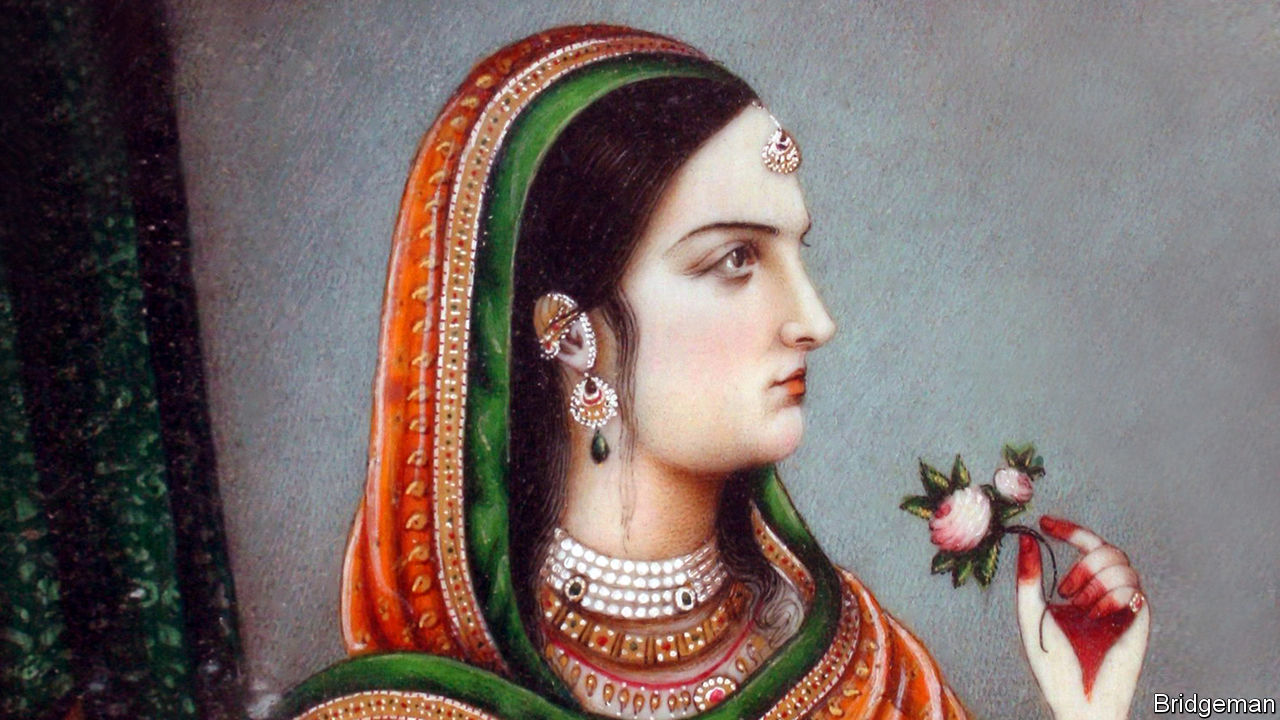
Nur Jahan - the many facets of Nur Jahan's personality - Empress, poet, an expert hunter, an innovative architect, and also led an army when her husband was made captive.
"She was born only a few decades after Queen Elizabeth I, yet she ruled a territory far more diverse than that of her British counterpart."
Nur Jahan ruled a bigger empire than Queen Elizabeth and had a much stronger impact on arts, culture and architecture.
Image copyrightPenguin - Nur Jahan was the only female ruler in the Mughal dynasty
Empress Nur Jahan was the most powerful woman in 17th Century India. She played an unprecedented role in running the vast Mughal empire. Historian Ruby Lal explains why the history of her leadership is important to understand today.
She was named Mihr un-Nisa at birth and was later named Nur Jahan (light of the world) by her husband, the Mughal emperor, Jahangir. She was born only a few decades after Queen Elizabeth I, yet she ruled a territory far more diverse than that of her British counterpart.
The Mughals ruled much of the Indian subcontinent for more than 300 years after they came to power early in the 16th century. It was one of India's biggest and most powerful dynasties. Many of its emperors and royal women, including Nur Jahan, were patrons of art, music and architecture - they built grand cities and majestic forts, mosques and tombs.
And as the dynasty's only woman ruler, Nur Jahan is omnipresent in the folklore of India, Pakistan and Bangladesh.
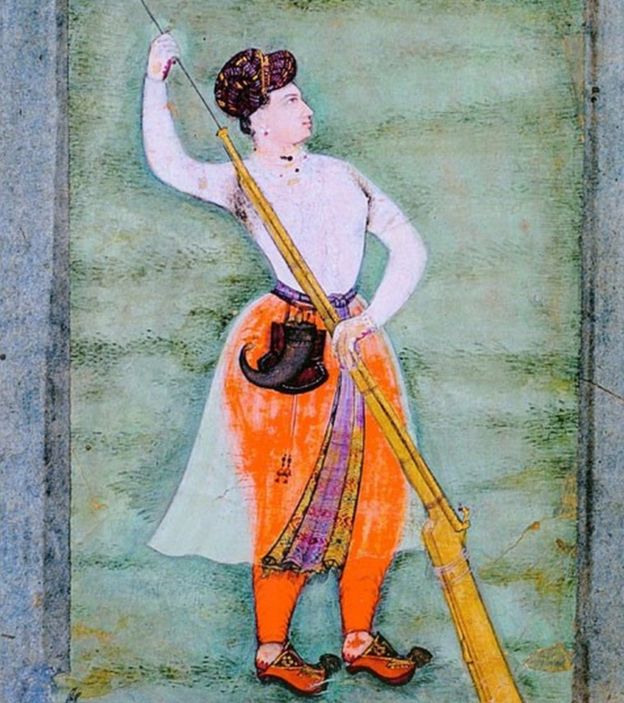
Stories about her abound in the homes, and near monuments, in Agra in northern Indian and Lahore in northern Pakistan - two major cities in the Mughal era, especially during her reign. Older men and women, tour guides and history aficionados tell stories of how Nur and Jahangir met and fell in love; of how she saved a village tormented by a man-eating tiger - she shot it deadwith a musket from her perch on top of an elephant.
Though people have heard stories about her romance and, infrequently, of her bravery, little is known about her dynamic world, political acumen and powerful ambitions. She was a fascinating woman who came to rule an empire against extraordinary odds.
She was a poet, an expert hunter and an innovative architect. Her design for her parents' tomb in Agra later inspired the construction of the Taj Mahal.
A remarkable leader in a male-dominated world, Nur didn't come from royalty. Yet she ascended from the emperor's harem to great heights as an astute politician and the favourite wife of Jahangir, ruling the vast Mughal empire as a co-sovereign. Image copyrightCourtesy of Rampur Raza LibraryImage caption An artist's impression of Nur Jahan holding a gun
The development of English literature in Pakistan evolved its own identity and has become the socio-cultural document of an era of aspirations and austerity for the past seventy years. Authors have a third eye which venerates curiosity, inspiration, imagination, where seeing is a synecdoche and synesthetic gerund. The disbandment of the British throne in the Subcontinent in 1947, and the accompanying mass migration across the new borders between the newly independent states of India and Pakistan, stands out as one of the momentous developments in socio-cultural history.
It subsequently categorized issues of class, community formation, ideological fissures and cultural separatism, however with the absence of women and ordinary people playing any role. In the post-1947 inception of Pakistani English literature, authors tried to hold their ground for the leftist and liberal issues of class and people, in a discourse which simply portrayed a pivotal and exclusive role in the literary backdrop for novels of partition horrors. However, these historical accounts never acquired the discipline of art and no literature based on hate and prejudice can be great.
For Artwallaa, Parallax is one of the most powerful works of art coming out of Pakistan in the recent past. It is being shown in Delhi at the Kiran Nadir Art Museum.
Go experience it!
Source: Honolulu Museum
Shahzia Sikander
"Pakistani-American contemporary artist Shahzia Sikander’s Parallax is an experience in itself. Originally created for the 2013 Sharjah Biennale, and borne out of her road trip through UAE, this large video installation consists of hundreds of watercolor, gouache and ink paintings, with traditional Indo-Persian miniatures, all interwoven with drawing and animation into a three-channel immersive artwork. The haunting music score is specially done by Chinese composer Du Yun who mixes new poetic compositions in classical and colloquial Arabic by three contemporary Sharjah poets. The result is a tense, eerie slow-burn sound art which features many ant-like creatures on video. The power tensions surrounding the Strait of Hormuz, the world's most important transit chokepoint for crude oil exports in the Middle East, is the more immediate inspiration behind the breathtaking Parallax".
A scene from Nalini Malani's 1973 Taboo, at Kiran Nadar Museum of Art
When you enter Kiran Nadar Museum of Art's latest exhibition, Delirium/Equilibrium, on video, film and kinetic artworks from the museum’s collection, prepare to be besieged by a sense of uncertainty and displacement. Bukowski's book title Tales of Ordinary Madness might flash through your mind's eye—not because the show recreates wild and weird stories from a city's dark underbelly, but because it feels like an apt description to simplify a group of bewildering works which play on light, sound, shadow, noise and speech/moving objects, images and gibberish. The result is a strange, funny, complex techno-dystopic maze stretching into the inner reaches of a dark and semi-dark gallery. The experience can only be equated to wandering lost and confused in a cavernous hideout, but persisting all the same for the many fascinating finds its many nooks and crevices hold.
As curator Roobina Karode explains in her note, "The world today is disenchanting and distraught, yet alluring and demanding, desiring poise and equilibrium." The show wants to respond to our collective drive towards "mechanisation, technology and and scientific knowledge", and the need to construct new architectonic forms in a “rewiring of the world”. But could this assemblage of disconcerting animation works, mechanised objects, echoing speeches of leaders and quiet, determined acts of resistance as performance, also speak to the dizzying political and social climate of absurd priorities and cacophonous disinformation? Or is this the future trajectory of art, when new media will more prominently collaborate, intervene and upstage in an age of post-human development? With another mainstream gallery (Nature Morte) in Delhi already hosting a show on art and artificial intelligence, this merits some contemplation.
Works of five artists will be representing Pakistan in the 9th Asia Pacific Triennial in Brisbane (Australia) starting from 24 November. In total, works of 80 artists from 30 countries across Asia Pacific will be shown. Pakistan is represented by Naiza Khan, Aisha Khalid, Waqas Khan, Ali Kazim and Rasheed Araeen.
Looking forward to its opening
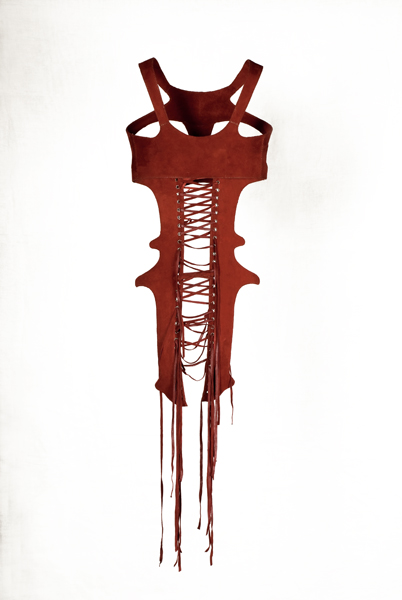
Spine, 2008, Galvanized steel and suede leather, H. 26 x W. 12 5/8 x D. 6 3/8 in. (66 x 32 x 16 cm) Source: Asia Society
The 9th Asia Pacific Triennial of Contemporary Art (APT9)
24 Nov 2018 – 28 Apr 2019 QAGOMA
Stretching from Iraq to Hawai'i, 'The 9th Asia Pacific Triennial of Contemporary Art' (APT9) will bring new and significant art from across the region to Brisbane. QAGOMA's flagship contemporary art series draws visitors with its unique mix of visual spectacle and cross-cultural insight.
Highlights will be a substantial number of newly commissioned works, as well as works by emerging, mid-career and senior artists and influential works that continue to shape contemporary art in the region. The exhibition will feature over 80 artists and groups whose work is notable for making an impact in contemporary art in its local context, including a large representation of Australian artists. Their works will reveal a number of preoccupations, such as the use of innovative approaches to indigenous traditions and modern thought, the re-imagining of histories or poetic narratives and the ability to show our universal yet diverse relations to nature and culture.
APT9 Kids will include interactive artworks, hands-on making, and multimedia activities developed in collaboration with exhibiting artists, especially for children and families. APT9 Kids on Tour will provide children and families throughout Queensland with the opportunity to enjoy a selection of adapted projects at their local venue.
APT9 will also include a symposium and extensive public programs, as well as an APT9 Cinema program.
The artists participating in the ninth Asia Pacific Triennial are: Jananne al-Ani Zico Albaiquni Sadik Kwaish Alfraji Monira Al Qadiri Rasheed Araeen Martha Atienza Kushana Bush Cao Fei Gary Carsley Roberto Chabet Chen Zhe Kawayan De Guia Enkhbold Togmidshiirev Erub/Lifou Project Nona Garcia Simon Gende Lola Greeno Gunantuna (Tolai people), led by Gideon Kakabin Shilpa Gupta Tada Hengsapkul Gavin Hipkins Joyce Ho Hou I-Ting Htein Lin Images of the Crisis Zahra Imani Mao Ishikawa Jaki-Ed Project Jeong Geumhyung Kathy Jetñil-Kijiner Jonathan Jones Karrabing Film Collective Ali Kazim Aisha Khalid Naiza Khan Waqas Khan Kim Beom Meiro Koizumi Kapulani Landgraf Idas Losin Ly Hoàng Ly Gregory Dausi Moah Mochu Yuko Mohri Vincent Namatjira Nguyễn Trinh Thi Anne Noble Aditya Novali Elia Nurvista Shinro Ohtake Donna Ong and Robert Zhao Renhui Alair Pambegan Pangrok Sulap Bona Park Bounpaul Phothyzan Souliya Phoumivong Qiu Zhijie Iman Raad Margaret Rarru and Helen Ganalmirriwuy Lisa Reihana Peter Robinson Handiwirman Saputra Mithu Sen Hassan Sharif Tcheu Siong Jakkai Siributr Soe Yu Nwe Herman Somuk Harit Srikhao Ayesha Sultana Latai Taumoepeau Tungaru: The Kiribati Project, led by Chris Charteris James Tylor Vuth Lyno Munem Wasif Boedi Widjaja Areta Wilkinson Women’s Wealth Sawangwongse Yawnghwe Pannaphan Yodmanee Young-Hae Chang Heavy Industries
The brilliant career of Nur Jahan, empress of India
Chauvinism has reduced her to caricature. Ruby Lal’s biography brings her back to life
Empress: The Astonishing Reign of Nur Jahan. By Ruby Lal. W.W. Norton & Company; 336 pages; $27.95 and £19.99.
THAT India’s Mughal emperors could be devoted to their queens is no surprise. The Taj Mahal, their most famous monument, was a homage to the memory of Mumtaz Mahal, the emperor Shah Jahan’s most-mourned wife. Less well-known is that Mumtaz’s aunt (and Shah Jahan’s stepmother), Nur Jahan, was, for 16 years from 1611, in effect India’s co-ruler.
In fact, according to Ruby Lal’s biography, she became “prime minister as well as empress”. Uniquely for a Mughal woman, her name featured on coins. Not until Indira Gandhi became prime minister in 1966 would India again be ruled by a woman. (Queen Victoria was rather hands-off.)
Not that Nur Jahan has been forgotten. Hers is a household name in South Asia, and her story has been told in at least eight films, several plays and many historical romances. But she is famous for having won the heart of her husband, the emperor Jahangir, with her beauty, and for using her charm to promote her own interests and her allies’. She came to be seen, in Ms Lal’s words, as “a gold-digger and schemer”, the “besotted” Jahangir as a “drunk, stoned and oversexed despot”.
New York, NY, April 10, 2018 ––Tonight, Mohsin Hamid was awarded the inaugural $35,000 Aspen Words Literary Prize (AWLP) for his novel “Exit West.” The award, which is one of the largest literary prizes in the United States, was established by the Aspen Institute to honor a work of fiction “that illuminates a vital contemporary issue and demonstrates the transformative power of literature on thought and culture.”
“The book is my attempt to write against this growing anti-migrant sentiment,” said Hamid. “I wanted to portray migrants as heroes, not criminals. But more than that, I wanted to show that everyone is a migrant, even those who never move geographically, because moving through time, aging, is itself a form of migration.”
“Mohsin Hamid’s sentences are exquisite, capable of jaw-dropping surprise, elegant emotional exploration, and bone-chilling horror within a few clauses,” said the AWLP jury. “And by bringing the contemporary refugee crisis into countries that have mostly ignored the suffering beyond their borders, he forces us to ask ourselves how we are reacting to the crisis, and what potential we have to do better. In a world with 50 million displaced people, this is a novel that affects us all.”