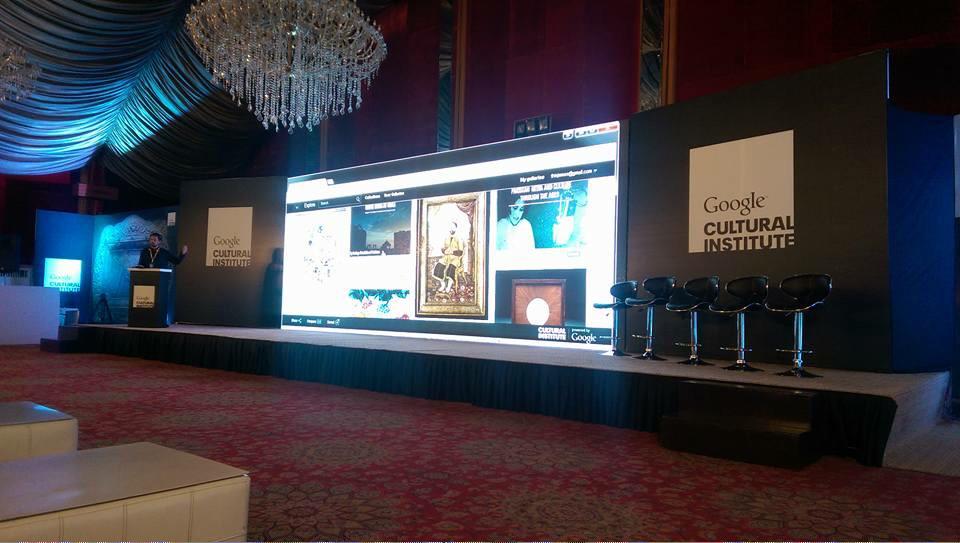
The launch of the Google Cultural Institute's Pakistan chapter is indeed another step in bringing Pakistani arts into the global main stream.
The launch had a good representation of all types of cultural variables including architecture, old civilisations, works of masters as well as contemporary art.
The six exhibitions can be viewed at g.co/pakistanculture.
“Pakistan is brimming with a rich historical and cultural heritage, with stories and artifacts that we are keen to preserve for future generations,” Google Asia Pacific Public Policy and Government Affairs Director Ann Lavin said on Thursday at a ceremony to unveil six online exhibits from Pakistan that have been added to the Google Cultural Institute platform.
The collections at the Lahore Museum, the Mohatta Palace Museum, the Walled City of Lahore Authority, the Heritage Foundation of Pakistan, the Fakir Khana Museum and the AAN Collection have been uploaded online to g.co/pakistanculture. The exhibit features more than 400 items and 12 special exhibits, including the rare Fasting Siddartha sculpture dated to 200 BCE and re-discovered in a 19th century excavation.
Inspiration from Shahzia Sikander for the 2015 BFA Fine Arts Graduates
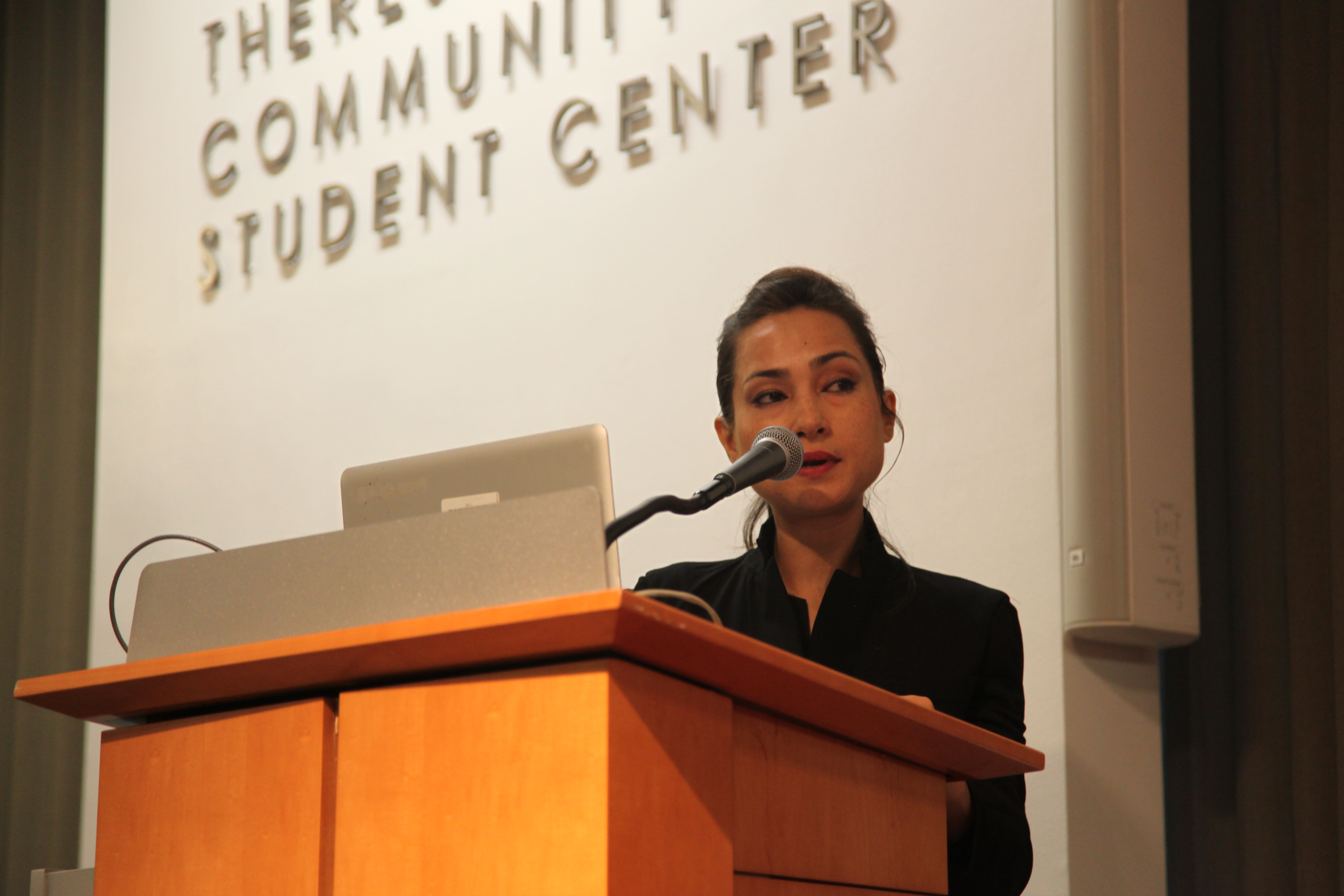
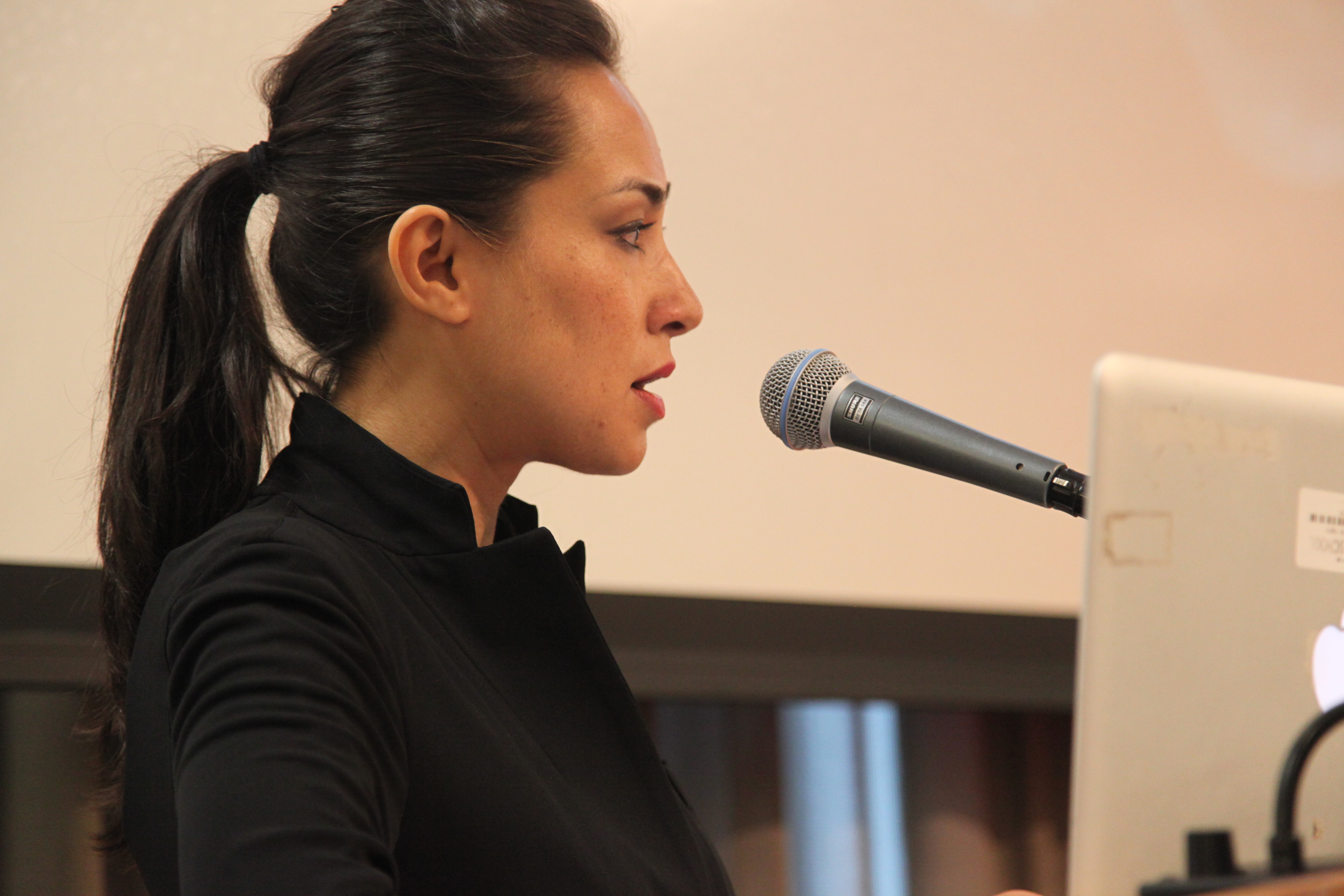
We were thrilled to have internationally renowned artist Shahzia Sikander with us to celebrate our class of 2015 BFA Fine Arts Commencement. Please take inspiration from her words and work below.
Commencement Speech by Shahzia Sikander – The New School, Parsons BFA Fine Arts, 2015
Dear Creative Class of 2015,
I am thrilled to be here to witness this exciting and pivotal time in your lives. I am also equally humbled to give you some words of inspiration from my own lived experience as an artist.
For me art is not just an impulse to make aesthetically pleasing objects. It has been an instinct to think and imagine the future. Ideas are a powerful entity and creativity is essential to all of us in harnessing our thoughts, impulses, desires, and dispositions into expression.
I know all of you are hungry to venture out and explore the world and find your place in the communities that you will gravitate towards and engage with. I encourage you to take lead and plunge into what your heart desires. Take risks. Be open to learning, to engaging, to analyzing and to change. Embrace your potential and create solid and healthy bridges around you with others of your ilk and of those who you may not yet fully understand. It is when you explore and push your own boundaries you discover the potential within and around you. Don’t be afraid to speak your mind, but be cognizant of your heart.
An artist often has the burden to re-‐imagine. In re-‐imagining lies the ability to break molds and re-‐examine the norms. Contemporaneity is about remaining relevant by challenging the status quo not about holding on to positions of power. It is this spirit that should guide you. It is this spirit that still guides me and remains the fundamental reason for my interest in continuing to explore and experiment.
In 1991, just like you, I too was looking outward to the world as a young person feeling very lucky to have ventured into the Arts. The National College of Arts in Lahore Pakistan was my beacon, nurturing curiosity and intellectual debate and a commitment to the creative process. It was within this environment that I had chosen to engage with Indian and Persian miniature painting during a time when it was not popular. What others then saw an as enslavement to craft and technique, I saw as a path to opening possibilities for dialogue. It was exciting to examine, imagine and explore the many possibilities of miniature painting whose future as a contemporary mode of expression had not yet been laid. My instinct to engage with miniature painting was so strong as a young creative person of 18 years of age that I embraced it with full force and did not let go whenever I was challenged. And believe me, I was challenged many times and I felt alone and I felt upset and not understood yet I persevered and kept at it, slowly, steadily, methodically at my own pace and belief. Fast forward 25 years, and contemporary miniature painting is now considered a valid visual global language in its own right and an important vehicle of contemporary expression.
The path I took was neither easy nor predictable but it was passionate, exciting and utterly adventurous. Of course I had many hurdles from putting my parents anxieties to rest and finding ways to pay for my tuition to figuring out my unique identity within the cultural space to learning how to master a language to then eventually challenge its limitations and expand its potential. And I wanted to do all of it all at once. Such was my drive and hunger. Art for me translated as the ultimate ticket to life.
Being an artist requires courage. It requires sensitivity, intuition, clarity, and an open-‐ness to risk and failure as well as a tenacious drive. Often gratification and results are not immediate and believe me patience comes in very handy.
Over the years I have worked in a variety of mediums and formats, including small detailed paintings, murals, animation, installation, video and many collaboration with other artists. I became interested in cultural and political boundaries for opening up new frameworks for dialogue and visual narrative as an outcome of participating in the complexities around me, complexities of identity, histories and ownership. It is often in these sites of engagement that meaning is in constant flux. In our current complex global socio-‐geo-‐political realities it is essential that we all contribute and create an open and responsible dialogue and not shy away from questioning that rhetoric which aims to confuse and misguide. Be aware and open to the departures and shifts that will happen as you progress and grow. These ruptures will be varied in both technique and form and in terms of your understanding of the world around you. Consume knowledge. Absorb it. Digest it. And then when you regurgitate, own it and make it speak your own brand of language. Language of truth and of sincerity. Be strong and believe in your ability to make a difference. And don’t waste time. Time is one of the most invaluable elements around you. Be mindful of how you use your time as it goes fast. Take leap and don’t look back! Imagine the impossible. In imagination lies your new republic. Dream it and serve it.
I wish each and every one of you the most exciting and meaningful journeys ahead.
And a very happy Commencement Day!
Echo, 2010 25 x 55 feet Acrylic, ink on paper and wall Installation at Museum of Contemporary Art, Tokyo
“Shahzia Sikander Selects” 2009 Cooper Hewitt National Design Museum, New York
Reinventing the Dislocation, 1989-‐97 Transparent and opaque watercolor, tea on wasli paper 13 x 9 5/16 inches Permanent Collection:Whitney Museum of American Art, New York
The World is Yours, The World is Mine, 2014 Ink and gouache on prepared paper Created for The New York Times Turning Points magazine and Opinion Page, December, 04 2014
Parallax, Traveling Exhibition 2013-‐2015 Opening at Guggenheim Museum, Bilbao, Spain July 17, 2015 And Tufts University Museum, Boston Sept. 15, 2015 Above: Installation at SPACE: The Linda Pace Foundation, 2014-‐2015 Collection of Linda Pace Foundation, San Antonio, Texas
Unseen, 2011-‐2012 Outdoor Projection at Doris Duke’s ShangriLa, Honolulu, Hawaii
Images: ShahziaSikanderStudio
Shahzia Sikander (b. in Lahore, Pakistan; lives and works in New York) is an international artist whose pioneering practice takes Indo-Persian miniature painting—a traditional style that is both highly stylized and disciplined—as a point of departure. Sikander received her BFA in 1991 from the National College of Arts, Lahore, Pakistan, and an MFA from the Rhode Island School of Design in 1995. She challenges the strict formal tropes of miniature painting, as well as its medium-based restrictions, by experimenting with scale and media including animation, video, performance, and large scale murals and installations. Sikander’s innovative expansion on this traditional genre helped launch a major resurgence of work with miniature painting beginning in the 1990s at her alma mater in Lahore, which spread and brought international recognition to this medium within contemporary art practices. Her process-based work is concerned with examining the forces at stake in contested cultural and political histories and the artist’s deft negotiation between traditional representations from Hindu mythology and western modernism creates a nuanced commentary that transcends cultural borders.
Sikander has been the recipient of solo exhibitions at the Nikolaj Kunsthal, Copenhagen; Whitney Museum of American Art, New York; Museum of Contemporary Art, Sydney; Cooper Hewitt Design Museum, New York; Irish Museum of Modern Art, Dublin and the Hirshhorn Museum and Sculpture Garden, Washington, D.C., among others. She has participated in notable group exhibitions including the Fukuoka Asian Art Triennale, the Istanbul Biennial, the Sharjah Biennial, and the Venice Biennale. The artist has received many awards and honors for her work, including the honorary artist award from the Pakistan Ministry of Culture and National Council of Arts. She is also a recipient of the U.S. Department of State’s inaugural Medal of Arts Award and a John D. and Catherine T. MacArthur Foundation “genius award.”
Known for her work in miniature painting mixing ages-old technique with contemporary statements—she studied the traditional art of Indo-Persian miniature painting at the National College of Arts in her native Lahore, Pakistan—Sikander’s work has expanded to include huge painting installations and animated video installations. In 2008, she was an artist in residence at Shangri La, where she created the projection installation Unseen, slides of which take up an entire wall in the exhibition Doris Duke’s Shangri La: Architecture, Landscape, and Islamic Art, now on view through June 7.
Shahzia Sikander’s ‘Unseen,’ projected at Shangri La in 2008.
Due to the nature of your project—projections on Shangri La’s foliage and architecture—Unseen, more than any other Shangri La residency project, engages with the estate. What informed your decision to interact with the site through projection? I found Hawai‘i’s landscape intense! You turn a corner, and it’s tropical, you drive up a mountain, and it’s craters! The terrain changes so much in a short amount of time. I found it incredibly intriguing. The gardens at Shangri La are such an integrated part of the site’s identity; some aspects of the landscape connected to the larger engagement with the Mughal architecture aesthetic and the influence of Isfahan architecture. The interior-exterior interplay is heightened also by the close proximity of the ocean, which at nighttime was physically (sound) and psychologically intense.
The medium of projection was a great solution for me to respond to the various objects and aspects of the house via drawings first. Then I scanned the drawings and used them as digital data to recast a layer back onto the site itself. Like a light tattoo onto the site.
Projection is sculptural but also ephemeral. When Unseen was exhibited at night, there was a different audience: I saw people fishing at night, I saw several people at night on the Shangri La water interface. Shangri La is perched on a hill. So that also influenced my decision. I thought neighbours would be able to see the projections on the trees from afar. Also there was a noise restriction at night, so it was a way for me to exhibit noiseless work. I am a night person so found myself awake and walking around the site as soon as I arrived there. The environment at night was magical.
You say in your label for Unseen that Shangri La is “engaging yet full of contradiction”—can you elaborate on that contradiction, and did it make it hard for you to get started working, or did it fuel your creativity? Also, would you say contemporary Islamic art is “a thing” today? And if you do see it as a genre (as opposed to seeing it as simply great contemporary artists who happen to be of Islamic heritage), where is it headed? The quest to define an Islamic identity in the contemporary visual context may be a paradox in itself. Muslim communities have varied histories and geographical locations that challenge singular definitions. Furthermore, in today’s transnational ways of living and being, the older frameworks feel increasingly restrictive. Inherently nationalistic sentiments remain strong even in art history. Though it has been labored upon and often reduced to a cliché, its potential remains strong, since fundamental values of inclusiveness and plurality lie at its core.
The range of mediums and aesthetics residing within Shangri La are varied. Observing objects incorporated and placed around the house and living quarters and learning about Doris Duke’s engagement as a wealthy American patron and collector and tastemaker was also a case study to unpack Orientalist tendencies of that period.
I imagine that for someone exploring colonialism in South Asia, Shangri La, for all its beauty, could be unsettling. Your fellow Shangri La artist in residence Ayad Alkadhi said he is OK with the Islamic art treasures being at Shangri La due to the fact that they are being preserved, rather than at risk of being destroyed by war in regions such as Syria and Iraq. How do you feel about this? I don’t consider such a discussion about this collection as being any different from other major institutions or individuals collecting art at the time from the region. Doris Duke’s records on provenance on all the objects seemed thorough: they include information on when she was buying, and whom she was buying from. It was at the same time as other institutions such as the Met were building collections also. Often everyone was buying from the same sources! That story of the provenance is so interesting. So much has been destroyed in the name of war—it’s not an “East/West” thing. War has a very long and complicated history. When it’s separated as having a single perpetrator for the destruction of objects, I find that problematic. Afghanistan has been looted in recent years. So I think we have to look at the complexity of how objects are acquired throughout history, it’s not just about current “Middle East” politics.
The Unseen projections are “abstract, representational, and textual forms”—were they created on paper and you photographed them? What are the representational images? They were created on paper, scanned at high resolution, and then I projected them directly into space with a projector. I’m sitting in one of them as a representation of the artist signature. It gives a reference to scale and I end up participating in the piece. It’s not clearly visible, but I’m sitting there in on the ground in the corner, partly hidden between the various forms and colors.
Does the included Urdu calligraphy say something, or is it purely a visual element, as in the work of Ayad and Lalla Essaydi? It says “I am also not my own enemy.” The verse is about unrequited love, and it’s from Ghalib’s poem. I thought the text fit well with Doris Duke’s story. I spent time talking to people who either grew up hearing about her or their parent may have worked for her. The oral stories about her are fascinating. I also watched some of the home movies she made with her friends. So there was this intimate insight into this mythic character that was further enhanced by staying in her guest house! She’s often portrayed as a victim of extreme wealth! I used the phrase to elicit the multiple meanings in it also.
We are delighted to announce that Aisha Khalid's work 'YOUR WAY BEGINS ON THE OTHER SIDE' 2014 is now the part of permanent collection of Aga Khan Museum Toronto. This is one of the very first contemporary art work acquired as part of their museum collection.
Short film about Aisha Khalid's work 'Your Way Begins On The Other side' 2014
Inspired by Sufi songs and scripture, Waqas Khan toils through the night making vast hypnotic pictures out of tiny dots – and his work is now being snapped up around the world. Jonathan Jones goes drinking with art’s hottest new star
Detail from The Text in Continuum, 2015. Photograph: Waqas Khan/Galerie Krinzinger, Wien
Waqas Khan is talking to me in paradise. Or at least, his art makes me feel as if I’ve been transported there. The artist’s delirious drawings are all around us in Vienna’s Galerie Krinzinger: spirals, waves and circles that shimmer delicately in pink, black and white ink. Some are vast. One resembles a gigantic book. Yet when you walk close up to them, each turns out to be composed of thousands of tiny, extremely precise dots.
They make you feel differently about yourself and the world. Fifteen minutes after arriving at his latest exhibition, I felt cleansed and relaxed – like I’d been in a hammam. And after a couple of hours, I had the same feeling I got when I first walked through the light-as-air tiled wonderlands of the great Islamic buildings of Andalusia.
Khan, 31, is breaking down the barrier between traditional Islamic art and the contemporary art world. His prices are soaring as he shows all over the world, from this cutting edge Austrian gallery to the Frieze art fair, while big institutions – including the British Museum and the V&A – are snapping him up (“while we can still afford you”, one BM curator told him). Yet the really important, urgent thing about this extraordinary young Pakistani artist is his message of peace. The calm emanating from his art is not just an aesthetic effect – it speaks of a spiritual vision rooted in the Sufi side of Islam.
Around the edges, as i see it, 2015, by Waqas Khan.Photograph: courtesy the artist/Galerie Krinzinger
“I deal with the script of the Sufi,” says Khan, as he smokes. “It’s a side of Islam that is peaceful, happy. For me, Sufism is like meditation, that kind of calm.” He first encountered its ideas as a child, having grown up in a village where stories of Sufi mystics are remembered in folklore. “People would come and sit in the communal space and sing about the Sufis,” he says. “I was the kid holding the cups of tea. They would just talk about the good things for everybody in this world – love, peace and kindness. Sufi for me is behaviour, how you are with others.”
So how can you express love in art? One way is to make it with love. Art created by a devoted hand projects its kindness into the space around it and the hearts of those who view it. This, anyway, is what I feel among the works of Khan. Yet he wasn’t born or brought up a mystic and his family definitely did not expect him to pursue an artistic career. “In the village I come from, there are two professions: doctor or engineer. My family wanted me to be a doctor.”
Khan’s father is a businessman, his mother a maths teacher. He always drew as a kid, but when he got it into his head to apply to the National College of Arts in Lahore (whose first principal, he says, was Rudyard Kipling’s father), his family’s worst fears – of a child throwing it all away for art – seemed to be confirmed, especially since it took him three attempts to get accepted. Once in, he says, he was not exactly studious: “I was the one who was always at parties.” Waqas Khan: ‘This work changed me. It pushed me into kindness.’Photograph: Linda Nylind for the GuardianOne of the key influences on his style, which has matured quickly since his graduation in 2008, was the college’s course in miniature painting. The Mughal dynasty, one of whose imperial cities was Lahore, sponsored a superb style of precise and richly coloured figurative art on a small scale in the 17th century. At college, Khan was able to learn its delicate techniques. Even the paper he uses is traditional, thick archival paper like that used for miniatures in the age of Akbar the Great – though Khan’s pens are modern Rotrings. In fact, he’s actually getting a bit bored of being compared to Islamic scribes as if he were a character in My Name is Red, Orhan Pamuk’s novel about Ottoman artists. “It’s a cliche,” he says.
When his work was shown at the V&A in 2013, a magnifying glass was supplied so that people could look, in mind-boggling detail, at the high-definition ink dots with not a single mistake or blot. In reality, though, the all-over shimmer of his art is just as important as its microscopic detail, and he has much in common with western minimalists such as the painter Agnes Martin.
Certainly, when he describes himself at work, it is hard not to think of a secluded scribe. His studio in Lahore is tranquil. He works through the night, by battery-powered light because of the unreliability of Pakistan’s electricity. His desk is a specially adjustable drawing table that he designed and made himself. He bends over the paper using both hands for perfect ink-dot accuracy. “In a miniature painting, you can change a mistake,” he says. “I don’t have that option.” And he works like that for hours, nights, weeks. “My whole body’s hurting but making this art is so lovely. It’s like writing: a dot for me is a word. I can tell by every dot what my mood was. This work literally changed me. It pushed me into some sort of kindness.”
Waqas Khan’s The text in continuum, 2015, on show in Vienna.Photograph: courtesy the artist/Galerie Krinzinger, Wien
The most powerful of all the hypnotic drawings in Vienna is a diptych of two tall sheets resting against each other at an angle, like the pages of a gigantic book. The organic flesh-like pink waves that rise and fall across their surfaces, composed of innumerable dots, give off a powerful feeling of antiquity. This is a book whose words are in a lost language, yet somehow they are clear. The ancient wisdom cannot be read but it can be felt. In a world of terror, fear and violence, this is the book of peace – a vision of harmony and happiness rooted in Islamic art and Sufi scriptures. “One of my teachers used to say, ‘If you get something good from any religion, just take it.’ It’s not about Islam or Sufi – it’s about everybody.”
At 2 am, we’re in a Viennese bar and I don’t know if I am drunk on the cocktails, the Sufism, or the art. There aren’t many young artists around whose vision is as clear as Khan’s. There are even fewer with something of such importance to say. At the restaurant, he noticed the napkin-holders made nice bracelets and, as we were leaving, asked if he could keep one. They happily agreed. There’s just something about this artist that makes you want to say yes.
Sharing a blog here on NCA's MA Degree show. Sharing it not because Artwallaa is necessarily blown away by the artwork or the article itself but rather because it is written be a new contributor who was moved enough to share his thoughts, and that too at an international publication. The more we create written content on Pakistan, the more we introduce Pakistani art to the world.
Kudos to AB Hussain and all new entrants who are trying to add to Pakistani art (AB, thanks for reaching out too).
Let’s just start by establishing a fact, that I’m not an artist, nor a critic.
I might write some average lines sometimes, but I know nothing about visual arts and my knowledge about contemporary art circle in my locality is almost nothing. So whatever I’m stating here is just based upon what I could see and sense with my low artistic-self. Everything coming up in the lines below is just a spectator’s view, not a maestro’s opinion!
I am just a random guy, who had a chance to visit MA Visual Arts degree show at Zahoor-al-Ikhlaq Gallery, National College of Arts, Lahore, Pakistan, a while ago (Dec 2014). Then I had to visit it again and again! There were things which provoked my interest and actually inspired me to write some of my own “average lines.” I wanted to write about the show immediately, but two concerns held me back;
A show of the most prestigious visual arts’ degree in Pakistan, curated by “The”Quddus Mirza himself, can I write about it?
How lasting are the effects of these visual pieces? Glimpses? Moments? Days? Weeks? Or Lifelong Memorizations?
Now when these effects are just not fading, I’m trying to put them in words.
Let’s talk about the moments in the show first. Asad Ali Changazi’s untitled work, which later on was recognized as the Window, was the first moment of the show. An eye-catching extravaganza of paint and projected visuals, and then you could easily turn towards other festivities! Ali Abrar’s distracted yet calculative coherence, the standard commercial practice, visual catch, and again I could move forward. These were moments of the show!
Then come the Days.
Sadia Farooq’s celestial craftsmanship with acrylics and Fareeha Haq’s hard-worked MFD screens, they really were fascinating to watch for any common spectator like me. The efforts were really evident on their pieces; being prepared for the highest available art degree’s final thesis show in the country, so they did caught my eye for some days. Hard work should be respected! However, then I realized that I’m supposed to be at an art exhibition, these pieces were more or mere craft. For me, there’s a minor difference between art and craft.
The difference between Yanni and A.R Rehman’s music!
The difference between N.M Rashid and Jon Elia’s poems!
The difference between Christopher Marlowe and Shakespeare’s drama!
The difference between Picasso’s “Blue Nude” and his own “Old Guitarist!”
So the respect for craft stayed for a while, but it faded away.
Then were the weeks!
Mehreen Niazi’s boxes and cases, they were as nostalgic as it could get. A tidy army suitcase with lavish interior – depiction of life, from inside out, or outside in. Her pieces actually connected to everyone I think; everyone has an accomplished or an unsatisfied dream! But again, somehow, after few weeks of the show, right when I’m writing these lines, they are fading away. New memories are filling in for old, as her work filled in for such experiments by previous artists. Al Pacino did a great job later on, but everyone knows, he just filled in (or tried to fill in) for Brando!
When I was walking in the corridor, towards the entrance of the show, the small door at the bottom right of the gallery was open. (You have to visit the place to understand the setting, I’m not a writer!) I couldn’t see the flashing mix media visuals hanging on the right wall, nor was the strange old window artwork interesting, which I could see right in front of me. I entered a bit confused and turned left.
Then I had to visit the show almost daily, had to walk that corridor, had to enter that door, and daily, I had to turn left! I’m just lucky that I was able to locate the artist online and that “left-turn visual” was her cover picture on Facebook!
Lo and behold!
Transition!
And the transition in both directions!
From surreal existence towards Paradise, and from Paradise to calculative realities.
From colourful life emerging out of death and the hopeful, superstitiously glamorized, singularly originated but branched life turning in to the sublimity of grandeurs death.
From false, innocent hopes turning into religion and religion becoming the vague sense of existence.
The demotion of human race from the Paradise and its unsure struggle towards older sublimity.
These were the four visuals I could see respectively on my left as I walked by, and every time, it took me hours to walk by them. I knew that these artworks probably never be sold for millions, as it might take more than years, centuries, for people to know their worth, in billions!
The artist, Sehr Jalil, surely was the only lifetime impact of the show. An artist, standing at the defining brink of Utopian Promise Lands and actual brutality of hopeful existence. An artist, who know all the tricks of trade, who know how to resolve an art piece; but leaves every piece unresolved at a point, where every eye (and even under-eye) can make the final visual of its own, depending upon its artistic and philosophical sensibilities. She might never be a commercial success, but someone has to carry forward the artistic legacy of contemporary art in this region; she has made a smart choice!
I’m missing names, but as mentioned in the very start, there were some glimpses too!
The show was a success for me. After over a month, when I’m able to finally write about it, I can feel the impact of uncategorised sublimity, uncalculated excellence but a much intended severity of Miss Jalil’s work. If National College of Arts can produce one such artist every year, after some decades, we might still be short of monetary success, but we surely shall not be short of artistic legacies in Pakistan!
.... and nice to see that our thought leaders are moving away from stereotyping ......
"To think ‘Pakistan’ is to think of its turbulent history and the violence it endures with alarming regularity even today. So, it is a departure from norm when it barely resurfaces in a conversation with Salima Hashmi, Pakistani artist and editor of The Eye Still Seeks."
A new book looks at contemporary art in Pakistan, which reflects the country’s turbulent, provocative relationship with its political and social fabric, writes Kareena Gianani
Even before a reader could run her finger down the contents of the book, The Eye Still Seeks, which looks at Pakistan’s contemporary art scene, she is greeted by an artwork of a cherubic child, barely three, holding a pistol. His glee is unmistakable, as is the background in artist Faiza Butt’s artwork, splattered with scenes of violence. An artwork by Pakistani contemporary artist Faiza Butt. (Below, L-R) Some eclectic artwork by Hamra Abbas and artist Salman Toor
To think ‘Pakistan’ is to think of its turbulent history and the violence it endures with alarming regularity even today. So, it is a departure from norm when it barely resurfaces in a conversation with Salima Hashmi, Pakistani artist and editor of The Eye Still Seeks. Pakistan and surprises To the naked eye, The Eye Still Seeks is about Pakistani contemporary artists’ experiments with a range of media such as digital, video, sculpture, painting and installations. But, look deeper, and these are experiments with naked truth. Religion, gender and politics are as unmistakable as colours mixed together, as if never to be separated from Pakistan’s fabric. Yet, when Hashmi began curating this book, she had her eye on only one idea — what are Indians curious about when it comes to Pakistani art? She decided not to pay much heed to the oft-discussed what-is-common-between-Indian-and-Pakistani-art question. “Indian and Pakistani Modernists had much in common. In fact, Indian artist SH Raza’s younger brother is a Pakistani artist. But this commonality wasn’t of interest to me, because it is Pakistan’s contemporary art which is bold and holds more surprises for the world,” says Hashmi over a telephone call from Lahore. Artist and writer Salima Hashmi
The Eye Still Seeks takes a refreshing approach — it has Pakistan’s best fiction writers writing about artists they admire, looking into their work and then looking inward to place the art in personal and political context. So, Kamila Shamsie writes on Naiza Hasan’s art, while Mohsin Hamid writes a beautiful meditation on the work of Rashid Rana. Another experiment is one wherein artists and partners Aisha Kahled and Imran Qureshi explore their works in a conversation. “My initial idea was to get Pakistan’s political scientists to write, but none of them were interested in art. That’s when I hit upon this idea, because they are such relevant parallels —crisscrossing Pakistan’s fiction and art. I selected authors who are not only interested in art, but could also articulate why the artists they chose resonate with them,” says Hashmi.
We’ve all heard of the Coliseum, the Great Wall of China, and the Taj Mahal.
But what about the world’s undiscovered architectural wonders: the man-made
marvels where most crowds don’t stray?
Palace of the Parliament, Romania
The world’s largest,
most expensive and heaviest civilian administrative building, Bucharest’s Palace
of the Parliament is truly an unknown wonder. “Built by hated communist
dictator Nicolae Ceausescu… the building is so huge that it is difficult to take
a photograph that does its scale justice,” said Quora user Jann Hoke, a lawyer
who worked in the palace in the mid-1990s.
The Palace of the Parliament in Bucharest, Romania has some 3,100 rooms covering 330,000sqm. (Thinkstock
Built in 1984, the neoclassical building has 12 stories (with eight
additional stories underground), and some 3,100 rooms covering 330,000 sqm. The
project cost an unprecedented 3.3bn euros, but it also cost the people of
Bucharest much of their city. To build the Palace of the Parliament, one-fifth
of central Bucharest was razed, including most of its historical districts,
more than 30 churches and synagogues and some 30,000 homes.“The patterned carpets on the main level, which run through hundreds of yards
of wide corridors, were woven inside the building during construction,” Hoke
said. “Weaving them outside and bringing them in was not feasible due to their
sheer size.”
Great Mosque of Djenne, Mali
Built in 1907, the Great
Mosque of Djenne is the largest mud structure in the world, constructed almost
entirely of sun-baked earthen bricks, sand and a mud-based mortar and plaster.
It is considered one of the greatest achievements of the Sudano-Sahelian
architectural style and was designated a Unesco World Heritage Site
in 1988.
The Great Mosque of Djenne, in the Niger Delta region in central Mali.
(Francois Xavier Marit/Getty)
The mosque’s three minarets are decorated with bundles of rodier palm, which
double as scaffolding for the annual repairs – a tradition that’s become a local
festival in April and May.
“The brutal North African summers bring out cracks in the mud and weaken it
over time,” said Quora user Abishek Lamba. “Before the yearly rains that follow,
the locals get together and re-coat the entire building with clay from a dried
up pond.”
Derawar Fort, Pakistan
A fortress of monumental
proportions, Derawar’s 40 stunning bastions rise from the desert in a striking
square formation. Combined, the fort’s walls form a circumference of some 1,500m
and stand some 30m high.
To visit the Derawar Fort, visitors must hire a guide with a four-wheel
drive vehicle and make the daylong trip through the Cholistan Desert. (Nadeem
Khawar/Getty)
“This is a magnificent structure in the middle of the Cholistan Desert,” said
Quora user Faisal Khan. “Many people don't know about the Derawar Fort. Even
most Pakistanis don't know of it.”
And for good reason: to get to the fortress, visitors must hire a guide with
a four-wheel drive vehicle to make the day-long trip from the city of
Bahawalpur, Pakistan through the Cholistan Desert to the fort, where special
permission from the amir, or local leader, is needed to go inside.
Unlike a lot of other countries, Pakistan, by no stretch of imagination, has witnessed an 'excess' of art books. So a publication of a new art book is nearly a story in itself in the land of the pure. On top, add Salima Hashmi's name to a book and it becomes a 'must see'. 'The Eye Still Seeks' seems to extend its scope and importance even beyond that.
Visual beauty combined with the beauty of the word
Apart from the normal coverage of the contemporary art scene in the country, the book has beautifully combined some of the best visual artists in the country with the leading literary figures of the country. Mohsin Hamid has written on Rashid Rana's work, Kamila Shamsie on Naiza Khan's and Mohammad Hanif on Asim Butt's.
For those amongst us, who enjoy both visual beauty as well as the beauty of the word ...... this is a double treat indeed !
There’s little serenity in contemporary art by Pakistani artists. In a country that has seen turbulence in both its political and social worlds since its very birth, the artists’ responses have been courageous, provocative even.
The Eye Still Seeks—Pakistani Contemporary Art: Edited by Salima Hashmi, Penguin Studio, 303 pages, Rs 4,999
As artist, critic and curator Quddus Mirza says in his write-up on artist Adeela Suleman, “the acts of violence are… deep- rooted in our ideas, psyches and selves”. That is what one sees in the works that have been published in this coffee-table book edited by artist and teacher Salima Hashmi (also, incidentally, the daughter of poet Faiz Ahmed Faiz).
The writings that accompany the images of artworks are a great introduction to Pakistani art in its most vibrant phase—there is Kamila Shamsie on Naiza Khan, Mohsin Hamid on Rashid Rana, Mohammed Hanif on Asim Butt and the provocative language of graffiti art, a recorded conversation between artists and partners Imran Qureshi and Aisha Khalid which touches, among other things, on domesticity and keeping the artist’s ego aside in their marriage, and Nafisa Rizvi on the hugely influential output of female artists.
This book was conceived along with a Pakistan contemporary art show in Delhi that has now been “indefinitely postponed”. The book is a reminder that that time has to come soon.
Shahzia Sikander, Afloat, 2001, silkscreen, gift of Sandy Lipson '71, Tang Teaching Museum 2009.5
Shahzia Sikander presents a group of works from the Tang Teaching Museum collection and on loan from the artist on the Tang’s mezzanine and second-floor bridge. Sikander, an internationally acclaimed Pakistani-born artist and MacArthur Fellow, studied the techniques of Persian and Mughal miniature painting as an undergraduate at the National College of Arts in Lahore, before coming to the U.S. and attending the Rhode Island School of Art and Design, where she received an MFA.
In her artistic practice she has taken traditional miniature forms and techniques and imbued them with personal content and global history to deconstruct cultural and political boundaries, including that of Hinduism and Islam, East and West, and the tension between traditional form and contemporary experience. Her experimentation and disruption of historical Indo-Persian painting styles results in a hybrid of cultural iconographies and works dense with multivalent imagery and concepts. Sikander works in numerous media, including miniature painting and watercolor, large wall murals, installation, prints, digital animation, and performance. Shahzia Sikander is presented in conjunction with the exhibition Realms of Earth and Sky: Indian Miniatures from the Fifteenth to the Nineteenth Century.
Shahzia Sikander will lecture on Thursday, February 5, 7:30 pm, Payne Room, Tang Teaching Museum. This event is presented by the Department of Art History and the Tang Teaching Museum and supported by the Alfred Z. Solomon Residency Fund.
Exhibit at Tang features Indian miniatures depicting gods, rulers and more
Amy Griffi, Times Union
By Amy Griffin
Published 1:59 pm, Wednesday, February 4, 2015
Unknown Artist, A Ruler Worshiping Rama, Sita, Lakshmana, and Hanuman, 18th-19th century, India, Rajasthan, Bundi, Opaque color and gold on paper, 11 11/16 x 9 in, 26.69 x 22.86 cm, Fralin Museum of Art at the University of Virginia, Gift of Sanjay Guha ()
Unknown Artist, A Ruler Worshiping Rama, Sita, Lakshmana, and...
Attributed to Sahibdin, India, Rajasthan, Mewar, Udaipur, Leaf from a series illustrating the Rasikapriya of Keshava Dasa: Krishna as the Ideal Hero and Lover, c. 1630-35, Opaque color and gold on paper, 10 13/16 x 8 1/4 in, 27.46 x 20.96 cm, Fralin Museum of Art at the University of Virginia, purchase with Curriculum Support Funds, 2003.1 ()
Attributed to Sahibdin, India, Rajasthan, Mewar, Udaipur, Leaf from...
"Realms" is a traveling exhibit, and the Tang is the second stop on its tour. It originated at the Fralin Museum of Art at the University of Virginia. The exhibit has a Skidmore connection in Krista Gulbransen, assistant curator of the exhibition. Gulbransen, who now teaches at Whitman College, is a former visiting professor of art history at Skidmore. While a graduate fellow at the Fralin, Gulbransen worked with exhibition curator Daniel J. Ehnbom, who helped build the museum's extensive collection. The exhibit also features works from major private collections.
Now that we are talking about performing art, here is another theatre show - this time in New York, involving the Pakistani playwright, Ayad Akhtar. In case you don't know, Ayad Akhtar is the recipient of the 2013 Pulitzer for Drama (for his play 'Disgraced').
Somebody give this playwright a Pulitzer. Oh, right — Ayad Akhtar already has one, for a previous play, “Disgraced,” which is currently running on Broadway. Although this new one continues the scribe’s interest in the clashing ideologies of Americans and Muslims, “The Invisible Hand” is far more politically provocative, opening as it does in a Pakistani prison where an American banker is being held for ransom. Confounding initial indications, the play is not a captive narrative about pain and torture but a scary (and dreadfully funny) treatise on the universality of human greed.
Akhtar takes the title of his play from Adam Smith, who opined that “the invisible hand” of free market forces will function as an automatic corrective whenever the economy is out of whack. “It is not from the benevolence of the butcher, the brewer or the baker that we expect our dinner,” Smith declared, “but from their regard to their own self interest.”
That quasi-religious belief in the profit motive is something to keep in mind during the first act of this charged drama, which opens in a bleak prison cell somewhere in Pakistan, where an American banker named Nick Bright (Justin Kirk, earnest and ultimately endearing), is now in his third week of captivity. Riccardo Hernandez designed the chilling cinderblock of a set and Tyler Micoleau provides the punishing lighting, jointly establishing (with a nice assist from Leah Gelpe’s sound design) a claustrophobic environment that would drive anyone mad. Under the circumstances, Nick is remarkably self-possessed.
But not even the repetition of our mantra (Wait for the Profit Motive to Kick In) can cut the tension when Bashir (the totally commanding Usman Ally), Nick’s heavily armed and thoroughly imposing captor, steps in to harangue his prisoner for the failure of Citibank to cough up his exorbitant $10 million ransom. The fact that the intended target was Nick’s boss cuts no ice with Bashir or his frighteningly serene Imam Saleem (the charismatic Dariush Kashani). One rich American is as good as another — and as expendable.
Not only Pakistan's visual art is going global, other forms are heading in the same direction. Be it Pakistani actors crossing over the borderline, our writers making a mark internationally or fashion designers spreading their wings beyond the land of the pure (and in case you re wondering, yes fashion designers are for sure artists too!).
And now we have our own very Ajoka Theatre's production being reproduced in London. Great start to Pakistan Art in 2015 !
Enjoy !
Your ever wondering Artwallaa (what would our history - and future - had been if Dara had won the feud !!)
Zubin Varla stars in Dara at the National Theatre (Photo: Ellie Kurttz)
What’s it all about?
A gripping cocktail of Shakespearean history play, Game Of Thrones-style epic legend, fairytale and modern theatremaking, Dara is a tale of warring brothers.
First performed by Pakistan’s Ajoka Theatre, it tells the compelling story of the bitter 17th century battle for power over the South Asian Mughal Empire fought by the liberal Sufi poet Dara and his strict fundamentalist brother Aurangzeb.
Leaping through time and space like an indecisive Gallifreyan – I’m sure I heard the TARDIS somewhere in the sound design – it charges towards its conclusion while exploring the events that shaped the sibling’s characters.
Who’s in it?
The ever reliable Zubin Varla is back at the National, giving a stirring central performance and bringing earnestness, honesty, passion and unwavering conviction to Dara.
Sargon Yelda takes on Aurangzeb, a role that could easily become a panto villain. Here, rather than moustache-twirling rogue, the younger brother becomes a confused boy, desperately, relentlessly and viciously lashing out in an attempt to control the world. Credit goes to Yelda, writer Shahid Nadeem, adapter Tanya Ronder and director Nadia Fall.
Chook Sibtain and Anjli Mohindra star in Dara at the National Theatre (Photo: Ellie Kurttz)
What should I look out for?
The courtroom scene that concludes the first half, which features Prasanna Puwanarajah as a wily lawyer interrogating Dara about his Muslim beliefs or lack thereof in the eyes of his brother. It finds the title character at his most eloquent and Varla at his most passionate. Most importantly of all it perfectly lays bare the arguments for differing interpretations of religious texts, from fundamental acceptance to understanding the circumstances of their writing. I’m not sure there has ever been a more important time to put a scene of this clarity on the stage.
In a nutshell?
A bewitching tale of Indian history with a scintillating first half finale as good as any Shakespearean stand-off.
Zubin Varla and Prasanna Puwanarajah star in Dara at the National Theatre (Photo: Ellie Kurttz)
In 2009 a Hazara artist Khadim Ali said goodbye to Pakistan and moved to Australia.
Artist Ali Khadim with his artwork. Picture: Edwina Pickles. (Source: Sun)
IN 2009 a Hazara artist Khadim Ali said goodbye to Pakistan and moved to Australia on a Distinguished Talent Visa. Five years later, the 36 year-old Doonside resident has been appointed to the Art Gallery of NSW Trust.
On December 24, Mr Ali was named one of two gallery trustees alongside former Harvard University Professor Bruce Dowton, with their joint role to support and advise the Art Gallery of NSW’s management team over the three years from January 1.
‘‘I feel blessed. Really, it’s such a prestigious place. I’m very excited, I’m very thrilled and looking forward to it,’’ Ali said.
From as young as five, Ali began drawing with pieces of charcoal he’d collect from a local bakery in Quetta, after his family sent him to pick up bread. ‘‘I was drawing on the floor and the walls.’’
Years later, he studied at the National College of the Arts in Lahore, Pakistan, where he specialised in miniature painting.
December is a great time to be in Karachi; weather is more amenable to outdoor activities, people are dressed better and food is somehow more enjoyable. So the timing of Ms Syed's latest exhibition at the start of December at Canvas was a definite plus. But Artwallaa, is not writing about this exhibition because of this trivial facet of the exhibition, but rather because this exhibition again highlights the growing sophistication of the local art shows - hence the title of this article - Local YET Global - II. (see - Local YET global - Adeel-uz-Zafar - October 26, 2014)
Artwallaa has always been curious about Ms Syed's works and the whole thought process behind them, as she does not show very often, is a little bit of a 'recluse' as compared to a lot of other artists who are always 'out there' and more importantly she delves into much more conceptual art than most of the other main stream artists.
Experiencing Syed's work is un-nerving. One cannot just have a cursory look at the works, get the message/meaning from them instantly and then move on.
For each of her works, it is difficult to make immediate sense of what the work is about; both in its physical appearance as well as metaphorically speaking. it was very evident in the recently concluded exhibition - 'Kaal Pakhan' (Black Birding).
Atteqa Ali has put it very well in a recently published article in Dawn, "Unlike some other well-known Pakistani artists who seem to get stuck using the same type of imagery over and over again in a stamp-like, cut-and-paste method, Syed’s incorporation of similar parts and pictures from one work to the next is done in such a way that it makes sense. She never does it in exactly the same manner, blindly putting down the same image no matter the context.
Instead, the artist’s use of sewing and embroidery makes perfect sense in each work, for example in this body of work; a quilt seems to serve as the guide for the exhibition. Entitled ‘Kaal Pakhan’, “black birding” is a term that emerges from a particular moment in history. Black birds served as “guards” that exposed escaping slaves by screeching their terrible calls. This multifaceted quilt takes this reference to the British from other parts of its colonial empire and applies it to contemporary Pakistan. Other elements sewn on to the bedding suggest both imperial rule and life in the post-colonial nation today. The viewer has to put together the story in a way that makes sense to him or her." (Dawn, January 11, 2015)
Enjoy the images !
Source: Canvas Gallery ( for all images in the article)